As the world prepares for the 79th World Health Assembly (WHA79) in Geneva from 18-23 May 2026, global health and gender justice advocates are raising urgent questions.
The World Health Assembly, the supreme decision-making body of the World Health Organisation, comes at a critical moment when campaigners warn that attacks on sexual and reproductive health rights, transgender rights, abortion access, and gender equality are intensifying worldwide.
Speaking during the SHE & Rights sessions at the Women Deliver Conference 2026, activists, journalists, feminists, healthcare experts, and human rights defenders from across the globe demanded that governments place gender equality at the heart of global health policy.
“It is a human rights imperative to counter anti-rights and anti-gender pushbacks while we accelerate progress towards achieving gender equality and the human right to health,” said Shobha Shukla, Coordinator and Host of SHE & Rights.
“Governments cannot deliver on Health For All while abetting anti-rights and anti-gender regressive agenda,” she added.
Shukla noted that while the WHA79 agenda includes references to the “Strategy for integrating gender analysis and actions into the work of WHO and this alone is insufficient to achieve Universal Health Coverage by 2030.
Gender equality and health rights ‘indivisible’
Human rights defender Matcha Phorn-in, Executive Director of Sangsan Anakot Yawachon, insisted that gender equality and health rights must become central to all development policies and investments.
“There must be accountability for human rights violations and environmental harms caused by development projects and business activities,” Matcha said, while also demanding inclusive healthcare systems that provide gender-affirming care and comprehensive sexual and reproductive health services without discrimination.
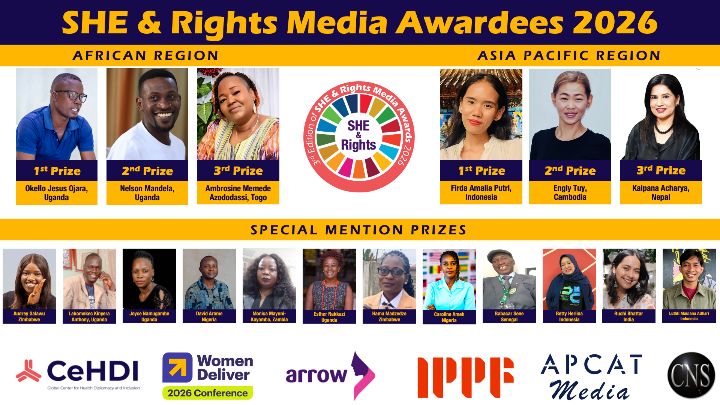
Also read: tndNews, Uganda’s Okello Jesus Ojara wins Africa’s top honour at SHE & Rights Media Awards 2026
Global health advocate Dr Harjyot Khosa warned against narrowing reproductive health conversations.
“With the current right-wing uproar, we need to remember that we demand sexual and reproductive health, rights and justice, not just reproductive health,” she said.
She added that “we also need to decolonize development finance, have radical inclusivity and pivot intersectionality.”
A major focus ahead of WHA79 is the UN Decade of Healthy Ageing (2020-2030), with campaigners calling for a legally binding international treaty protecting the rights of older persons.
Shobha Shukla, founder leader of Development Justice for Older Persons (DJ4OP), said ageism remains one of the most ignored forms of discrimination globally.
“Ageism lurks everywhere in homes, workplaces, healthcare systems, media and society,” she said.
“To be elderly and a woman, gender diverse person, or person with disability often means double discrimination.”
According to Shukla, by 2050 the global population aged over 60 is expected to reach 2.1 billion people, nearly one-fifth of humanity.
Senior journalist Rita Widiadana from Indonesia criticised how media portrayal often reinforces harmful stereotypes against elderly women.
“Older men are associated with wisdom and experience, while older women are portrayed as frail caregivers,” she said.
Rita further revealed that this contributes to discrimination in workplaces, families and public life.
Dr Imran Pambudi from Indonesia’s Ministry of Health highlighted rising violence against women, revealing that over 330,000 women experienced violence in Indonesia in 2024 alone, with many cases unreported.
“Protecting rights must go hand in hand with ending gender-based violence across the life course,” Dr Pambudi said.
Abortion rights spark heated global debate
One of the strongest themes emerging from the Women Deliver Conference was the defence of abortion rights amid growing political backlash worldwide.
“Safe abortion is healthcare. Abortion rights are human rights,” declared independent gender justice activist Debanjana Choudhuri.
She warned that criminalising abortion does not stop it but instead forces women into unsafe and deadly procedures.
In the Philippines, where abortion laws remain among the most restrictive globally, campaigners from the Philippine Safe Abortion Advocacy Network (PINSAN) described the devastating consequences of criminalization.
“Upwards of a million women undergo abortions annually in the Philippines and restricting abortion does not stop it and it drives it underground,” said Pauline Fernandez of PINSAN.
Fernandez said unsafe abortion complications kill up to three women every day in the Philippines.
Healthcare workers and patients alike, she added, operate in fear of arrest or prosecution, turning hospitals “into sites of interrogation rather than healing.”
The anti-rights backlash has also affected broader reproductive health policies. Fernandez noted that the Philippines’ proposed Adolescent Pregnancy Bill faced strong resistance for including language around sex education and reproductive rights.
Meanwhile, in Nepal where abortion is legal, journalist and health advocate Kalpana Acharya said social stigma continues to prevent equitable access to safe abortion services.
“A 29-year-old woman recently died from unsafe abortion despite being a healthcare worker herself and we must bridge the gap between policy and implementation,” Acharya revealed.
Transgender activists warned that gains achieved over decades are increasingly under attack across several countries.
“Visibility is not the same as having rights,” said Hua Boonyapisomparn, International Trans Fund Program Officer for Asia-Pacific.
Thailand recently approved approximately US$4.3 million for free gender-affirming hormone therapy and counselling services for more than 200,000 transgender people, a move celebrated by campaigners.
However, activists also expressed concern over setbacks elsewhere, including controversial amendments to transgender laws in India that critics say increase state control over transgender identities.
“Governments cannot selectively decide who deserves dignity,” said Indian transgender rights advocate Simran Shaikh Bharuch.
Discover more from tndNews, Uganda
Subscribe to get the latest posts sent to your email.