Judicial officials at Hoima High Court have cited ignorance of court procedures, personal interests as some of the common habits among media practitioners, and unethical behaviours for blocking media from court news.
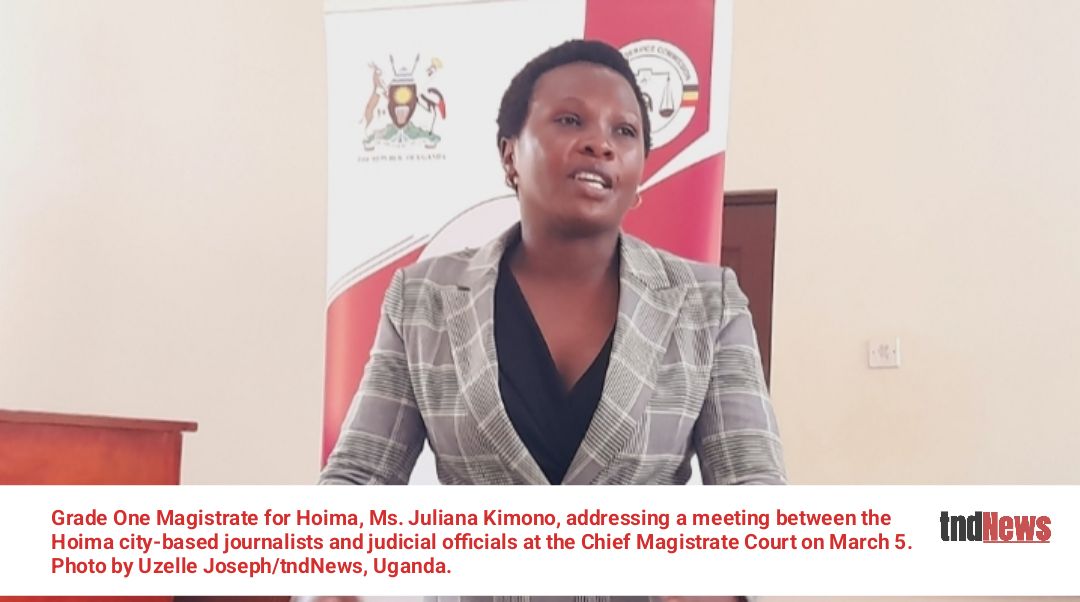
Identified behaviours within journalists were cited by Juliana Kimono, the Grade One Magistrate on March 5 during an engagement between the Hoima City-based journalists, judicial officials including judicial service commission at the High Magistrate Court at Hoima High Court Headquarters.
At the commencement of the engagement, most journalists expected to know why the media had always been blocked from covering court stories, but also to know how best they could work closely together with the court.
However, while addressing the meeting, Ms Juliana Kimono who represented the Chief Magistrate His Warship George Kunihira, said some media practitioners come to court with wrong intentions, which intimidate judicial officials thus making them uncomfortable while executing their duties.
“I noted some of the bad existing habits among journalists such as taking photos without authorisation, failure to adhere to the court rules and regulations,” she said.
According to her, such behaviour equally upholds no professionalism and code of ethics in reporting when covering court proceedings.
Besides bad practices, Kimono also cited a lack of information among some media practitioners while writing which led them to biased reporting.
“In case you know that you have not got the right information during the court proceedings, always feel free to ask for the charge sheets for self-guidance, writing and reporting court matters instead of publishing incorrect and biased information,” she urged.
Meanwhile, Kimono noticed the region is faced with a court case backlog, which she attributed to an increasing population with more crimes, language barriers and understaffing of the judicial officials.
“We are operating in an area with a large population which has a lot of criminal offences and yet we have only three Grade One Magistrates and one Chief Magistrate.
“That’s why sometimes I personally work on over 25 cases. And you find one judge entitled to 300 cases annually and you find it hard to achieve the target.”
Over time, she said, journalists have been passed through court procedures but also denied access to cover court proceedings.
Therefore, the information from the “learned fellows” brings to light ignorance of the law among the journalists, a disease which can be solved through teamwork.
Speaking on backlogs, Jane Margaret, the Undersecretary at the Judicial Service Commission, attributed it partly to some Ugandans who engage in drug abuse, a habit which leads to crimes.
She added that there is a need to sensitise the public and address drug abuse to help curb crime rates.
Okello Emmanuel, a journalist from the Uganda Radio Network (URN), and Banabus Peter, a reporter attached to New Vision, said many journalists previously lacked adequate knowledge of legal matters.
They added that the engagement will help improve their reporting careers in the region.
Felix, a reporter attached to Daily Monitor, called on the judicial services commission to have a thorough training with journalists to boost their capacity in court reporting.
The engagement was meant to improve community awareness of the services rendered by the judicial arm of the government.
By Uzelle Joseph
Discover more from tndNews, Uganda
Subscribe to get the latest posts sent to your email.