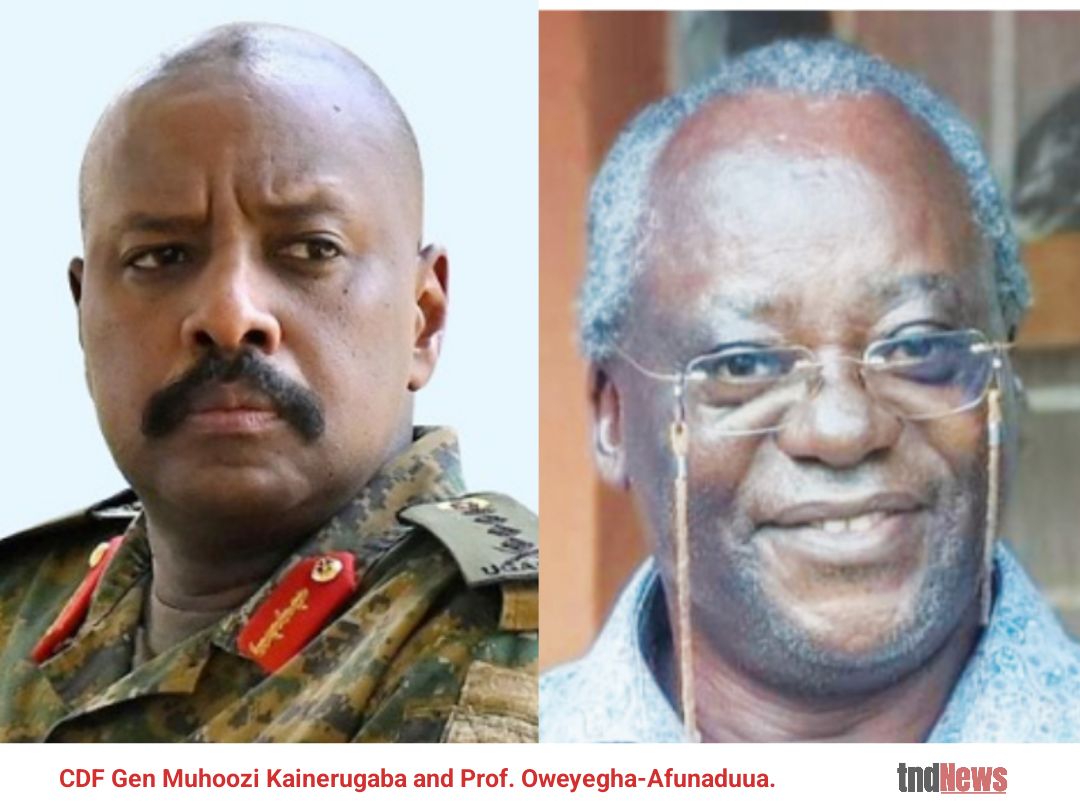
Gen Muhoozi Kainerugaba’s declaration that no civilian will ever rule Uganda again must be understood in this context, Prof Oweyegha-Afunaduula, says.
He added: “It is not merely a prediction but a programme—an assertion that the military’s capture of the state is now permanent, that civilian governance belongs to the past, and that Ugandans must reconcile themselves to perpetual rule by uniformed power.
“This is de-civilisation in its most naked form: the explicit rejection of the foundational principle of modern democratic governance,” he added.
Conservation Biologist, Prof Oweyegha said in contemporary Uganda, human rights have become subordinate to the single imperative of power retention by the President’s family.
The consequences are borne most heavily by those who dare to participate in leadership outside the NRM framework, he stated.
“Even more chilling is the declaration by Gen Muhoozi Kainerugaba, the President’s son and Chief of Defence Forces, that no civilian will ever rule Uganda again.
“Speaking in the context of his father’s long tenure and his own rising political profile, this statement represents the most explicit articulation yet of the regime’s fundamental project: the permanent displacement of civilian democratic governance by military rule, cloaked in the language of continuity and stability.
“As one analyst observed, the military’s political role is not temporary or transitional, but appears designed to be permanent.”
The Professor added that the rise of the Special Forces Command (SFC), led by Muhoozi, as what researchers describe as a “praetorian guard” mirrors the emergence of dynastic authoritarianism in countries like Togo and Equatorial Guinea.
“In February 2026, opposition leader Robert Kyagulanyi (Bobi Wine) alleged before the Geneva Summit for Human Rights and Democracy that Gen Muhoozi had issued orders that he be taken “dead or alive” following the elections—a chilling indication of how military power is being deployed in service of familial succession .
“The distinction between the “rule of law”—where law serves as an impartial framework constraining all actors, including the state—and “rule by law”—where law becomes merely an instrument of state power—is central to understanding Uganda’s de-civilisation. The latter now prevails.
The 1995 Constitution, despite its flaws, envisioned a military under civilian control. Yet successive legislative and administrative actions have systematically undermined this vision. The Terrorism Act has been deployed selectively against opposition figures, he noted.
“Most significantly, the UPDF Amendment Bill 2025, tabled for first reading in May 2025, seeks to expand military court jurisdiction in ways that directly contravene a Supreme Court ruling that outlawed the trial of civilians in military courts,” the Professor stated.
Discover more from tndNews, Uganda
Subscribe to get the latest posts sent to your email.