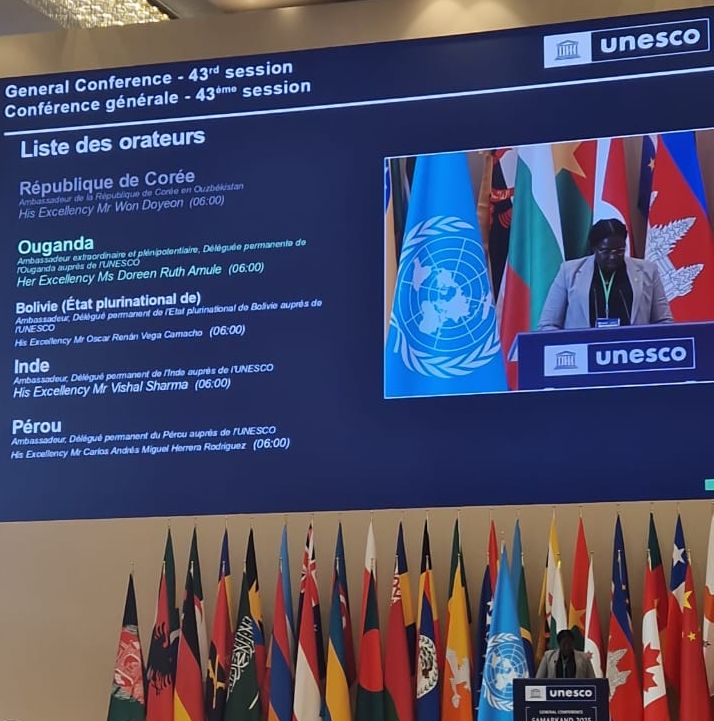
On November 4, 2025, Ambassador Doreen Ruth Amule, the Head of the Republic of Uganda’s delegation and Chair of the Non-Aligned Movement Paris Chapter, delivered the country’s national statement on behalf of the Non-Aligned Movement (NAM).
The statement was delivered during the 43rd Session of the UNESCO General Conference in Samarkand, Uzbekistan.
Ambassador Amule conveyed Uganda’s congratulations to the President of the 43rd Session of the UNESCO General Conference on being elected to Chair the General Conference, appreciation for the Director General’s excellent performance and stewardship during her eight-year tenure in office.
She also congratulated the incoming Director-General, pledging cooperation and support for a successful term of office, and congratulated Uzbekistan for successfully hosting the General Conference.
The Ambassador reiterated Uganda’s commitment to UNESCO’s mission and informed that the country was refocusing its efforts on upscaling and fast-tracking lagging areas in the Sustainable Development Goals (SDGs) 2030.
These goals, she noted, align with the national priorities of poverty eradication, healthcare provision, climate change, quality education, the digital agenda; science and technology, and innovation, among others.
She informed the conference that Uganda had reformed, adopted and introduced a competence-based curriculum in secondary education to enhance learner-centred and skills-based learning, to meet the needs of the current and future generations.
“Relatedly, there was a crucial need for vital UNESCO technical support to focus on university curricula to ensure relevance in the 21st Century,” she said.
She stated that Uganda appreciated UNESCO’s efforts to improve access to information, encourage media development, and close the digital divide, and was committed to advancing digital transformation in education and developing a digital repository for the Ministry of Education and Sports.
“In this regard, Uganda sought UNESCO’s support in capacity-building programmes to tackle challenges related to misinformation and responsible reporting,” the Ambassador stated.
Uganda is a host to over 1.8 million refugees from the Great Lakes region and beyond, she informed the conference. “And with support from the UNESCO Qualifications Passport Programme, the country had awarded Passports to 49 refugees in the interest of inclusivity and was promoting higher education among disadvantaged groups.”
Additionally, she informed that Uganda had a youth population of about 73%, and that the Government through social and economic programmes was addressing issues of unemployment and lack of employable skills.
“The National Commission for UNESCO in this regard had established 35 UNESCO clubs, a fully constituted national federation embraced by the youth and the Multi-Disciplinary Youth Executive Committee providing leadership in various youth initiatives, including conference and inter-generational dialogues.
“In addition, the China-Funds-in-Trust (CFIT) Phase III project has supported capacity building in entrepreneurship and innovation.”
The film industry has been transformed through the International Funds for Cultural Diversity project (IFCDP), she said, adding that the fund has unified filmmakers in Eastern African countries aiming at a regional platform for film distribution and monetisation. “This has yielded capacity-building initiatives, regional copyright protection, dialogue, and support for creative industries.”
She emphasised Uganda’s appreciation for UNESCO’s support to Uganda and Kenya in having the shared Mt. Elgon designated as a Transboundary Biosphere Reserve. “Importantly, the capacity-building programmes for managing the Biosphere Reserves and Natural Heritage sites have significantly resolved human-animal conflicts.”
Uganda, she announced, was preparing nomination documents for World Heritage Sites, a Geopark, and Biosphere Reserves in locations of Lake Victoria, Mt. Moroto, Mt. Napak, Kibiro Salt-producing village, and the serial Transnational Geometric Rock Art Sites in the Lake Victoria region, funded under the International Assistance Fund.
Also read: How Uganda voted at the UNESCO 43rd General Conference in Uzbekistan
The Ambassador highlighted Uganda’s gratefulness to the governments of Japan and Norway for the enormous support for reconstruction of Tombs of Buganda Kings at Kasubi, a UNESCO World Heritage site destroyed by fire in 2010; and appreciation to the government of Japan for the funds committed to protect and support the operation of the site upon reopening.
Taking the floor also as Chair of the Non-Aligned Movement (NAM), she stated that Uganda was honoured to address the General Conference in that capacity.
She stated that NAM, in unity and solidarity, remained committed to advancing its founding principles for international peace, cooperation of human rights, the sovereignty, and territorial integrity of all nations, stating further that NAM called for continued international efforts culminating in Two-State Solution on the Israel-Palestinian situation.
At the same conference, she said NAM reaffirms its commitment to strengthened multilateralism in advocating for the promotion of mutual interests and co-operation which underscored consensus-building at UNESCO.
Discover more from tndNews, Uganda
Subscribe to get the latest posts sent to your email.