President Yoweri Kaguta Museveni has proposed the formation of a select committee of trusted representatives from the Lango sub-region to directly engage him on the long-standing issue of livestock compensation.
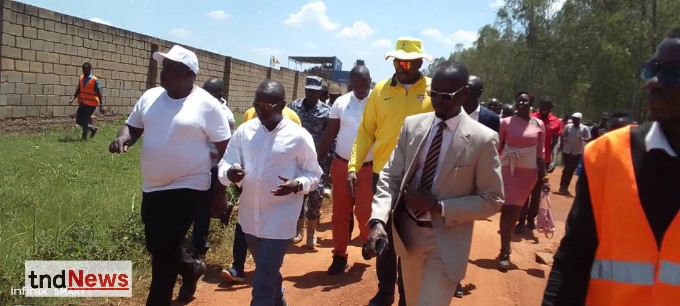
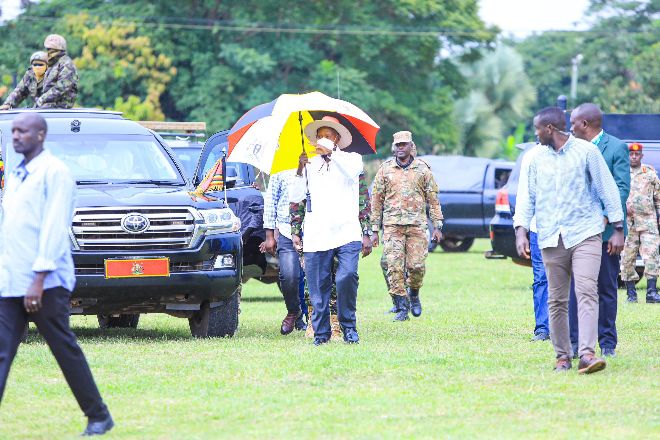
The President made the proposal during a high-level meeting with leaders and residents of Lango at Lango College playgrounds, on Sunday 17, August, 2025 where emotions ran high over delays, and frustrations surrounding the compensation program.
“I was recently in Soroti in the Teso subregion and heard the same concerns. I think the best way now is for you to select very reliable people who will represent you in Kampala so that we can conclude this matter once and for all,” President Museveni told the gathering.
The President’s remarks marked a significant shift in approach, as leaders and citizens from the sub-region voiced deep dissatisfaction with the current system, which they said has been captured by middlemen and riddled with corruption.
The cattle compensation program, officially launched in March 2022 with a budget of shs200 billion, was meant to compensate victims in Acholi, Lango, and Teso whose livestock and property were destroyed during past insurgencies and conflicts.
President Museveni stressed that the initiative was not a standard government practice but rather an exceptional measure to foster peace and reconciliation.
“In most countries, compensation is not done for wars or natural disasters. In the 1979 war, Mbarara was destroyed, Masaka was flattened, and in Luwero we have 33 mass graves with over 330,000 people killed. If we were to compensate all those, how would we manage?” the President asked.
According to the President, the process was originally compromised when lawyers inflated claims and pocketed money meant for the poor beneficiaries.
“That is why we insisted on direct payments. So far, shs169 billion has been spent. But we still need dhs506 billion for verified claims and another shs275 billion for unverified ones – close to shs800 billion in total,” he said.
Community outcry
Several local leaders and residents openly decried corruption and inefficiencies in the compensation process, claiming that much of the money announced has not reached the intended beneficiaries. Angello Okello, one of the original petitioners in the compensation case, regretted taking the matter and the government to court.
“The lawyers took advantage and stole money meant for the poor. We ask that you cancel the current process and find another way to rehabilitate the region.”
Dennis Okwi revealed that Otuke district alone lost shs15 billion to middlemen.
“We reject this approach. The best way is to distribute cattle per household.”
Barbara Akech, RDC for Dokolo, reported that payments for 53 beneficiaries bounced.
“We need a new model, something like PDM, where the money can reach people directly.”
George Kamara from Otuke accused the Attorney General’s office of unnecessary bureaucracy, proposing that the program be transferred to the Office of the Prime Minister.
The voices painted a picture of widespread mistrust, with several leaders warning that without reform, the exercise would continue benefiting elites at the expense of genuine war victims.
Eng. Dr. Moses Odongo Okune (Won Nyaci), praised the President for initiating the program, but urged him to decisively conclude the matter.
“The heads of families who lost cattle have, in many cases, passed away, leaving children and grandchildren still waiting. Let us take decisive action so that this matter has a beginning and an end,” he said, while appealing for patience from his people.
Dr. Okune also commended President Museveni for poverty-reduction efforts, citing statistics showing that poverty in Lango had dropped from 23.4% in 2021/23 to 18.8% today. He expressed confidence that with President Museveni’s continued leadership, the sub-region would witness greater transformation.
The Deputy Attorney General, Jackson Kafuuzi, presented a status report indicating that since 2014, only shs2.5 billion had been released for Lango, with some payments bouncing due to invalid accounts, double claims, or inconsistencies in data.
Dr. Samuel Opio Acuti, MP of Kole North and General Secretary of Lango Parliamentary Group presented the memorandum on behalf of Lango leaders, who called for full payment of all verified claimants without age discrimination, clear payment plans in a maximum of three installments for transparency, printing of additional data cards for those left out and fast-tracking the program with defined timelines.
“This matter touches the bone marrow of issues affecting Lango. We must settle it with certainty and finality,” MP Acuti emphasized.
In response to other concerns, President Museveni emphasized that infrastructure and resources could only be delivered step by step through prioritization, rather than raising unrealistic expectations.
He made specific pledges to the sub-region, including: A bus for Lango footballers, shs50 million to the Agong Foundation and shs550 million to the SACCO of clan heads under the Lango cultural institution.
Bad politics
President Museveni used the meeting to caution against sectarian politics, which he blamed for Uganda’s past instability. He traced the roots of bad politics to the 1950s and 1960s when parties like DP, UPC, and Kabaka Yekka were founded on religious and tribal lines.
“Once you take the line of sectarianism, you are committing suicide. That wrong politics damaged our parties and institutions. That is why the NRM insists on patriotism, Pan-Africanism, socio-economic transformation, and democracy,” President Museveni said.
He attributed peace in Lango today to the NRM’s correct politics and a strong national army, and the support of the Amuka (Rhino) Boys who fought insurgencies alongside the UPDF. President Museveni urged the people of Lango to remain patient and united as the government works to resolve the compensation issue.
Discover more from tndNews, Uganda
Subscribe to get the latest posts sent to your email.