Kitgum | The Ugandan government’s effort to eradicate poverty through the Parish Development Model (PDM) has been recognized as a crucial factor in reducing the alarming school dropout rates across the country.
Educationists have pointed out that poverty remains the primary cause of school dropouts in Uganda. In what appears to be a response, the government has implemented the PDM, a strategic approach for organizing and delivering both public and private sector interventions aimed at wealth creation and employment generation at the parish level, the lowest economic planning unit.
On March 26, 2025, stakeholders from the Acholi sub-region gathered in Kitgum district to applaud the government’s initiative. They expressed optimism that the PDM would play a significant role in eradicating poverty, thereby reducing school dropout rates among households.

Dr. Opul Joseph, a lecturer at Gulu University, highlighted that PDM pillars 4–6, which focus on financial inclusion, social services, mindset change, community mobilization, and cross-cutting issues, would help promote education in the Acholi sub-region and other parts of the country.
Also serving as Director of Quality Education Consultancy Ltd (QECL), Dr. Opul advocates for innovative approaches to education and social business concepts. He emphasized that these initiatives serve as beacons of hope amidst challenges in Uganda’s education system.
Through his organization, OPUL Skilling Foundation Africa (OSFA), he aims to integrate education with socioeconomic empowerment, aspiring to catalyze 20 million business start-ups and create 40 million jobs by 2035.
However, Dr. Opul expressed concern over the dire statistics on school dropouts in Uganda. He urged government leaders, district officials, teachers, religious leaders, traditional leaders, and parents to address the crisis urgently.
“The story of education in Uganda is marked by a consistent pattern of abandonment, reflecting an educational framework that has, in many instances, failed to nurture the full potential of our youth,” Dr. Opul stated.
He emphasized that education should blend knowledge acquisition with real-world skills and values that foster resilience, creativity, and an entrepreneurial mindset.
“Education is a multifaceted construct, characterized by five essential elements: knowledge, skills, values, attitudes, and talent development,” he said. “Unfortunately, many institutions remain fixated on academic achievement, measuring success through grades and certificates rather than equipping students with holistic skills necessary for navigating life and work.”
Dr. Opul argued that while knowledge is a key pillar of education, it must not overshadow skill development and talent nurturing, noting that the traditional educational model is inadequate in preparing students for the realities of the 21st century, where adaptability and entrepreneurship are crucial.
The role of religious institutions in education
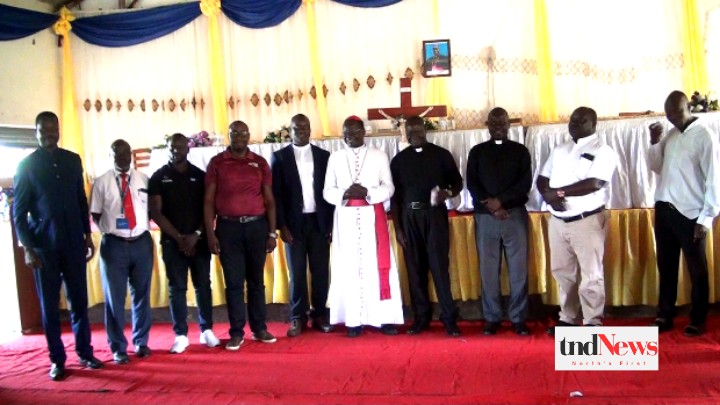
Rev. Fr. Ronald Reagan Okello, Executive Secretary for Education at Gulu Archdiocese, emphasized the importance of revitalizing education during the Deanery Engagement Meeting. He urged educators to see teaching as a vocation rather than just a job.
Fr. Okello expressed concern about the decline of Catholic schools in the Gulu Archdiocese, attributing it to financial struggles. He called upon stakeholders to take responsibility for revitalizing Catholic education.
Similarly, Rev. Fr. Robert Odong, Education Secretary for Gulu Archdiocese, provided an overview of the education system in the region. The archdiocese currently manages 453 Catholic-founded primary schools, 32 Catholic-founded secondary schools, and 20 tertiary institutions, totaling 629 educational institutions.
Teenage pregnancies and their impact on education
Pader district vice chairperson Justine Ocen,.highlighted the increasing cases of teenage pregnancies, exacerbating the education crisis in the region.
Between July and December 2024, a total of 1,116 school-going girls under the age of 19 became pregnant, contributing to the 2,291 recorded pregnancies in the region that year. Ocen, who also serves as the Secretary for Health in Pader District Local Government, stressed the urgency of addressing this crisis.
The need for a holistic approach to education
Kitgum District Education Officer (CEO), Lawot Anthony Lam, emphasized that addressing dropout rates requires a broader approach to education.
“It is imperative that all stakeholders mobilize collectively, innovate our teaching methods, and foster a culture that views education as a tool for empowerment and a catalyst for change,” Lam stated.
He stressed the need to bridge the gap between theoretical knowledge and practical application.
His Grace Raphael Wokorach P’Mony, Archbishop of Gulu Archdiocese, underscored the role of educators in combating poverty. He urged the public to fully grasp the philosophy behind efforts to reduce dropouts.
“Together, we can turn the tide against dropout rates, creating a brighter and more equitable future for all our children,” the archbishop affirmed.
Statistical analysis: The dropout crisis in Uganda
Since the launch of Universal Primary Education (UPE) in 1997, statistics have shown a troubling trend of school dropouts. Out of the 27 million children who entered Primary One, a significant number never made it to the Primary Leaving Examination (PLE).
For instance, in 2010, approximately 1,943,552 pupils enrolled in Primary One, yet only 639,037 (32%) sat for the PLE in 2016. The dropout trend continued as follows: 2011: 1,839,714 registered in P1, but only 646,190 (35%) sat for PLE; 1,193,524 (65%) dropped out.
In 2012, 1,877,801 registered in P1, 671,923 sat PLE (35%), while 1,205,878 (65%) dropped out.
In 2013: 1,883,803 registered in P1, but only 695,804 (36%) sat PLE; 1,187,999 (64%) dropped out. 2014: 1,932,489 registered in P1, yet only 749,761 (38%) sat PLE; 1,182,728 (62%) dropped out.
While in 2016: 1,888,847 registered in P1, with only 832,654 (44%) sitting for PLE; 1,056,193 (56%) dropped out.
Over six years, Uganda experienced a staggering dropout rate of about 68%. This trend has persisted, with an average of over 1 million students dropping out annually.
After 27 years of UPE, the country faces an urgent educational crisis that demands immediate intervention.
The Parish Development Model is a promising initiative in addressing poverty and, consequently, reducing school dropout rates in Uganda.
However, for long-term change, stakeholders including government agencies, educators, religious institutions, and local communities must collaborate to ensure that education is holistic, inclusive, and responsive to real-world challenges.
By Vincent Kaguta
Discover more from tndNews, Uganda
Subscribe to get the latest posts sent to your email.