Summary
- The Land and Equity Movement in Uganda (LEMU) is the lead campaigner, and together with other partners, they have compiled a list of issues related to land loss, land productivity loss, and indigenous food loss.
- Okwongodul sub-county in Dokolo district hosted the campaign launch on November 7.
- The campaign’s main goal is to encourage rural farming and pastoral communities to preserve land as well as indigenous seed and food varieties.
Dokolo | The Land and Equity Movement in Uganda, or LEMU, is currently leading the “Keep Your Land Keep Your Seed” campaign, which has been embraced by various stakeholders in the Lango sub-region and throughout the nation.
On November 7, 2024, a sizable assembly was held at the Okwongodul sub-county headquarters in the Dokolo district to discuss solutions to the relevant land and food issues.
At Hotel Africa in Kampala on November 5, Dr. Theresa Auma, Executive Director of LEMU, told the media that in all five areas covered by their preliminary studies: Busoga, Teso, Kumam, Lango, and Karamoja, it was clear that processes embodying commodification, commercialization, and monetization of land had resulted in a direct mode of land loss for landed communities.
In Lango, for example, she said participants took note of the rampant land sales for ‘big and small cash needs’.
Similarly, while in Dokolo, she stated that the campaign is rising against what has been promoted in the mainstream, which is that land is for sale and only improved seeds are viable. “This has caused a serious challenge in communities because we see a lot of land is being turned into boda boda engines. People are selling off land for boda bodas; in the communities, our indigenous food such as malakwang is not something that is out there, the seeds are disappearing, people are looking for indigenous and nutritious foods, these seeds are either considered wild, they are not demanded in the market so the farmers are not producing them.”
This campaign is an alternative campaign from the masses, a campaign that is looking at what the people are grappling with, Dr. Theresa added. “Today in Okwongodul, school children, the women’s group, clan leaders, the other leaders (it is a day of lamentation), everyone is lamenting about our lost land, our degraded land, our lost food varieties.
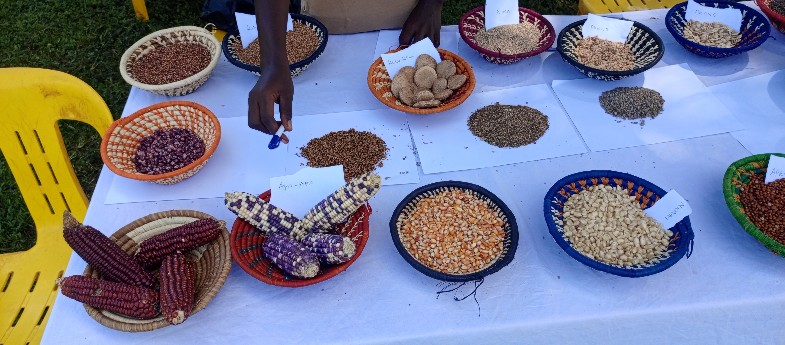
“There is an old man of 78 years who looks like he’s 40, and he came with the kind of food that we used to eat, the fruits that have degraded because people have destroyed the wetlands, they have destroyed the communal grazing land.”
Adding to the campaign’s importance and relevance, the LEMU executive stated that it is linking the food and land issues as one–that you cannot separate land from food, and we cannot commodify everything. “So, if land and all the seeds and food are for sale, then what about production for food? So, we are here saying that production for the market is as important as production for food, and therefore we cannot give priority to produce for the market, wealth creation and then neglect the issue of producing for food.”
She gave an example of a woman seen lifting rotten cassava. “She was saying there is cassava in the garden but her children were sleeping hungry because all the cassava in the garden was rotten; the new variety, the improved variety that matures after six months. The moment it matures; it is rotten….Someone from Alebtong came with a cassava variety that can last in the garden for five years. So, talking about fast maturity without talking about how durable it is from the garden doesn’t help.”
LEMU and partners are now urging people to bring these indigenous varieties of foods and crops, including those that are considered wild, into the mainstream to be replanted for redistribution. “This thing should go back into circulation; people should preserve the land where these things can grow.
“We will be moving forward from one location to another. We will be continuing with advocacy for protection and keeping the need for people to keep their land and produce their food on it.”
Amplifying the campaign
Dr. Theresa promised educational programs in secondary and tertiary schools, as well as alternative education, because children are unaware of the importance of local food production and preservation. “We will be promoting all of this. We will also be working with the media to make sure that information goes out there as much as possible.”
When people become landless and they are not in control of how they produce their food, then we are creating dependence in communities, she noted.
Pamela Lakidi Acan is a consultant who has been engaging communities to identify issues related to land loss and productivity loss. According to her, the widespread self-dispossession is one of the issues that fall under the land loss category.
“People themselves are leasing their land. It is different from when the government comes and fences off your land; this is a situation whereby some decide to sell land, maybe to pay the child’s fees, marry a wife; to pay a court debt; it is so rampant.”
Land renting is a problem in this community [Lango], she said. “They rent out–someone rents out the entire three acres and they remain without space for production, that has implications on food security.
Land grabbing within the family, particularly for widows, is another problem Lakidi and her team discovered. The rest of the family wants to sell the land when someone becomes a widow. There is also land grabbing between family and neighbors. Someone extends their boundaries to another person. But there is also administrative land grabbing between Kole and Dokolo districts, she revealed.
“We also found that there is rampant land loss to government programs like road constructions, electricity projects,” she said, adding that the “overflow of Lake Kwania has resulted in a lot of people losing their land because the water has overflown their land.”
Lakidi also disclosed that even those who possess customary certificates of ownership are nonetheless evicted from their land, indicating a problem with land documentation.

On loss of land productivity, she said it’s where land is not supporting crops to produce its former yields or the crops that grow there can no longer produce as it was supposed to.
“Now, we found the following: that the high population is making people subdivide land. If you have ten acres in the last generation, then you have 20 children. Divide it by 20. So, the land becomes small. How does that connect with land productivity? You farm it over and over and over, it doesn’t rest, it loses its ability to support crops.”
Furthermore, she stated that there is a lack of basic agricultural knowledge because indigenous knowledge is not being passed down from generation to generation, and that our agriculture extension system is completely ineffective. “People are farming without agricultural technical knowledge.”
SP Patience Baganzi, Dokolo District Police Commander (DPC), chose to speak on women and land, emphasizing that “security perspective” when it comes to land, women are more affected than any other gender.
“Women who don’t have land have higher chances of being vulnerable to violence. So, for example, when food is not at home the man will think the woman should look somewhere, somehow to look for food at all cost, and when you find these women who are renting, when she doesn’t have what to cook, at least she will put an empty saucepan with water on fire; that is how touching it is.”
“Once they have the land, they are not vulnerable to domestic violence. Once they have the land, there is food security; once they have the land, they can even have access to credit.”
Dr. John Jaramogi Oloya serves as the chair of LEMU’s board of directors. He said, “It is a privilege for me, and our advocacy, which we appreciate that the government accepted and allowed customary land to be a land tenure regime.”
According to him, the campaign is multi-sectoral and does not only focus on land issues, but also emphasizes indigenous knowledge. “I think the launch is about land health. It is about seeds; and about land health is how we keep our land, and how we can use our land beyond planting the seeds.
“…as we adopt the modernization which we must be conscious of, some aspects of what we have……and sometimes in modernization, we tend to forget that and is not really the commodity; land is actually the community, something that you shouldn’t try to sell…”
Calistas Mubangizi of the Coalition of Pastoralist Civil Society Organizations (COPACSO) issued demands and calls to action. He said land occupied by the farmers and are agrarian or pastoral should not be purchased from the community and allow the owners to preserve it.
Cultural justice has to be made integral to the land protection system, he said, adding that traditional leaders, some of whom were present at the launch, are “embodiment of knowledge” and “understand the issues of cultural justice”.
He added that traditional leaders know how they share the land, especially when they are putting “those seeds”–that partition lines and nobody crosses them. The government has now been called to respect those modes of land governance and communities always be consulted when such a case of handling land issues comes into play.
There is also a call to revitalize and reform agricultural extension systems to support both modern and indigenous knowledge.
What the church says
“…land is not merely a resource; it is our home. It is the foundation of our identity, our sustenance and our relationship with one another, our ancestors and with God,” said Diocese of Lango Bishop, Rt. Rev. Prof Alfred Olwa.
The Bishop went on to say that in the Lango tradition, land has always been passed down through families and generations, from fathers to mothers to sons and daughters. “It is a sacred trust to nurture, to protect, and to share.”
In the context of the Lango customary land tenure system, Bishop Olwa stated, “We understand that the land belongs not to the individuals but to the entire family administered by the head of the household and the clan provides governance responsibility. Land is the lifeblood of our communities.”
The theme for the campaign, he said, “touches at the very heart of our livelihoods, our culture, and our spiritual connection to this beautiful earth God has entrusted to us”.
Policy change and empowerment
The Bishop noted that while our customs, traditions and community systems provide a strong foundation, we must also look to the future. “We need policies that protect our land, strengthen our tenure rights, and ensure the sustainability of our agricultural practices.
“We need laws that guarantee the security of women’s land rights, the protection of orphans, and the empowerment of small-scale farmers.”
He assured the Okwongdul gathering that the Church is committed to standing with the people of Lango in advocating for these changes. “We will continue to call on the government and other stakeholders to implement policies that promote land security, the preservation of indigenous knowledge and the empowerment of local communities.”
Naome Kabanda, who represented Lands, Housing and Urban Minister Judith Nabakooba at the launch applauded Dokolo district for accepting to take on the mantle at national level. She stated that the Dokolo district was chosen to ensure the campaign’s success.
Kabanda described the launch in Dokolo as “national,” saying “from here it will go to other districts” and take off, expressing her gratitude to LEMU for taking the initiative and collaborating with others.
“This is a very good link for land security, and land tenure because in the Ministry we say we are protecting people’s land rights.”
She mentioned that the Lango sub-region benefited from the registration of customary land ownership. A lot of work had already been done while they were doing a review of the national land policy in Lira City, which Dokolo district participated in, she said.
The campaign, Naome said is coming in handy, especially on the food component when people have security over their land. “I am aware that this region 80 percent of your land is customary tenure and most of this land is either held by clan but I have also seen individualized tenure in some of these districts especially Teso where they have now individualized the ownership of land, smaller families getting titles as well as the clan where there is communal land.”
If you can grow food, it means you are creating security of tenure but also food security is one of the areas which has been studied by many scholars as a contributor to economic development and peace in the home, Naome said.
“If you have food in your house then there will be peace not only in the family but you can also be assured that the people who have been stealing small, small things like chicken, taking away people’s food when it’s on fire you will have done away with that kind of thieves in that community.”
As a Ministry, we look forward to working with you on this campaign, particularly on the component of ensuring that there are no land conflicts at the family and community levels, she promised, outlining what the ministry will do. “We are going to ensure that we safeguard the land rights of small scale farmers and we have established ministry’s zonal office in Lira where all your land transactions are being handled.”

Door open
Masaba Ismael, Dokolo’s deputy RDC, stated that land can be used for a variety of purposes, including residential and agriculture, adding that agricultural land is used for crop cultivation, animal grazing, and industrial use.
“As we move forward with his campaign of Keep Your Land, Keep Your Seed, we need to add a component of land laws and policies, and at the same time, we need to also keep mobilizing the population to embrace the government programs.
“When we talk about indigenous plants, I think this side of the country–this side of the north still has the original land and I think if we are interested and mobilize well, we can meet the targets. As the Office of the President, you have our support and our doors are open for you,” Masaba added.
Discover more from tndNews, Uganda
Subscribe to get the latest posts sent to your email.