Adjumani | The Eastern and Southern African Small-scale Farmers (ESAFF) Uganda is changing the lives of millions of small-scale farmers, according to ESAFF’s 2023 impact report, which was published last month.
The report also revealed that ESAFF has been working in more than 50 districts in Uganda, including Soroti, Serere, Amuria, Ngora, Bukedea, Kumi; Kabale, Kisoro, Masaka, Mubende, Mityana, Mukono, Nebbi, and Zombo.
Other districts include Kamuli, Jinja, Mbale, and Mayuge; Bugiri, Gulu, Amuru, Nwoya, Pader, Adjumani, Manafwa, Iganga, Arua, Apac, Kasese, and Kanungu; Kassanda, Omoro, Maracha, Moyo, Agago and Oyam.
Kole, Buyende, Kaliro, Pallisa, Namutumba, Kibuku, Budaka, Luuka, Namayingo, Buikwe; Buvuma, Kalangala, Gomba, Bukomansimbi, Kalungu, Lwengo, Sironko, and Bududa were also among the districts that benefited.
According to the 2023 report, the community agroecology school empowered at least 2,167 community members, while the agroecology business hub boosted 17 small-scale farmer-led businesses.
The report further elaborated that 4,560 small-scale farmers and citizens are supported through the land rights support centre, and 2,448 small-scale farmers are supported through the farmers’ seed lab to access quality and affordable seeds.
“At least 8,610 small-scale farmers are actively influencing agriculture financing using the agriculture budget watch platforms, 1,100 children and community members accessed information and techniques through the agroecology clubs, and over 6.6 million people received information relating to farming through our media programs,” the report added.
Amplifying small scale farmers’ voices in policy processes
Mr. Hakim Baliraine discovered that in 2023, they conducted a membership mapping exercise, which showed a significant increase from 8,535 farmer groups in 2021 to 12,588 farmer groups with 384,354 members.
Women make up 231,915 of the new figures, and they report increased demand from many communities and districts to join Uganda’s largest small-scale farmer movement.

“We are thrilled to share our Impact Report for 2023, reflecting our incredible strides over the past year. The year has been highlighted with impactful events and new challenges for the Movement. At the heart of our work lies our unwavering commitment to empowering small-scale farmers and amplifying voices,” Hakim Baliraine, National Board Chairperson, Board of Directors said.
He also stated that they recognise the dynamic challenges that limit their mobilisation and engagement in the context of a shrinking civic space, limiting their participation, voice, and influence in key policy and development processes.
He pledges that through the ESAFF Uganda components, they will continue to engage with policymakers at all levels, advocating for policies and programs that prioritise the needs of small-scale farmers and people in rural areas.
“From supporting women’s land rights through the Land Rights Support Centre to advocating for financing for agroecology under the Agriculture Budget Watch to mobilising the media under the Online Agroecology School for Journalists and Communicators, we have been relentless in our pursuit of a more equitable and inclusive agricultural sector and the economy at large.”
Empowering small scale farmer led businesses
The Agroecology Business Hub is an initiative by ESAFF Uganda that seeks to address environmental, social, and economic challenges faced by small-scale farmers, especially women.
It promotes sustainable practices, community engagement, and innovation, thus creating a more resilient and ecologically sound food system. The ABH supports small-scale farmers through three pillars including business capacity building, access to affordable credit, and access to favourable markets.
The agroecology business hub works towards building a case for the economic viability of agroecology.
According to the report, in 2023, the Agroecology Business Hub held its first small-scale farmers’ agroecology business workshop, in which 14 agroecological enterprises took part.
17 small-scale farmer-led enterprises comprising 413 small-scale farmers from 12 districts were supported in the formulation and running of businesses, as well as awarded value-added equipment.
Four Participatory Guarantee System (PGS) groups were also established and supported. 19 small-scale farmers were supported to take part in five different business exhibitions in four different countries. The ABH has built functional small-scale farmer-led businesses that are formally recognized, hence becoming viable competitors for business opportunities in their localities.
This has also increased small-scale farmers’ confidence in running businesses.
The 2023 report also shows that the adoption of PGS as an alternative mode of certification has led to increased production of organic food and penetration into profitable organic markets, including the KilimoMart Shop.
These profitable market opportunities have led to increased earnings and the improvement of small-scale farmer livelihoods.
Community members leading the transition
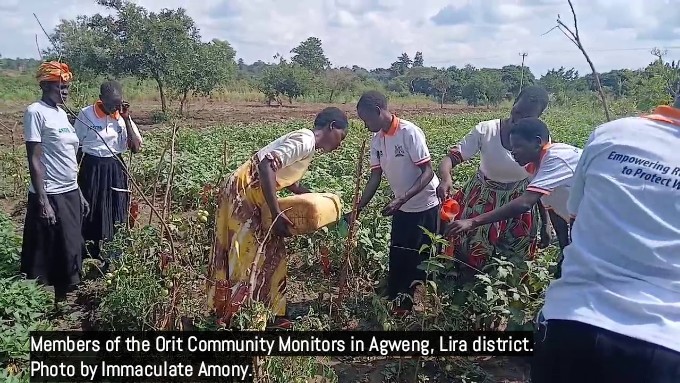
The Community Agroecology Schools are essential for supporting small-scale farmers to come together, share experience and knowledge on agroecological farming practices and natural resource management, and later replicate in their farms, hence the farmer-to-farmer extension approach.
The schools support members in building sustainable and resilient communities, promoting food security through the practices of agroecology, preserving biodiversity, fostering environmental and cultural stewardship, and empowering local populations to advocate for the development of laws and policies that suit community members at all levels.
In 2023, ESAFF Uganda established 28 community agroecology schools, making a total of 35 community agroecology schools. Throughout the year, ESAFF Uganda supported the functionalization of the 35 community agroecology schools, including the establishment of nine agroecology gardens in the different member districts, supporting engagements within the schools, and organised 3 exchange learning visits.
These Community Agroecology Schools have a total of 1,129 members with streamlined leadership structures.
The land rights support centre (LRSC)
In Uganda, there are persistent land rights challenges, including insecure tenure, land grabbing, gender disparities, and unsustainable land practices. These threaten ecosystems, hinder food sovereignty, impede sustainable development, disrupt social harmony, and hinder economic progress.
ESAFF Uganda established the Land Rights Support Centre to foster a fair, knowledgeable, and empowered society, enabling small-scale farmers to confidently assert and safeguard their land rights.
The centre operates three key products: the information dissemination platform to create a mass of informed small-scale farmers who can ably defend their land rights; the legal aid platform, where a team of legal professionals offers legal support and advice to small-scale farmers; and the Alternative Dispute Resolution Mechanisms (ADRM) for conflict resolution through mediation.
In 2023, the centre enhanced access to vital land rights information for small-scale farmers and citizens in the country.
A total of 1,103 individuals were empowered to defend their legitimate land rights. The center also established eight local grievance structures, mediated 78 land and investment-related disputes, held 19 radio talk shows, and organized 46 awareness-raising events.
15 local investors are now guided by the local government on national and international standards compliance. Within the center, policy briefs on responsible land and investments were crafted using community voices gathered from various radio talk shows, community dialogues, and awareness sessions.
These policy notes were then amplified during the national and regional land reform processes led by the Ministry of Lands, Housing, and Urban Development (MoLHUD).
As a result of different engagements at the LRSC, there is increased awareness of the land rights of women in the community. More investors are engaging with community members, resulting in reduced
Background
ESAFF was formed in 2002 during the World Summit on Sustainable Agriculture which was being held in Johannesburg, South Africa by small-scale farmers.
The main aim was to make small-scale farmers, pastoralists, and fisher folk, who are central to sustainable natural resource management and development, more visible.
It was operationalized in Uganda in 2008 as a direct response to the need to create a regional forum to bring together small-scale farmers into a farmer-led advocacy movement to influence policies and practices at global, continental, regional, national and local levels.
Currently, it has a membership of 12,543 farmer groups with 384,056 individual small-scale farmers of which 64 percent are women in 54 districts (under the administration of 30 historical districts’ forums).
ESAFF Uganda is also part of a bigger network of small-scale farmers in the other 15 countries in Eastern and Southern Africa including South Sudan, Rwanda, Burundi, Kenya, Tanzania, Swaziland, Zambia, Zimbabwe; Malawi, South Africa, Lesotho, DR Congo, Madagascar, Seychelles and Mozambique.
Discover more from tndNews, Uganda
Subscribe to get the latest posts sent to your email.