Entebbe| The African Institute for Investigative Journalism (AIIJ) has selected sixteen journalists from various media outlets across the country for its first Annual Investigative Journalism Fellowship on Democracy and Human Rights.
Every year, sixteen cohorts will receive intensive capacity building training, culminating in the production of investigative pieces during their fellowship period. Dozens of journalists from print, online, television, and radio will benefit from the four-year fellowship programme.
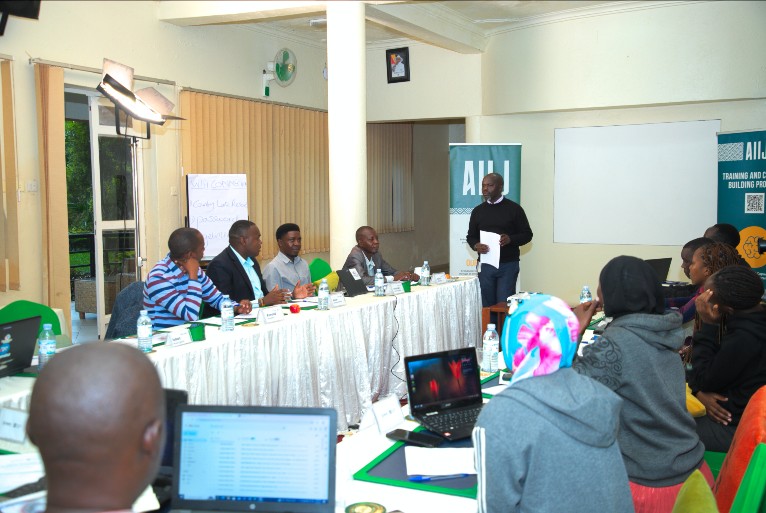
The inaugural cohorts began their fellowship on April 29, 2024, at Country Lake Resort Garuga in Entebbe.

Speaking to the fellows, AIIJ Executive Director Solomon Serwanjja stated, “…we are excited as the African Institute for Investigative Journalism for this annual investigative journalism fellowship, which is tailored to training journalists in investigative reporting in the areas of democracy and human rights.”
The AIIJ Executive believes that during this fellowship, journalists will be empowered to conduct real investigations into democracy and human rights.
“Certainly, Uganda is going for elections and the electoral commission released a roadmap. The role of investigative journalism is going to be very critical as we get into the elections. So journalists need to be on top of their feet to not only report the five ‘Ws’ and ‘Hs’ and what is said in the campaigns, but rather dig deeper and find out the critical issues.
“For example, I expect journalists to look at what were the manifesto promises that were made by the government in power when it was coming into power. Have they actually fulfilled these pledges and if not, why? I think that is going to be the role of journalism to actually put the people to account and tell them, this is what you promised us, but have you actually done it?” Serwanjja noted.
In addition to campaigns, Serwanjja, an award-winning investigative journalist, wants journalists to look at issues. “I think that largely Uganda’s politics is really marred by politicking rather than issue-based politics.
“Journalists need to stand up and ask real critical issues as we get into the elections. We can no longer just tick an umbrella or bus or what, no. I think that there must be some sort of reasoning behind why the voters should vote in a certain way. So we believe that the journalists who have been trained here will go back to their individual media houses and go beyond what they have been doing, which has been, for example, basic reporting: to interrogate issues, to ask the people in power and hold them accountable and ask uncomfortable questions, even as we get into the elections.”
We are going to have these journalists you’re training working alongside what we call the citizen journalists. How do you intend to maintain them at that game? The AIIJ Executive Director was asked by Godwin Abedican, a journalist working with Radio Pacis in Arua City.
“So, I think firstly, the most important thing for us is we’re going to attach mentors to every journalist so that we walk with them on this journey. Our vision is to grow a network of investigative journalists with the heart of the public. And part of this vision is to mentor people to take over from us.
“As journalists leave the newsroom, there’s a new crop of journalists who are coming into the newsroom. Some of these journalists have never covered elections before, it’s going to be their first time to cover elections, and that’s why they need to be grounded in journalism or in investigative journalism. So we want to walk this journey with them to prepare them much more. After the training, we are going to start doing stories.

“We are going to form a community of journalists from all across the country who are going to be on the front line of covering elections, and therefore, the need for them to be able to be on their guard. We are going to be giving them equipment to report better, we are going to be supporting them right from story pitching to story publication or airing of the story and we are excited about this. But too, in this cohort we have also brought on board some citizen journalists. I think that citizen journalism is a runaway train. You can’t stop it.
“The citizens have taken on the role of journalism. Even when we feel like journalism still maintains its core role of reporting the truth and accurately, we know that that role has now also been given to the citizens. People have their phones, people have, you know, they can do a Twitter post and it goes viral.”

Serwanjja observes that mainstream media is currently picking from citizen journalists, and thus the role of citizen journalism will be very important during these campaigns and electoral processes as we shape our democracy.
“And this is why it’s going to be important as well to train them and fine-tune them on how to actually use their platforms in a much better way to promote peace during the elections, but most importantly, to actually put out content that mainstream media may fear to put out…the nexus between citizen journalists and mainstream journalists and quality reporting is going to be very central as we get into elections. The public needs to know democracy dies in darkness. We have to be there to tell the world what’s going on,” he noted.
Investigative journalism “is very risky by its very nature,” Serwanjja warned the fellows about the dangers ahead. “Even for the team that we’re going to be working with, risk assessment is very important. Certainly, as we have been taught in journalism school, no story is worth our lives, but a story needs to be told.”
Journalists need to find a way of measuring risk: how big is the risk? What can we do when the risk comes? When do we say stop? When do we say, let’s keep digging? Sometimes we dig a rabbit hole and it never stops. But when do we actually say stop?

At AIIJ, the Executive stated that at the heart of what they do, they understand that investigative journalism is risky; we also understand that we must protect journalists from these risks as they report these stories.
“So for us, at the Institute, we take the issue of protecting journalists very important. Some of us have been in that, you know, we have gone through it all. And over the years, we’ve got some experience on how to manage that. And this is why we’re here to share this information with the journalists out there.”
Gender balance
“What we’ve noticed is that the number of female journalists that are into the practice of investigative journalism is significantly low,” Serwanjja noted, adding that many of the journalists who have done investigative journalism have been largely men.
He believes that female journalists have the potential and skill sets to advance in the field of investigative journalism; all they need is support and motivation.
“And so this is why we see here in this training, and indeed across all our training, we have a 50-50 percentage of female and male journalists. I think female journalists are going to be the next frontier of investigative journalism if they are well trained and if they are well supported.

“We are going to ensure that we continue with the policy of 50-50 training opportunities for both male and female journalists,” he promised.
Tracy Nayiga is a journalist at Charmer News. As one of the female fellows, she stated: “From the fellowship, I got a deeper understanding of issues relating with human rights, elections and democracy and this will enable me to report more comprehensively and accurately on those issues since I now know what I will be reporting about.
“Additionally, from the fellowship I got new story ideas or angles on human rights and democracy issues which will allow me to cover these topics because initially, I would only focus on the general stories yet there are so many stories we can tell about these subjects beyond what is told in the media.”
Benzamin Matata, a journalist with Voice of Life FM and Daily WestNile Info in Arua City, spoke about the fellowship: “I am optimistic about improving my writing skills and broadening my career in journalism because this training has opened my mind to understand how and why we should take human rights and democracy seriously.”
By Milton Emmy Akwam & Robert Edwomu.
Discover more from tndNews, Uganda
Subscribe to get the latest posts sent to your email.