Ugandan consumers are facing growing financial and safety risks from weak transport insurance protection, freight accountability gaps and poor enforcement of road safety standards, with farmers, traders and households bearing the cost when goods are damaged, delayed or lost in transit.
Transport accounted for 2,774 of the 11,154 consumer complaints recorded across Uganda’s four regions, representing approximately 25 per cent of all grievances, according to the November 2024 Consumer Voices Report by CONSENT Uganda.
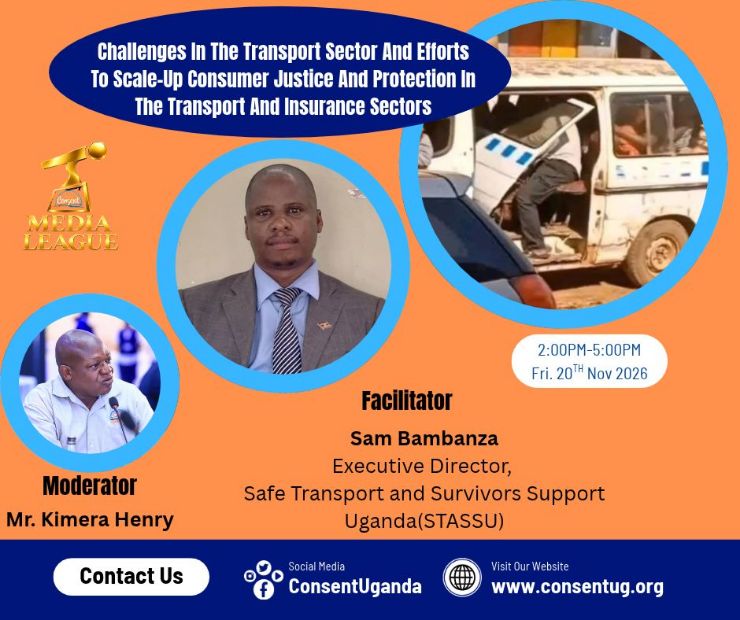
The figures were highlighted on November 20, 2026, by Sam Bambanza, Executive Director of Safe Transport and Survivors Support Uganda (STASSU), during a presentation on consumer justice in transport and insurance organised for the Media League Initiative and CONSENT Uganda.
Bambanza said transport-related consumer protection challenges extend beyond road accidents to include inadequate insurance compensation, freight charges, cargo damage, theft, delayed deliveries and limited accountability among transport service providers.
The concerns raise questions about the safety of Uganda’s transport systems and the reliability of supply chains that connect agricultural producers to markets and consumers.
For farmers and traders who depend on road transport to move produce, a damaged consignment, unexpected storage charges or delayed delivery can translate into lost income. For households, the additional costs may eventually be reflected in the prices of food and other essential commodities.
Reporting on CONSENT Uganda’s consumer complaints findings has also highlighted concerns about substandard and uncertified goods and food safety, reinforcing the need for stronger consumer protection across the entire supply chain.
Motor third-party insurance leaves accident victims vulnerable
One of the major concerns raised by STASSU is the limited protection available to road accident victims under Uganda’s motor third-party insurance framework.
Although third-party insurance is compulsory for motorists, Bambanza’s presentation points to low uptake and limited public understanding of insurance rights and claims procedures.
Boda boda riders, among the most vulnerable categories of road users, are particularly affected by gaps in insurance awareness and compliance.
Many motorists reportedly purchase insurance simply to meet legal requirements without understanding the circumstances under which compensation can be claimed or the documentation required after an accident.
For victims, the challenges become more serious when compensation is needed to meet medical expenses, support dependents or address the financial consequences of permanent injuries.
STASSU’s presentation identifies statutory compensation limits of shs1 million per person and shs10 million per accident as a significant weakness in the existing motor third-party protection framework.
The limits raise concerns about the adequacy of compensation, particularly in accidents involving several victims, including bus crashes where injuries and losses can affect entire families.
The presentation also highlights exclusions that leave some categories of losses outside ordinary motor third-party insurance protection, including damage to the insured vehicle, the policyholder’s own injuries and property damage.
Hit-and-run victims also face difficulties because of the absence of a dedicated compensation mechanism that can reliably support people injured by unidentified motorists.
Another challenge involves accidents involving government, police and army vehicles.
According to Bambanza’s presentation, these vehicles are uninsured under the framework discussed, leaving injured citizens and bereaved families to pursue compensation through legal proceedings against the Attorney General.
For families already struggling with medical expenses and the loss of income following an accident, lengthy legal processes can make access to justice even more difficult.
Bureaucracy discourages insurance claims
Beyond the financial limitations, STASSU identifies administrative barriers that prevent accident victims from successfully accessing compensation.
These include difficulties obtaining police accident reports, travelling back to districts where crashes occurred, navigating complicated policy conditions and dealing with insurance companies whose claims settlements are centralised at their head offices.
Victims may also struggle to understand the relationship between criminal proceedings and civil compensation, particularly when police investigations and court processes become entangled with insurance claims.
Such procedures can discourage people from pursuing legitimate claims, especially those living in rural communities with limited financial resources.
STASSU is therefore advocating simpler, faster and decentralised claims procedures that allow victims to access services without repeatedly travelling long distances or navigating complicated administrative requirements.
Fraud is another concern affecting consumer confidence in the insurance industry.
Bambanza’s presentation cited findings that approximately 80 per cent of COMESA insurance stickers examined were forged following the integration of systems at the Ministry of Works and Transport and the Insurance Regulatory Authority (IRA).
The revelation raises questions about enforcement, verification systems and the effectiveness of measures intended to protect motorists and other road users from fraudulent insurance documentation.
The IRA is mandated to license and supervise insurance providers, monitor industry compliance, protect policyholders and address complaints relating to insurance services.
However, consumer protection advocates argue that stronger enforcement and public awareness are necessary to ensure that insurance products provide meaningful protection rather than simply fulfilling regulatory requirements.
Freight risks threaten farmers, traders and food supply chains
While much of the discussion around transport safety focuses on passenger travel, freight and logistics challenges also have significant consequences for Uganda’s economy.
Farmers, agricultural traders, food distributors and businesses depend on road transport to move goods between production areas, storage facilities, processing centres and markets.
However, STASSU’s presentation identifies several challenges affecting freight customers, including cargo theft, damage and loss, delayed delivery and clearance, excessive transportation costs and hidden handling and storage charges.
Limited cargo tracking and unfair contractual arrangements further weaken the position of consumers who may have little bargaining power when negotiating with transport and logistics companies.
For smallholder farmers, these challenges can undermine already limited profit margins.
Agricultural produce is particularly vulnerable to delays and poor handling because some commodities require appropriate storage, ventilation and timely transportation to maintain quality.
When transportation arrangements fail, perishable food products may deteriorate before reaching their intended markets, resulting in financial losses for producers and traders.
The consequences can extend to consumers through reduced product quality, disrupted supplies and potentially higher market prices.
These concerns also highlight the importance of coordination between transport regulators, the Uganda National Bureau of Standards (UNBS), local governments and other institutions responsible for food safety and quality standards.
Ensuring that food meets safety requirements at production and processing stages is important, but maintaining those standards during transportation and storage is equally critical.
Without effective monitoring and accountability across the supply chain, consumers may remain exposed to products whose quality has deteriorated during transit.
Tyre safety and vehicle standards remain overlooked
STASSU also raised concerns about vehicle maintenance and tyre safety, warning that consumers often overlook important indicators when using public transport or hiring freight services.
The organisation highlighted the importance of checking tyre age, tread wear, load capacity and speed ratings.
A tyre’s four-digit Department of Transportation (DOT) identification code indicates its week and year of manufacture, helping consumers establish its age.
This is important because rubber can deteriorate, harden and develop cracks over time, even when a tyre appears to have sufficient tread remaining.
Tread wear indicators also provide important information about the condition of tyres and their ability to maintain grip, particularly on wet roads.
However, passengers travelling in buses and taxis, boda boda users and businesses contracting cargo trucks rarely inspect these safety features before using transport services.
The sale of used and retreaded tyres without adequate labelling or clear information about their condition creates additional consumer protection concerns.
STASSU argues that improving road safety requires consumers to have access to reliable information about vehicle conditions and the safety standards expected of transport operators.
Existing laws require stronger enforcement
Uganda has several policies and legal frameworks intended to improve transport safety, accessibility and accountability.
These include the National Transport and Logistics Policy (2021), Road Safety Policy (2014), Non-Motorised Transport Policy (2012), Traffic and Road Safety Act (1998), as amended in 2020, and the Persons with Disabilities Act (2020).
However, the existence of these frameworks does not automatically guarantee effective protection for transport consumers.
STASSU argues that transport should be treated not only as an infrastructure and mobility issue but also as a matter of consumer rights, social justice and public accountability.
The organisation identifies six areas of systemic injustice: safety, economic fairness, accountability, accessibility, access to information and consumer representation.
These challenges are particularly significant for people with disabilities, low-income households, rural communities and other groups whose ability to challenge poor transport services may be limited.
Calls for a National Transport Consumer Charter
To address the gaps, STASSU is proposing a National Transport Consumer Charter to establish clear standards for passenger rights, freight services, insurance protection and accountability.
The organisation also wants an accessible complaints and referral system through which consumers can report grievances and obtain assistance without facing unnecessary administrative barriers.
Other proposals include publishing an Annual State of Transport Consumer Rights Report, introducing transparent passenger fares and freight charges, conducting regular safety and service quality audits, and strengthening consumer representation in transport policy and regulatory processes.
STASSU is further advocating a National Transport Consumer Experience and Justice Study to generate evidence on the challenges affecting passengers, accident victims, freight customers and other transport users.
On insurance, the proposed reforms include increasing compensation limits, expanding coverage, simplifying claims procedures and decentralising insurance services.

One of the major proposals is establishing a Road Accident Fund financed through a fuel levy to provide compensation for victims who may not receive adequate protection under existing insurance arrangements.
The organisation is also calling for harmonisation of COMESA motor insurance arrangements across the East African Community to improve cross-border transport protection and reduce opportunities for fraud.
For Uganda, where road transport remains central to agricultural trade, commerce and access to essential services, addressing these weaknesses could have implications beyond individual accident victims.
A more accountable transport system would help protect consumers, strengthen confidence in insurance services and reduce avoidable losses across agricultural and commercial supply chains.
Ultimately, the challenge is ensuring that transport services deliver more than movement of people and goods: they must also guarantee safety, fairness, reliable information and access to justice when things go wrong.
Discover more from tndNews, Uganda
Subscribe to get the latest posts sent to your email.