At a military conference in Kampala on October 8, President Yoweri Kaguta Museveni called on African military chiefs to prioritise economic integration, political cohesion, and long-term strategic security.
He argued that a strong defence force cannot exist without a strong national economy and strategic cooperation.
Museveni said this as he delivered the keynote address on the final day of the first conference of African Defence Chiefs on Military Operations Other Than War, at Speke Resort Munyonyo, Kampala.
President Museveni reminded defence chiefs that as the continent’s strategists, they must address the root causes of insecurity even in times of peace.
“We cannot talk about operations other than war without first answering fundamental questions,” Museveni said.
“Can you have a strong army and a safe country without a strong economy? Can you have a strong defence force without reasonably cohesive politics? Can you guarantee security without addressing geostrategic realities?”
“My answer is no,” Museveni said.
He said Uganda has guided its citizens towards four sectors: commercial agriculture, manufacturing and artisanship, services, and information and communications technology.
Museveni argued that identity politics undermines prosperity, using his own experience as a cattle keeper as an example. He observed that members of the same tribe often produce the same goods and so cannot buy from one another; hence buyers from other parts of the country sustain their prosperity.
“Uganda is very important, more important than my tribe. My tribe is good, but Uganda is better,” he said.
He said this reasoning, developed by a student movement in the 1960s and later adopted by the National Resistance Army, which became the Uganda Peoples’ Defence Force (UPDF), produced the first ideological principle, patriotism. The second, he said, is Pan-Africanism.
“Uganda’s internal market is not enough. East Africa and Africa provide a larger market for our products. That is why Pan-Africanism remains essential,” Where possible, he said, African countries should pursue political integration, including an East African federation.
Turning to defence dynamics, Museveni cautioned that individual African nations, particularly landlocked states like Uganda, face inherent limitations in securing their interests across modern security domains.
“What is the strategic security of Africa?” Museveni asked.
“Some of the people are talking of four-dimensional superiority. Superiority on land, superiority in the air, superiority at sea, and superiority in space. What are the African chiefs saying about this?”
The President argued that individual African countries, particularly landlocked states such as Uganda, may struggle to independently achieve strategic military capabilities, making regional cooperation increasingly necessary.
President Museveni observed that modern armed forces are increasingly involved in activities beyond traditional warfare, including infrastructure development, disaster response, manufacturing and public service delivery.
He cited the UPDF’s contributions to infrastructure projects, agricultural production and other national development initiatives, arguing that defence institutions can play a significant role in promoting peace, stability and socio-economic transformation.
He urged military leaders to pay close attention to advancements in science and technology, describing technological superiority as a decisive factor in military and economic competitiveness.
Uganda’s Minister of Defence and Veteran Affairs, Kiryowa Kiwanuka, said the conference convened at a critical moment as Africa faces increasingly complex and interconnected security threats.
“These threats are interconnected and transcend national borders, requiring collective, coordinated, and adaptive responses. Therefore, this conference should develop solutions to strengthen cooperation, information sharing, and joint preparedness among African defence forces,” said Kiryowa.
He praised Uganda’s Chief of Defence Forces and Senior Presidential Advisor on Special Operations, Gen Muhoozi Kainerugaba, for organising the inaugural gathering under the theme: “Strengthening Adaptive Non-Combat Military Response to Emerging Complex Security Threats in Africa.”
Gen Muhoozi Kainerugaba said military operations other than war have evolved significantly across different countries and military traditions.
He observed that modern armed forces are increasingly required to undertake humanitarian assistance, disaster response, peace support operations, cybersecurity and support to civilian authorities alongside conventional military duties.
“No single country, institution or service can effectively confront today’s interconnected threats alone,” he said.
He said contemporary security challenges, including terrorism, cyberattacks, climate-related disasters, organised crime and economic warfare require adaptable, professional and technologically capable armed forces.
“Our objective must be to develop armed forces that can safeguard national sovereignty while simultaneously supporting peace, stability, prosperity and human security,” he said.
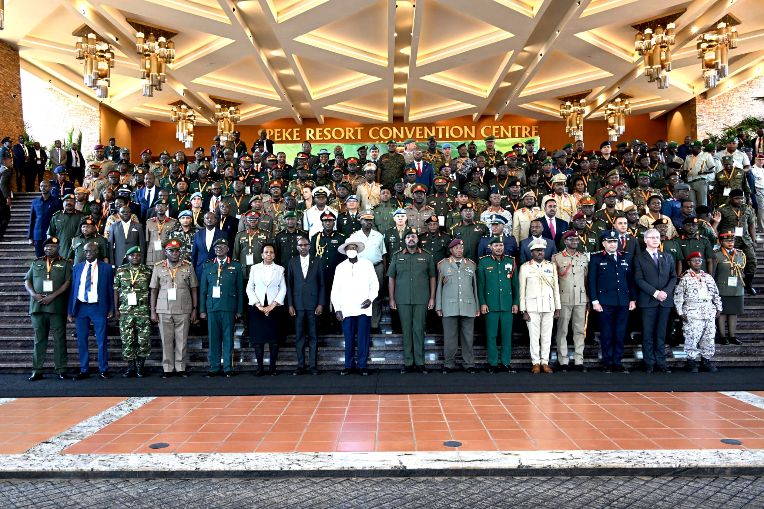
The military conference brought together delegates from more than 18 countries, African Union regional bodies, and Force Commanders from United Nations and African Union peace support missions.
Discover more from tndNews, Uganda
Subscribe to get the latest posts sent to your email.