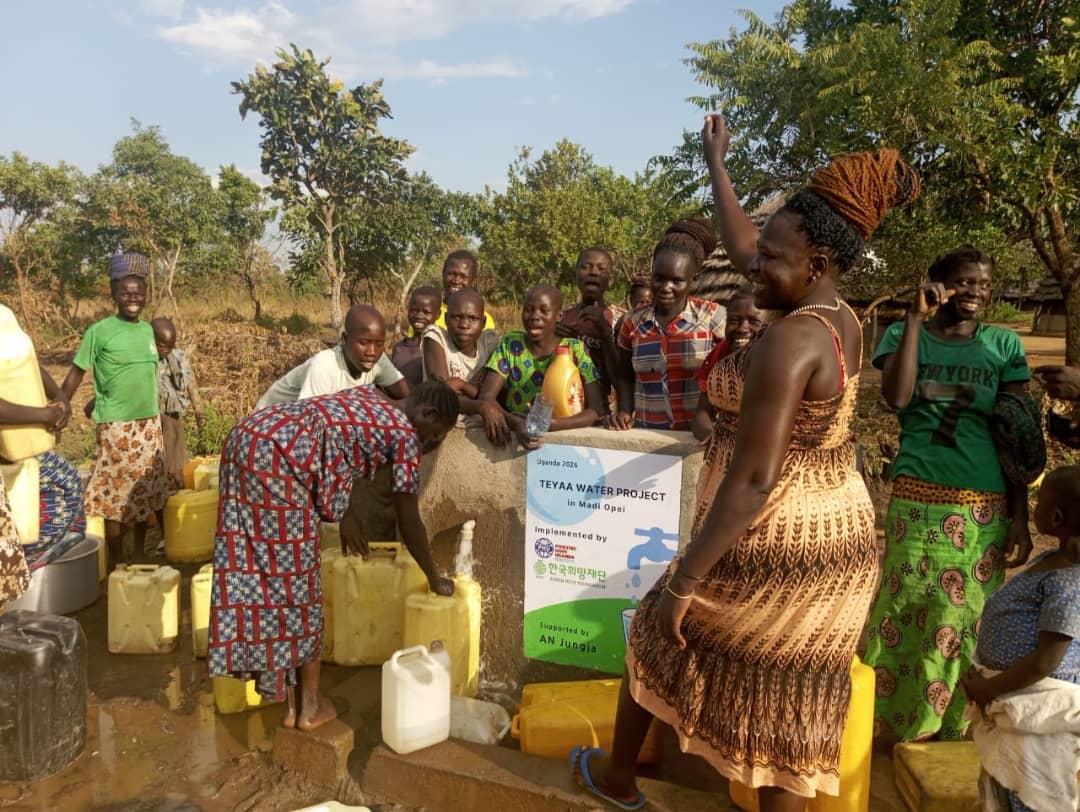
Residents of five villages in Okol parish, Madi Opei sub-county, Lamwo district, are enjoying improved access to clean and safe water after years of walking long distances to distant water sources.
The intervention has brought relief to residents of Teyaa, Obokeolot, Teceaa, Kiwiri and Odiaoket villages, where access to reliable water has for years been a challenge.
Before the intervention, residents depended on distant boreholes and, in some cases, swampy water sources, exposing families to health risks while placing a heavy burden on women and children responsible for collecting water.
For many households, fetching water was not simply a daily chore but a time-consuming activity that affected other responsibilities, including household work, childcare and personal hygiene.
Okot Simon Oyet, the LC1 chairperson of Kiwiri village, said residents previously walked about 1.5 kilometres to reach boreholes.
He said the situation was more difficult before the boreholes were established, when some residents depended on Pudul swamp, about four kilometres away, as a source of water.
Also read: New borehole brings hope as Lamwo expands access to safe water
“The distance was a big challenge, especially for women and children who were responsible for fetching water,” Okot said.
Otii Casto, a resident of Kiwiri, said water scarcity affected almost every aspect of household life. He said his wife could spend between four and six hours travelling to a water source and returning home, leaving little time for other domestic activities.
The shortage also affected personal hygiene because families had to ration the limited water they could collect. Otii said he sometimes bathed only once a day because there was insufficient water for household needs.
Layet Christine, resident of Teyaa village, said the arrival of piped water has brought relief to women who previously spent long hours searching for water.
“We are very relieved because fetching water used to take a lot of our time. We could walk long distances and spend hours before returning home. Now that water is nearer, we can use that time for other household activities and caring for our children.”
Christine said the previous water situation was particularly difficult for women, who carried most of the responsibility for providing water for their families. She said the new water system would also make it easier for families to maintain better hygiene because water would be more readily available.
Alimocan Brenda, also a resident of Teyaa village, said the intervention had reduced the burden of travelling long distances in search of water.

“Getting water was one of the biggest challenges in our village. Sometimes you could spend hours looking for water, especially when the nearby sources had no water. This new system has given us hope because we can now access water much closer to our homes.”
Alimocan urged residents to protect the water infrastructure and use it responsibly so that it can continue serving the community.
She said women and children were among those who would benefit most from the intervention because they previously spent considerable time fetching water.
“We should not take this water for granted. We need to protect the water points, avoid wasting water and contribute towards maintenance so that the system can serve us for many years.”
The two women said access to a reliable water source would not only reduce the time spent fetching water but also improve household hygiene and create more opportunities for women to engage in other productive activities.
The new piped-water system is being supported by Positive Hope Uganda, which is drilling and installing piped water systems in Okol and Litenge villages as part of efforts to improve access to safe and reliable water.
Akullu Grace Regina, the director of Positive Hope Uganda, said the initiative was intended to address the long-standing water challenges faced by communities in the area.
She urged residents to take responsibility for protecting the water infrastructure and using the facility responsibly.
Also read: Agago: 15 sub-counties embrace WASH program
Akullu said community ownership would be important in ensuring that the investment continues benefiting residents beyond the initial installation of the system.
Lokoroma Patrick, the health inspector for Madi Opei sub-county and Madi Opei town council, also urged residents to establish a water management committee to oversee the facility.
He encouraged households to contribute between sh1,000 and sh2,000 towards maintenance of the system whenever necessary.
Lokoroma said community contributions would help meet repair and maintenance costs and reduce the risk of the system becoming non-functional when minor faults occur.
He also cautioned residents against wasting water and allowing children to play around the water points, saying such practices could damage the infrastructure and undermine the purpose of the intervention.
The development highlights the importance of reliable water systems in improving household welfare and reducing the time communities spend searching for basic necessities.
For women and children, who traditionally bear much of the responsibility for collecting household water, shorter distances to water points can create more time for education, income-generating activities, childcare and other responsibilities.
Access to safe water can also support better hygiene and sanitation practices, reducing communities’ exposure to diseases associated with unsafe water sources.
Residents are now being encouraged to treat the piped-water system as a community asset and work together to protect it.
For the five villages, the new water system represents more than a new source of water. It marks a shift from years of long journeys and dependence on unsafe sources towards a more reliable supply that could improve health, hygiene and the daily lives of households.
The challenge now is to ensure that the infrastructure is properly managed and maintained so that the relief brought by the project becomes a lasting benefit for current and future generations.
The water project was implemented by Positive Hope Uganda with funding from Korea Hope Foundation in partnership with the community’s contribution of land and local labour.
Discover more from tndNews, Uganda
Subscribe to get the latest posts sent to your email.