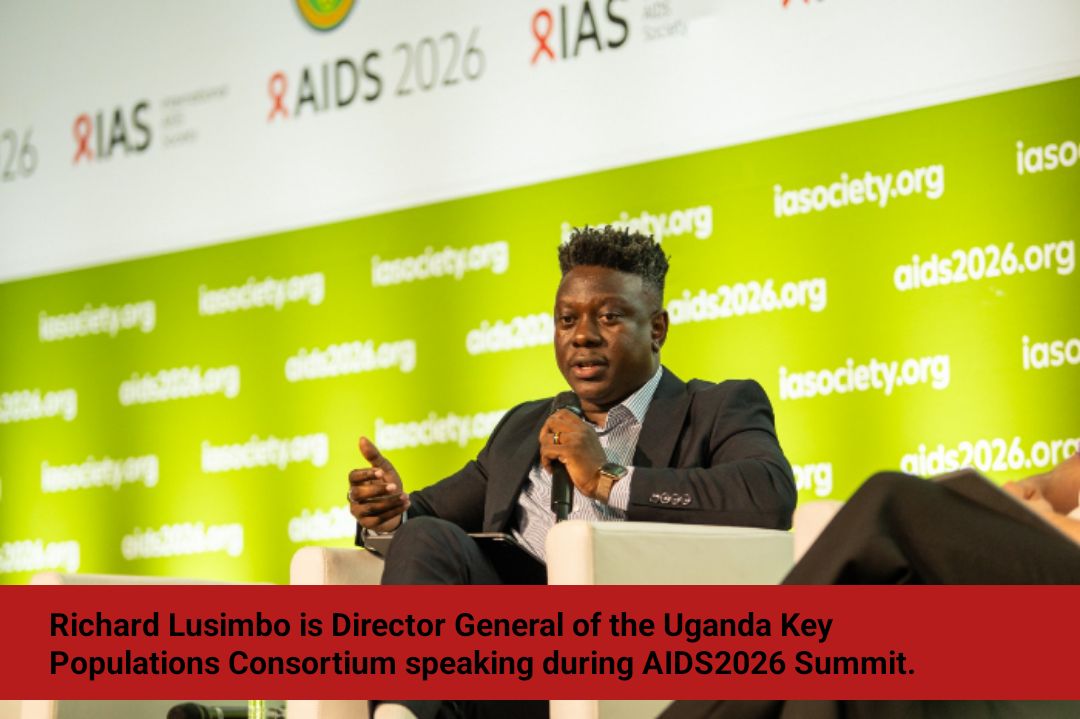
Kampala, Uganda | Governments and international partners must recognise, protect and finance community-led organisations as essential health infrastructure if the world is to end AIDS and respond effectively to future pandemics, Ugandan human rights and health advocate Richard Lusimbo has said following AIDS 2026.
Lusimbo, Director General of the Uganda Key Populations Consortium (UKPC), is a member of the Global Council on Inequality, AIDS and Pandemics. He participated in the 26th International AIDS Conference, held in Rio de Janeiro, Brazil, from 26 to 31 July.
In remarks examining how allies can demonstrate the value of communities, Lusimbo said preparedness cannot be measured only through laboratories, medicines, stockpiles and emergency plans.
It must also consider whether people trust health institutions and can obtain services without risking discrimination, violence, arrest, loss of income or eviction.
“Communities are not simply beneficiaries of pandemic preparedness. Communities are how preparedness becomes real.”
Uganda’s HIV response illustrates the importance of this approach. The country helped break the silence surrounding AIDS, adopted a multisectoral response and expanded HIV testing, treatment, prevention of vertical transmission and community-based care.
People living with HIV, civil-society organisations, cultural and faith leaders, researchers, health workers and public figures such as Philly Bongoley Lutaaya all helped turn fear and denial into public action.
There have been significant gains, but inequalities continue to leave adolescent girls and young women, children, men with low service uptake, people living in poverty and key populations at disproportionate risk. Uganda’s heavy reliance on external financing also leaves essential programmes vulnerable to sudden funding disruptions.
Uganda’s experience therefore offers both a record of progress and a warning: achievements secured through decades of public investment, international solidarity and community leadership cannot be taken for granted when financing contracts or exclusion deepens.
Lusimbo presented evidence of how community systems protect access to care. Through an emergency response mechanism, UKPC and its partners supported 1,185 people facing violence, eviction, medical emergencies, legal threats and other crises that affected their ability to remain connected to HIV and health services.

UKPC’s community-led information system also enables organisations to document service access, commodity gaps, referrals and rights violations in real time.
In one recent quarter, community organisations recorded more than 2,000 HIV-prevention service interactions while identifying violations that might otherwise have remained invisible.
“A health system may provide treatment, but communities help people reach it safely. Laboratories may detect a pathogen, but communities detect fear, misinformation, stigma and resistance.”
The Global Council’s research similarly found that inequality has measurable consequences. A one-point increase in a country’s Gini coefficient was associated with approximately 5.4% higher AIDS mortality and 5.5% higher HIV incidence.
The findings show that health outcomes are shaped not only by medicines, but also by income, housing, transport, employment, safety, criminalisation, discrimination and trust.
Lusimbo called for three commitments: national and global preparedness assessments should count strong, independent and representative community systems as preparedness capacity; governments and donors should provide community organisations with direct, flexible and predictable financing; and communities should have formal seats and voting authority in the bodies that design, fund and evaluate health programmes.
The appeal comes as reductions in international AIDS financing are affecting outreach, prevention services and last-mile distribution in Uganda.
Some community-led, peer-led and NGO-run services have reduced their operations or stopped providing services, threatening gains built over decades.
UKPC called on the Government of Uganda, Parliament, local governments and development partners to sustain HIV financing, increase domestic investment, protect non-discriminatory access to services and incorporate community-led systems into national health and pandemic-preparedness plans.
“When communities are funded, protected and empowered, they can interrupt inequality before an outbreak becomes a catastrophe.”
Discover more from tndNews, Uganda
Subscribe to get the latest posts sent to your email.