The growing pushback against gender equality and sexual and reproductive health rights could have particularly serious consequences for women and girls in Northern Uganda, where new government data shows child marriage, teenage motherhood, gender-based violence and unequal access to land remain persistent challenges.
The warning comes amid renewed calls by African rights advocates to resist what they describe as an anti-rights push and protect gains made in health, gender equality and women’s rights.
The issues were discussed during the 49th SHE & Rights session held on August 28 under the theme “Countering anti-rights pushes and upholding human right to health and gender equality.”
For Northern Uganda, the debate is more than a regional human-rights discussion.
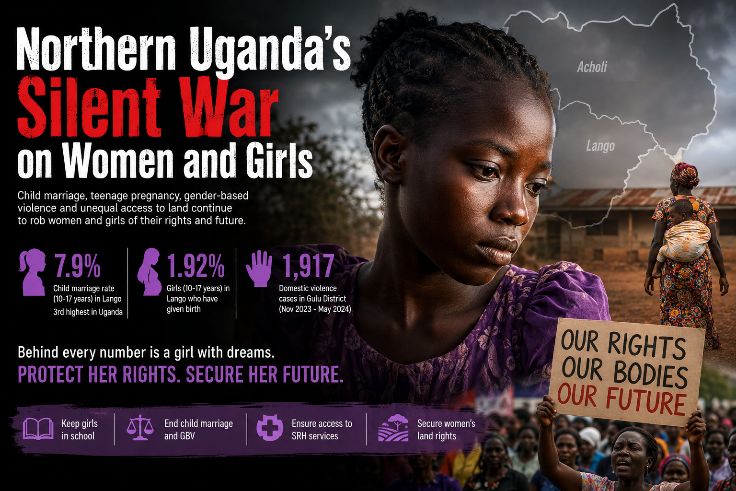
Recent data from the Uganda Bureau of Statistics (UBOS) shows that Lango recorded a 7.9 per cent child-marriage rate among children aged 10-17 in the 2024 census, the third-highest rate among Uganda’s sub-regions after Karamoja and Sebei and Acholi recorded 6.8 per cent.
Therefore, the figures represent children who were either currently married or had ever been married.
The UBOS 2024 Orphans and Vulnerable Children Census Monograph revealed that nationally, 610,790 children aged 10-17—6.7 per cent of that age group were currently or previously married, and the proportion was considerably higher among girls and 7.4 per cent nationally, compared with 5.5 per cent among boys.
Further, Lango remains a child-marriage hotspot, and the latest census shows that Lango’s problem has not improved in line with the national trend.

Between 2014 and 2024, the national proportion of children aged 10-17 who were ever married fell from 8.6 per cent to 6.7 per cent.
However, Lango moved in the opposite direction, rising from 7.6 per cent in 2014 to 7.9 per cent in 2024.
The UBOS census counted 41,438 married or formerly married children aged 10-17 in Lango, including 26,311 girls and 15,127 boys. Among girls in the age group, the proportion was 10.1 per cent, compared with 5.8 per cent among boys.
Also read: Jane Acilo Foundation, Thembekile Mandela Foundation sign MoU to advance SRHR in Africa
Therefore, this makes the issue particularly relevant to the SHE & Rights discussion, which identified ending child marriage and adolescent pregnancy as among the areas where progress needs to accelerate before 2030.
UBOS found that 5,026 girls aged 10-17 in Lango had already given birth, equivalent to 1.92 per cent of girls in that age group.
In Acholi, 2,873 girls aged 10-17 were recorded as child mothers, representing 1.34 per cent of girls in the same age group and nationally, 68,787 girls aged 10-17-1.5 percent were child mothers in 2024.
The census also found a sharp relationship between schooling and early motherhood. Only 0.1 per cent of girls aged 10-17 who were still attending school had given birth, compared with 7.5 per cent among girls who had attended school in the past but were no longer attending.
The data does not establish that pregnancy caused every school dropout, but it demonstrates the close connection between girls’ schooling, early motherhood and vulnerability.
Teenage pregnancy barely falling
Uganda’s 2022 Demographic and Health Survey found that 23.5 per cent of girls aged 15-19 had begun childbearing, 18.4 per cent had already had a live birth and 5.1 per cent were pregnant with their first child.
The figure has barely changed over two decades, and teenage childbearing was between 24 and 25 per cent in the 2006-2016 surveys and stood at 23.5 per cent in 2022.
The Uganda Demographic and Health Survey 2022 revealed that rural girls were more affected, with 24.9 per cent having begun childbearing compared with 20.5 per cent in urban areas.
In Lango, locally available evidence points to an even more worrying picture.
Reproductive Health Uganda reported that teenage pregnancy in Lango was as high as 28 per cent in 2020, with the organisation describing roughly one in three girls below 19 as either pregnant or already a mother.
More recent work by Lira University puts the Lira context at 26.7 per cent, compared with a national rate of about 24 per cent. The project also reported that only 20 per cent of adolescents accessed family-planning services in 2023.
These figures come from different studies and years and should therefore not be treated as a single trend line but together they point to a persistent adolescent sexual and reproductive health challenge in Lango.
A Ministry of Health report also says Uganda’s adolescent birth rate increased from 111 births per 1,000 girls aged 15-19 in 2020 to 128 per 1,000 in 2022, despite the slight fall in the teenage-pregnancy measure.
Violence remains a major concern
A 2024 report on Gulu district recorded 1,917 cases of domestic violence between November 2023 and May 2024.
Of these, 1,489 involved females and 428 involved males, with the reported cases including 955 cases of denial of resources, 461 psychological violence cases, 255 physical-assault cases and 52 sexual-violence cases.

Additionally, there were also 76 defilement cases, 54 rape cases, 20 forced marriages and 14 child-marriage cases.
At city level, research cited in a subsequent Northern Uganda GBV report found that Gulu City recorded physical violence at 58 per cent and sexual violence at 15 per cent, among the locations covered by the study.
Hence, these figures need to be interpreted carefully because they come from different datasets and are not equivalent to population-wide prevalence estimates; however, they underline the scale of violence confronting women and girls in the region.
A study of women in conflict-affected communities around Gulu and Omoro previously found that 78.5 per cent of 409 women surveyed had experienced at least one form of intimate-partner violence, with slightly more than half reporting violence in the preceding 12 months.
Therefore, the legacy of conflict, poverty, household economic stress and social norms continues to shape the region’s vulnerability.
Lango and Acholi face a service gap
Uganda’s 2023 Harmonised Health Facility Assessment found that only 54 per cent of health facilities nationally had services for victims of violence.
In Acholi, the proportion was just 40 per cent, while Lango performed better at 63 per cent, and for intimate-partner and gender-based violence services specifically, the figures were 40 per cent in Acholi and 61 per cent in Lango.
Also read: A just transition cannot be built on women’s land, labour and bodies
Thus, the difference highlights an important Northern Uganda reality, and the existence of a policy or legal right does not necessarily mean a survivor can access a functioning service when she needs it.
For a woman in a rural part of Acholi, for example, reporting violence may involve transport costs, distance to a health facility, limited psychosocial support and difficulties navigating police and courts.
However, land remains at the centre of women’s economic security, and the question of women’s rights in Northern Uganda also intersects directly with land.
Land is the principal productive asset for many rural households, yet women frequently face barriers to ownership, control and decision-making.
UBOS’s National Service Delivery Survey found that 92.2 per cent of households in Lango owned land, but only 4.1 per cent had registered land titles. In Acholi, 61.4 per cent of households owned land, and only 5 per cent had registered titles.
In addition, these are household-level figures rather than measures of women’s individual ownership, and they nonetheless demonstrate how heavily both regions depend on customary land systems.
Nationally, UN Women reports that women accounted for about 24 per cent of adult landowners, compared with 37 per cent for men, while only 31 per cent of women who own land have it legally registered in their names.
However, the challenge is particularly acute in Acholi, where customary land remains central to livelihoods and identity.
A 2025 study on land governance in Northern Uganda found that women in Acholi continue to face significant difficulties asserting land rights, particularly widows and divorced women, and it documented cases in which widows were pushed off land by in-laws and divorced women were denied claims to natal land.
Therefore, this makes the SHE & Rights debate about more than reproductive health and for women in Acholi and Lango, rights over their bodies, families, land and economic resources are interconnected.
‘Family values’ and whose rights are protected
Rehema Namukose, Senior Regional Programme Officer for sub-Saharan Africa at Musawah in Uganda, has questioned how the language of “family values” is defined in debates about women’s rights.
“When they throw around these words, you have to also ask yourself, what is the measure of what family is? How are they defining words like family? Values?,” she asked.
Deborah Nyokabi, Associate Manager for Economic Justice and Family Law at Equality Now, has similarly argued that some anti-rights campaigns promote a narrow definition of the family that can reinforce women’s dependence.
Also read: Cuts to prevention and community-led services could spark HIV resurgence in Asia Pacific
“Family values mean that the only type of family anti-rights actors believe should exist is a heteronormative, nuclear, patriarchal family consisting of a man, a woman and children,” she noted.
Hence, their concerns resonate strongly in Northern Uganda, where family structure, customary authority and land ownership remain closely connected.
Additionally, the debate over family law therefore has practical consequences, and a woman’s ability to leave an abusive marriage, retain property, access land, make decisions about her reproductive health or keep her daughter in school can determine whether she remains economically and socially dependent on an abusive or controlling household.
A warning against losing hard-won gains
The SHE & Rights discussion comes at a time when Uganda and other African countries are under pressure to accelerate progress on gender equality and health before the 2030 deadline.
Uganda’s own data suggests that progress remains uneven.
The national teenage-pregnancy rate has barely shifted, Lango’s child-marriage rate increased between the 2014 and 2024 censuses, and significant gaps remain in GBV services and women’s control over land.
For Northern Uganda, advocates say this means the response cannot stop at national policies and international commitments.
In Gulu and the wider Acholi region, it must mean functioning survivor services, protection of women’s land rights and stronger community mechanisms to challenge violence.
In Lira and across Lango, it must mean keeping girls in school, preventing child marriage and ensuring adolescents can obtain accurate sexual and reproductive health information and services.
The figures also point to the importance of involving cultural and religious leaders rather than treating rights protection as a matter for government and civil-society organisations alone.
UNFPA reports that Uganda’s cultural institutions including Ker Kwaro Acholi and the Lango Cultural Foundation have been engaged in efforts addressing GBV, sexual and reproductive health rights, child marriage and other harmful practices.
Therefore, the message emerging from Northern Uganda is therefore straightforward with protecting gender equality and the right to health is not an abstract international commitment.
For a girl in Lango facing pressure to marry, a teenage mother in Lira trying to return to school, a survivor of violence in Gulu seeking justice, or a widow in Acholi defending her land, the strength of those rights can determine the course of her life.
Discover more from tndNews, Uganda
Subscribe to get the latest posts sent to your email.