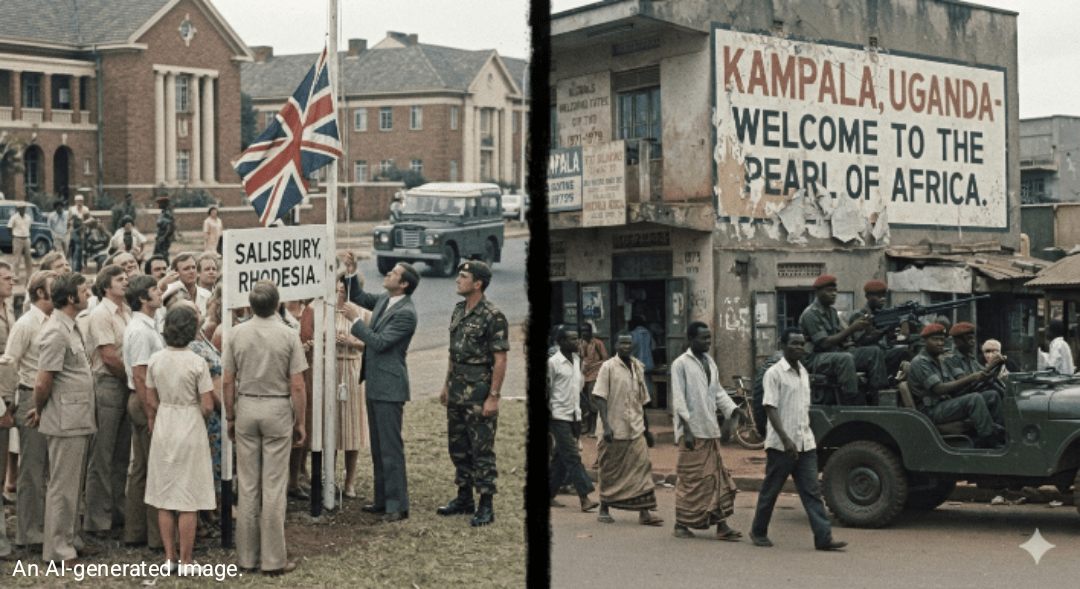
In colonial Southern Rhodesia, 200,000 white settlers ruled over 4 million Africans. In Kenya, a few thousand settlers took the White Highlands and pushed Africans into reserves.
In South Africa, apartheid perfected it: 10 Bantustans were created to fragment the Black majority so that whites could keep the cities, mines and factories.
We fought against that. We won independence on the principle of majority rule. Yet today, we are recreating the same logic in independent Africa, including in Uganda.
The mechanism is the same: a small minority captures the state, then designs a system to ensure the majority can never unite to challenge it.
At the Center for Critical Thinking and Alternative Analysis, we call this the 4-Dimensional Environmental problem.
Also read: Armies need to understand what is happening in society, says Gen Salim Saleh
Exclusion does not happen only in politics. It happens simultaneously in four dimensions:
The ecological dimension: Land as a weapon
In Rhodesia and Kenya, the first tool was land. Settlers alienated productive land and created reserves. The reserves were too small to feed people, so Africans had to work on white farms for cheap labour.
In Uganda today, look at Kween district. More than 7,000 families in Kiriki sub-county were evicted a decade ago and are still fighting illegal titles in court and before the Uganda Human Rights Commission without success.

Look at the Albertine Graben: oil discovery triggered a land rush, violent evictions and absentee landlords occupying ancestral land.
When a family loses land, it loses more than property. It loses economic independence and political confidence. A displaced person queuing for food aid cannot organise a political party. Displacement depoliticises the majority.
Add the Balaalo question in Acholi. However you view pastoralism, the perception on the ground is clear: the state appears to defend cattle keepers with money against indigenous communities. That creates the same feeling that colonial Africans felt: that the land is no longer theirs.
The economic dimension: When money becomes politics
The second tool is money. In our research we have documented how politics has shifted from ideology to what we call “money-ology”.
A candidate for party primaries today must transport 1,000 delegates at shs200,000 each and give another shs300,000 token on voting day. That is shs500 million before posters. With Uganda’s per capita income at about $1,300, how many honest teachers, farmers or nurses can afford to contest?
As Nigerian scholar Omoigberale warns, when politics is monetized, “financially disadvantaged individuals are often excluded from running for office… leaders serve the interests of the rich rather than the broader population.”
Also read: Uganda, Zimbabwe agree to strengthen defence ties to tackle regional security threats
The result is twofold. First, the impoverished majority cannot produce its own leaders. Second, communities are penetrated by outsiders with money – people sponsored by the centre who win local seats but represent central interests, not local interests. The vote remains, but the power to choose is lost.
Corruption then completes the cycle. Those who spend heavily to win must steal to recover. As we have documented, Uganda loses billions each year to graft – money that would have built clinics and roads. Corruption is not separate from repression. It funds it.
The sociocultural dimension: Capturing the mind and the civic space
The third tool is the most subtle: breaking the culture and capturing institutions.
Colonialists banned majority languages in schools and rewrote history. Today we do it differently. We fragment identity.
We have moved from 15 culturally cohesive nations at independence – Buganda, Bunyoro, Toro, Ankole, Busoga, Bugisu, Bukedi, Lango, Acholi, Karamoja, Teso, Kigezi, West Nile, Madi, Sebei – to 146 districts.

Most new districts follow ethnic lines: a district for this group, a sub-county for that group.
Scholar K. Byenkya calls these “veiled Bantustans”. He is right. Like South Africa’s Bantustans, they create the illusion of self-rule while ensuring economic non-viability and political dependence on the centre.
A tiny district cannot build a referral hospital. It must beg Kampala, and loyalty is the price of begging.
At the same time, we capture civic space. The NGO Act 2016 subjects civil society to extensive government control. The Public Order Management Act gives police discretionary power to veto gatherings.
The Protection of Sovereignty Bill 2026 now threatens to criminalize any support for “foreign interests” and restrict demonstrations.
Universities, media, professional associations – all are put under surveillance or clientelism. The goal is what I call “total governance”: no arena is left where the majority can meet, think and organize independently. Without independent thought, there is no majority consciousness.
The temporal dimension: Stealing history and the future
The fourth tool is time. You deny a people their past, so they cannot claim a future.
The most painful example is citizenship. The 1995 Constitution lists 65 indigenous communities. But thousands of people born here cannot get a national ID or passport because they cannot prove their family was here in 1926. Documents were lost in war. Bureaucrats exercise discretion.
Without an ID, you cannot go to school, open a bank account, get healthcare, or vote. You become a non-person in your own country.
When you deny citizenship to a child because of his grandfather’s papers, you are not just denying the present. You are capturing the future. That child will grow up excluded, generation after generation.
Similarly, when you deny quality education to rural schools, you ensure that the next generation of the majority cannot compete for leadership.
What must be done?
Understanding that exclusion is 4-dimensional shows us that our response must also be 4-dimensional.
Ecologically, we need land justice – secure tenure, cancellation of illegal titles, and restoration for communities in Kween and Albertine.
Economically, we need political finance reform – caps on campaign spending and public funding to allow poor but capable Ugandans to contest.
Socioculturally, we need to protect civic space – repeal repressive clauses in the NGO Act and POMA, and stop the proliferation of unviable districts. Fewer, stronger, economically viable districts would foster unity, not fragment it.
Temporarily, we need inclusive citizenship – remove the 1926 barrier and give IDs to all born here, and fix the education system so it produces critical citizens, not obedient subjects.
In South Africa, Bantustans left profound and lasting scars that persist today. The same will be true for us if we continue on the path of ultra-bantustanisation.
The majority will inevitably govern. The question, as always, is when, how, and at what cost. Beyond the 4DEF – beyond balancing land, economy, culture and history equally – no ethical or effective governance exists.
The author, Oweyegha-Afunaduula, is a conservation biologist and member of the Center for Critical Thinking and Alternative Analysis, Uganda.
Discover more from tndNews, Uganda
Subscribe to get the latest posts sent to your email.