The dream of a fully integrated East African Community (EAC) rests on four fundamental pillars. However, to transform this vision into a reality within our lifetime, member states must move beyond rhetoric and deliberately accelerate action under each one.
The four pillars of EAC integration include: Customs Union, Common Market, Monetary Union, and Political Federation—all based on a pillar-by-pillar action plan for member states.
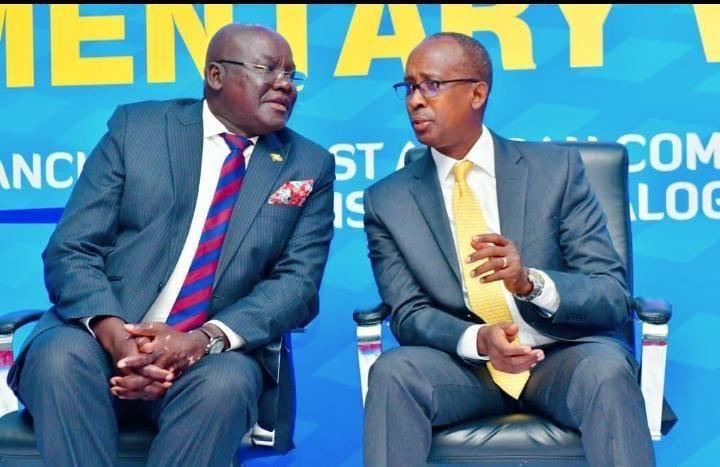
Otuke County Member of Parliament, Paul Omara, has emphasised that Uganda must intensify its efforts to both benefit from and contribute more significantly to the affairs of the East African Community (EAC).
Omara made this statement on Thursday, July 9, 2026, while delivering key remarks at the Parliamentary Forum on East African Affairs.
The session was attended by fellow legislators, including PACEID boss, Rwabwogo Odrek, among other Members of Parliament.
In his address, Omara highlighted trade, regional integration, infrastructure, and joint development as critical areas where Uganda must take the lead and deliver tangible results for the region.
He lamented that the Customs Union’s goal was to establish a single territory with a common external tariff, zero internal duties, and harmonised procedures.
Under fast-track actions, Omara called for the elimination of Non-Tariff Barriers (NTBs), accelerating clearance times at key borders like Busia and Malaba by fully implementing the Single Customs Territory and deploying electronic cargo tracking systems.
He also urged the harmonisation of product standards to adopt a unified EAC quality standard, ensuring that goods—such as Ugandan milk, Kenyan maize, and Tanzanian cement—can move freely across borders without costly and time-consuming re-testing.
Additionally, he stressed the need to protect regional industry by applying the Common External Tariff consistently and uniformly to prevent member states from undercutting each other and to safeguard local manufacturing.
Regarding the Common Market pillar, Omara emphasised the free movement of goods, services, labor, capital, and the right of establishment, effectively treating citizens of other EAC states as national citizens.
To ensure seamless movement of people, he called for widening the use of EAC passports, ensuring national IDs are recognized across all eight member states, and eliminating work permit fees for EAC professionals.
He proposed creating a system where a Ugandan teacher, nurse, or engineer can practice in Rwanda or Kenya without undergoing lengthy re-certification processes.
This would allow banks and companies to operate regionally with a single license and harmonise investment laws to create a predictable business environment.
On the third pillar—Monetary Union and Financial Integration—Omara stated that member states must urgently align their inflation, debt, and budget deficit goals as stipulated in the 2013 protocol to create a stable fiscal foundation.
He called for enabling cross-border mobile money, banking, and stock trading by harmonising financial regulations and supervisory frameworks.
He further urged the establishment of the East African Monetary Institute to coordinate monetary policy and prepare for the single currency, rather than delaying its creation.
Finally, on the Political Federation—a common political union and governance structure—Omara stressed the need to establish a common foreign policy, defense, and governance system.
This requires aligning national laws, election standards, anti-corruption legislation, and human rights frameworks to build trust and shared values.
He called for empowering EAC institutions by granting the EAC Secretariat and the East African Legislative Assembly the real, binding authority needed to enforce regional decisions.
He also emphasised speaking with one voice by formulating and presenting common positions on trade, security, and climate change at the African Union and United Nations.
Speaking during the EAC Parliamentary Week on the floor of Parliament, Odrek Rwabwogo—who presented the case for deepening Pan-African and regional market value chains stated that East Africa’s promise will not be unlocked by speeches alone.
“We must build the systems that make trade work: stronger standards, better infrastructure, affordable export finance, productive regional value chains, and the political will to remove barriers that slow our people down.”
Rwabwogo continued that Uganda’s opportunity is clear: the country must move from exporting raw commodities to building an export powerhouse that creates jobs, strengthens industries, and gives young people a real stake in the future of East Africa.
He emphasised that East Africa must become a working market, not just an aspiration.
In short, fast-tracking integration follows a clear formula: remove barriers, harmonize rules, build infrastructure, and get citizens on board.
If all eight member states move forward in unison across the four pillars, the vision of a united East Africa will not be a distant 50-year goal, but an achievable near-term reality.
Discover more from tndNews, Uganda
Subscribe to get the latest posts sent to your email.