President Yoweri Kaguta Museveni has called on officers from the War College of Mali to embrace patriotism, Pan-Africanism, economic transformation and strategic security.
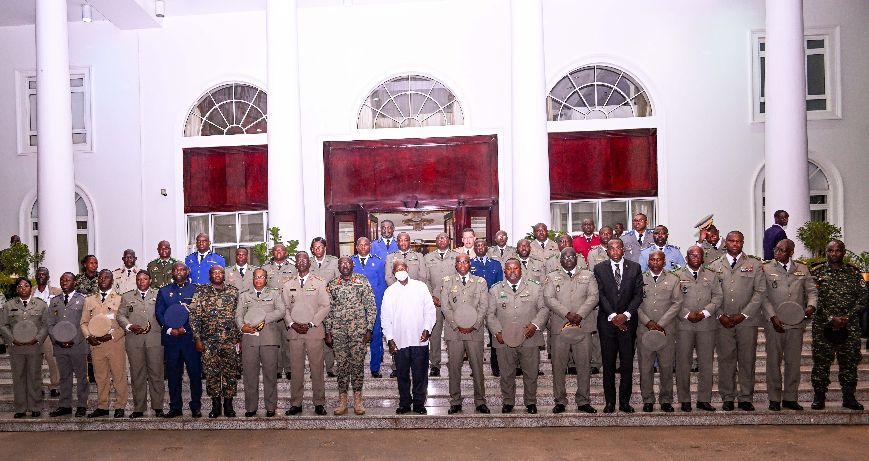
The above, he said, are the foundation for Africa’s prosperity, stability and long-term development. On Thursday, July 16, 2026, at State House Entebbe, Museveni delivered a Lecture of Opportunity to a delegation of student officers from the War College of Mali.
This delegation was led by Commandant of the War College of Mali, Brig. Gen. Moussa Yoro Kanté.
Drawing on more than six decades of his involvement in African affairs, President Museveni said the continent’s future depends on addressing what he described as “Africa’s three historical missions: creating prosperity, guaranteeing strategic security and promoting African unity.”
“I have been involved in African affairs for the last 65 years. I was a follower of Modibo Keita, Kwame Nkrumah and Mwalimu Julius Nyerere, and I am a Pan-Africanist,” President Museveni told his guests.
He explained that Africa’s liberation struggle was never solely about attaining political independence, but also about creating sustainable prosperity for its people.
“If African people need prosperity like other people, then the question is: where does prosperity come from? It cannot come from begging. Africa has been begging for decades, yet many countries remain poor. Prosperity comes from producing a good or service that other people are willing to buy,” he said.
Using his experience as a cattle keeper, President Museveni illustrated the importance of markets, noting that wealth is created by producing for wider markets rather than for one’s immediate community.
“My tribe cannot make me prosperous because they produce the same things I produce. It is the wider Ugandan market that buys my milk and beef. That is why patriotism is important. Uganda is the market that supports our prosperity,” he said.
The President noted that as production expands, national markets eventually become insufficient, making regional integration indispensable.
“When Ugandans began producing more sugar, textiles, milk and maize, the local market was no longer enough. That is why Pan-Africanism is not just an ideology; it is an economic necessity. Africa provides the larger market that will sustain our prosperity,” he said.
The President also underscored the importance of socio-economic transformation, urging African countries to move beyond subsistence farming to commercial production and wealth creation.
“We told our people to produce not only for the stomach but also for the pocket. Many needs can only be met through money earned from productive economic activity,” he said.
On security, the President stressed that prosperity cannot be sustained without the capacity to defend it.
“You may become prosperous, but if you cannot defend yourself, others will destroy what you have built. Strategic security is therefore the second historical mission,” he said.
He observed that modern warfare has evolved beyond the traditional domains of land, air and sea to include space, arguing that no single African country has the capacity to compete effectively across all four domains on its own.
“Even developed countries such as France, Germany and Britain cannot independently dominate all these areas. That is why political integration in Africa is so important,” Museveni said.
He welcomed ongoing efforts by Mali, Burkina Faso and Niger to strengthen regional cooperation, saying deeper political and security integration would better position African countries to safeguard their sovereignty and accelerate development.
On Africa’s current geopolitical challenges, Museveni said Africa’s renewed vulnerability to external competition stemmed largely from the failure of post-independence leaders to fully unite the continent.
“The new scramble for Africa is a reality because of our mistakes. Once we got our freedom, we did not use it properly to unite ourselves,” he said.
On terrorism, he said defeating violent extremism requires addressing both ideological and military dimensions.
“The first problem of terrorism is ideological. The second issue is army building. You must build professional forces capable of protecting the country and defeating those who use violence,” President Museveni said.
“This visit is a direct result of your decision to strengthen military cooperation with Mali. We thank you for the officers who have been trained in Uganda and for your enduring commitment to Pan-Africanism,” Brig. Gen. Moussa Kanté said.
He revealed that the 37-member delegation comprises staff, defence officials and student officers from Mali, Burkina Faso, Cameroon, Chad, Guinea, Morocco, Senegal and Togo.
Discover more from tndNews, Uganda
Subscribe to get the latest posts sent to your email.