Acholi, Lango | The maize stalks stood motionless under the scorching June sun. A few weeks earlier, they had swayed gently in the wind, their green leaves stretching confidently toward the sky.
For Bitek Robert Odoki, 45, his garden represented the hope that months of hard work would soon translate into food for his family, school fees for his children, and income to meet household needs.
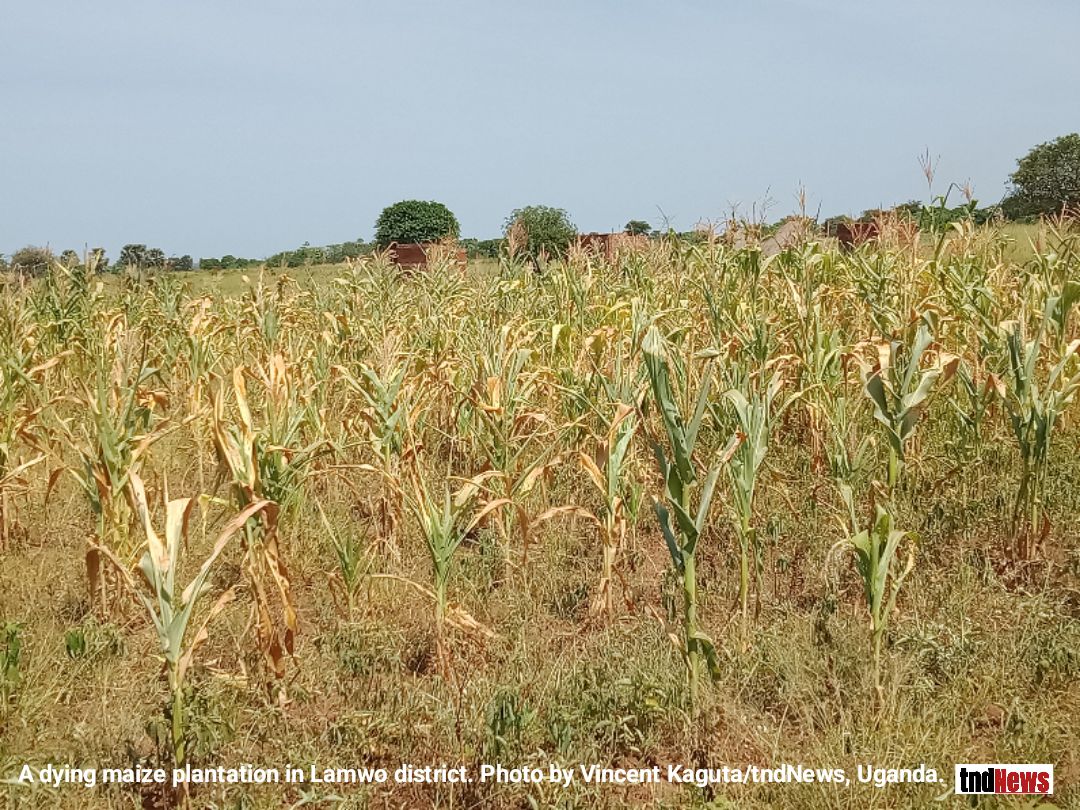
Now, standing in the middle of his field in Anyibi village, Gangdyang parish, Padibe town council in Lamwo district, he watches helplessly as that promise withers before his eyes.
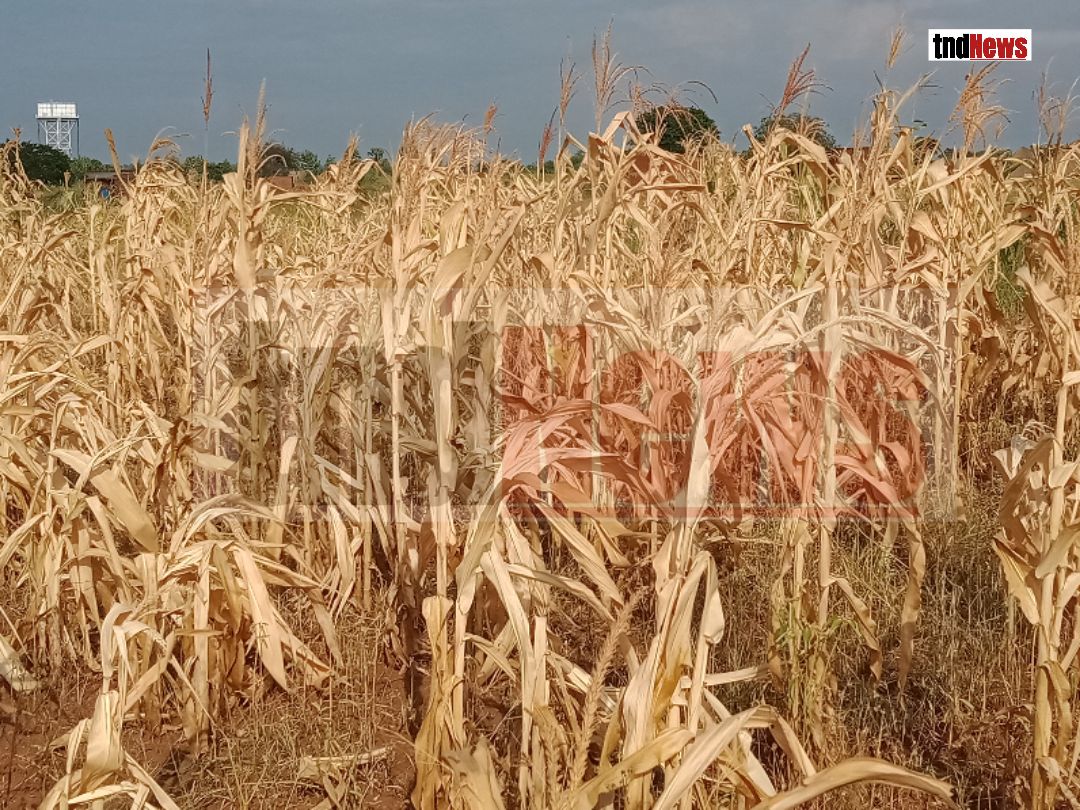
The leaves have turned brown. The soil beneath his feet is cracked. The maize cobs that once appeared healthy are shrinking under relentless heat. Odoki bends down and gently squeezes a drying cob before wiping tears from his face.
“I watched my harvest die,” he says quietly. “I invested everything I had in this garden. We were expecting a good harvest. Now the crops are drying before maturity. I don’t know how my family will survive if the rains don’t come.”
Around him stretches nearly three acres of maize that may never reach harvest. The silence in the garden is broken only by the sound of dry leaves rustling in the hot wind. For Odoki, this is more than a failed crop. It is a season of broken dreams.
 A village waiting for rain
Across Anyibi village, anxiety hangs heavily in the air. Farmers gather under mango trees discussing the weather, exchanging stories of losses and watching the skies for signs of rain that never seem to arrive.
Among them is Aciro Milly Grace, a mother of six whose maize and bean gardens are suffering the same fate. When she planted at the beginning of the season, the rains arrived as expected. Seeds germinated well, and farmers anticipated a productive harvest.
Then the rain stopped. Week after week, temperatures rose while moisture disappeared from the soil. Today, much of her garden is yellowing. “I was expecting to harvest enough food to feed my family and sell some produce at the market,” Aciro says.
“Now every day I come here and see the crops drying. It is painful because this is our only source of livelihood.”
She points toward rows of wilted bean plants.“These crops were supposed to pay school fees for my children. If they fail completely, I don’t know where the money will come from.”
Her fears echo those of hundreds of farming households across Lamwo district, where agriculture remains the backbone of the local economy.
For many families, farming is not simply a source of income. It is survival. A good harvest means food on the table, children in school, and money for medical care. A failed harvest threatens all three.
Climate change arrives at the farm gate
For decades, farmers in northern Uganda relied on relatively predictable seasons. The rains came, crops were planted, and communities planned their lives around familiar weather patterns. Today, that predictability is disappearing.
According to Richard Cyrus Komakech, the Lamwo district agricultural officer, the prolonged dry spell currently affecting the district reflects a growing climate challenge confronting farmers across northern Uganda.
“The weather patterns are no longer as predictable as they used to be,” Komakech explains. “We are increasingly experiencing prolonged dry spells, erratic rainfall, delayed onset of rains and higher temperatures. These conditions are affecting crop production and threatening food security.”
He says many farmers planted on time after the first rains arrived, only for crops to face moisture stress during critical growth stages. “Maize is particularly vulnerable when drought occurs during flowering and grain formation. Once crops reach that stage without sufficient moisture, yields decline significantly.”
Komakech warns that climate change is no longer a future concern. “It is already affecting livelihoods. What farmers are experiencing now is evidence that climate change is happening and communities must begin adapting.”
Among the adaptation measures he recommends are drought-resistant seed varieties, water harvesting technologies, soil conservation practices, agroforestry and small-scale irrigation systems.
“Farmers can no longer depend entirely on rainfall,” he says. “We must support them with climate-smart agriculture if we are to maintain food production.”
What the weather experts say
The changing conditions observed by farmers are also reflected in scientific data. According to the Uganda National Meteorological Authority (UNMA), Uganda is increasingly experiencing weather extremes linked to climate variability and climate change.
Meteorologists note that rising temperatures and increasingly erratic rainfall patterns are becoming more common across many parts of the country, particularly in regions heavily dependent on rain-fed agriculture.
Weather experts warn that prolonged dry spells can occur even during traditional rainy seasons, creating uncertainty for farmers who rely on historical planting calendars.
Such conditions often reduce crop yields, increase food insecurity and deepen rural poverty. For communities already vulnerable to economic shocks, a single failed season can have devastating consequences.
Hunger on the horizon
In Lamwo, discussions about rainfall are increasingly giving way to conversations about food. Many households are now calculating how much they are likely to harvest and whether it will be enough to last until the next planting season.
For some, the answer is grim. The crops are too damaged to recover. Others continue hoping that rain may still arrive in time to save part of the harvest. But every day without rain reduces those chances.
Children who once helped weed thriving gardens now walk through fields of drying crops. Parents worry about difficult choices that may lie ahead. Reducing meals, selling livestock and borrowing money.
Withdrawing children from school. These are coping mechanisms many families know all too well. And community leaders fear they may soon become necessary again.
Development gains at risk
The secretary for production, marketing and natural resources in Lamwo district, Nelson Lubangakene, says climate shocks are threatening years of progress made in improving household incomes and food production.
“Most people in Lamwo depend directly on agriculture,” Lubangakene says. “When crops fail, the impact extends beyond individual households. It affects local markets, household incomes, education and overall economic development.”
He notes that agriculture contributes significantly to livelihoods throughout the district and that repeated climate-related losses could undermine efforts to reduce poverty.
“We need increased investment in irrigation infrastructure, farmer training and climate adaptation programs,” he says. “The reality is that climate change is already affecting our communities, and we must respond accordingly.”
Lubangakene also calls for stronger partnerships between government, development agencies and local communities to improve resilience among farmers. “If we do not act now, these weather shocks will continue becoming more severe and more frequent.”
Resilience under pressure
Northern Uganda has endured many hardships. Communities here survived decades of conflict, displacement and economic uncertainty. Many rebuilt their lives through agriculture.
The land became both a livelihood and a symbol of recovery. Yet climate change is testing that resilience in ways many farmers have never experienced before.
Unlike war or displacement, drought offers no visible enemy. It arrives quietly. A few missed rains. A week of intense heat. Then another, and another.
By the time the damage becomes visible, it is often too late. For farmers like Odoki and Aciro, the struggle is no longer simply about producing food. It is about adapting to a future where the weather can no longer be trusted.
The waiting continues
Late in the afternoon, dark clouds begin gathering on the distant horizon. Farmers pause their work and look skyward. For a moment, hope returns. Perhaps this will be the rain they have been waiting for. Perhaps the crops can still be saved. But within an hour, the clouds drift away. Not a single drop fell.
As evening approaches, Odoki walks slowly through his maize field one last time. He stops beside a row of shrivelled plants and surveys the damage. What he sees is not simply a failed harvest. He sees school fees that may never be paid. Food that may never reach the family table.
Months of labour erased by a changing climate. Across northern Uganda, thousands of farmers are confronting the same reality.
And as another day ends without rain, one question grows increasingly urgent. In a region where farming has always depended on nature’s reliability, what happens when the rain forgets to come?
In Arok village, Aber sub-county, Oyam district, farmers are turning to God for Rain. Molly Okao, 45, says her maize and soybean gardens have all vanished.
Okao, like many smallholder farmers, expects to harvest “nothing” – blaming the projection on the prolonged dry spell. “Only God knows when it [the rain] will fall. For now, we are watching our crops dry. No hope”
Discover more from tndNews, Uganda
Subscribe to get the latest posts sent to your email.