Yumbe | When Francis Asiko got a job shortly after completing nursing school in 2012, his plan was straightforward: work hard, save money, and then start a private clinic.
But as months passed, something began bothering him at Midigo Health Centre IV, in Yumbe district, where he worked. Cases of malnutrition were high—especially among infants, expectant mothers, and elderly persons—and many homes were battling with food shortages in his community.
Yet the mango season had just ended, Asiko wondered, and the rotting fruits were still littered as animals and birds feasted on them.
Then he began thinking and researching hard on how to address fruit waste.
A few weeks later, Asiko, 52, discovered that sugar is a good inhibitor of microorganism growth and therefore can be used as a simple preservative for extending the shelf life of fruits like mangoes.
The following day, Asiko and his brother began experimenting by “jarrying” mangoes—a process that involves cutting mangoes into slices and putting them into jars filled with water and a little bit of sugar dissolved in it before closing them tightly.
“The few samples we made worked. The fruits were still edible after a month,” he says. “And since that time we knew we had found our local solution to even the problem.”.
Food waste is a big challenge in Africa, with about half of crops lost due to poor harvesting techniques and handling afterwards, according to the UN Food and Agriculture Organization. In Uganda alone, 40 percent of crops are lost every year after harvest, with fruits and grains most affected.
In Asiko’s village, Midigo, for instance, the mango season starts in March and end in May. That means that fruits and vegetables are not readily available for the next ten months or so, especially during the dry season. This makes food preservation critical in this community.
Since that time, Asiko started a not-for-profit nutritional centre known as the “mango project” on his family ancestral land to address malnutrition though mango preservation.
Infants, expectant mothers, and elder persons often flock there to get fruit and also get information on nutrition.
The canned mangoes, he says, can last up to a year and they are given out free of charge because “we want to keep our people healthy”.
But “we also rely on donations from well-wishers and non-governmental organisations,” he says, adding that the fund are used to “run the centre, buy supplies, and also give some tokens to our volunteers”.
Every week, at least 50 canned mangoes are given to the locals. The in charge at the neighbouring the Midigo health centre 4, Irene Andruzu, says the facility receives between three and five cases of malnutrition every week.
The facility has been receiving canned mangoes from Asiko’s centre to help the malnourished patients, Andruzu adds.
One of the beneficiaries, Lenia Juliet, says her three-year-old son, who had been suffering from acute malnutrition, has been able to improve thanks to medical attention her son has been getting from Midigo health centre and support from Asiko’s Mango Project.
But it has been costly to buy supplies such as sugar and jars and labour to do the prevention. Add to that, as the demand for the preserved mangoes increases, especially during the dry season, Asiko adds, more firewood is needed for the preservation process.
Yet downside, Asiko adds, it has become challenging to access charcoal since last year when the government banned commercial charcoal trade due to rampant tree depletion in northern Uganda—a major charcoal hub.
Statistics from National Forestry Authority indicate that Uganda lost 63% loss of its forest cover in the last 25 years.
Switching to solar
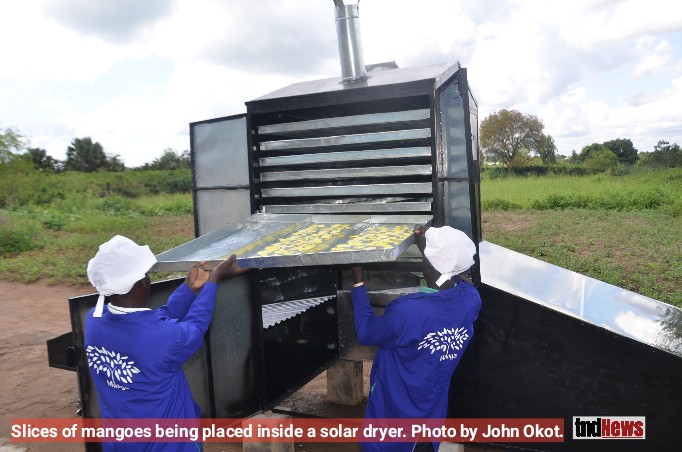
For the past seven years, Asiko has been scrimping and saving from donations. Early this year, he used his saving to buy a solar dryer worth two million Uganda shillings.
“Of course, we pay it in installments until we completed the payment,” he adds. “Now we can preserve fruits sustainably by using clean energy.”
The dryer has a solar panel on top of it, and inside there is a chamber lined with steel and a thick layer of wood that acts as an insulator to minimise heat loss.
A fan on top allows air to flow into the chamber where temperature is regulated between 40 and 50 degrees Celsius over the sliced of fruits that are stacked on the shelves.
“The regulated heat is meant to avoid destroying the micronutrients in the fruits or any food,” says Lawrence Okettayot, an engineer who runs a social enterprise known as “Sparky Dryers” in Kampala.
It takes about six hours to dry the 10 kilograms of mangoes. Uing a solar dryer is hygienic compared to sun drying, which in most cases attracts flies and is unfavourable during rainy season.
Now Asiko has also began drying vegetables such as okra and eggplants as well as herbs like ‘moringa’ to improve the diet of the malnourished families that visit his centre.
Nutritionists like Emmanuel Owiny caution the dried fruits are still nutritious as long as the heat is minimal enough to not damage the micronutrients such as roughages and vitamin A found in mangoes.
Samalie Namukose, Assistant Commissioner for Nutritionist at the Ministry of Health urges the government should invest in cheaper dryers to support local farmers who are unable to afford it.
In general, food dryers—especially solar-powered ones—are expensive and beyond the means of low-earning smallholder farmers, even though they are cost-effective, she adds.
The Ministry of Agriculture has previously said the government currently relies on extension workers to train farmers to keep their produce in good condition after harvest, but the number of agents is stretched thin due to financial constraints.
This story was done with support from the African Centre for Media Excellence in partnership with Mott Foundation.
Discover more from tndNews, Uganda
Subscribe to get the latest posts sent to your email.