In the early 1980s, Uganda was the epicenter of one of the greatest public health crises in modern history. HIV/AIDS struck us hard and fast, devastating families, villages, entire districts.
Before the discovery and roll-out of antiretroviral therapy (ARVs), millions of Ugandans succumbed to the virus. Every funeral was a silent epidemic. Entire generations of breadwinners disappeared, leaving behind orphans who became the face of a country in mourning.
Yet against all odds, Uganda rose. Through candid national leadership, grassroots mobilization, and community-centred approaches, we stunned the world with the “ABC strategy”: Abstain, Be faithful, Use condoms. By the late 1990s and early 2000s, infection rates dropped from a staggering 18% prevalence in the early years to around 6%.
Our efforts earned Uganda global accolades and established us as a model for HIV/AIDS control. We became a beacon of hope on a continent where despair had taken root. But today, the glow has dimmed.
A country losing the fight
The UNAIDS “90-90-90” targets 90% of people living with HIV knowing their status, 90% of those diagnosed accessing sustained ARV treatment, and 90% of those on treatment achieving viral suppression, were meant to be achieved by 2020. Globally, progress has been uneven, but many of our neighbors have performed remarkably well.
Rwanda, for instance, has surpassed the 90-90-90 benchmarks, with 97% of people living with HIV on treatment and 91% virally suppressed. Botswana and Eswatini are similarly success stories in Africa. Across Europe, countries like Sweden, Switzerland, and the UK not only reached but exceeded the targets, bending the epidemic toward control.
Uganda, however, is still far from the finish line. While strides have been made, nearly 1.4 million Ugandans are living with HIV, and thousands of new infections occur each year, especially among young people. Stigma, weak health systems, fragmented programming, and chronic dependency on donor funds continue to undermine progress.
And now, the ground beneath us is shifting: PEPFAR, the U.S. President’s Emergency Plan for AIDS Relief, the largest financier of Uganda’s HIV response, is withdrawing funding. For two decades, PEPFAR sustained our treatment programs, saving millions of lives. But like a child who never planted food despite years of warning, Uganda finds itself crying when the granary is empty.
We had time, decades, in fact, to prepare, to build a sustainable domestic HIV/AIDS fund. But political priorities swayed elsewhere. Corruption, complacency, and short-termism replaced foresight. Ironically, some of those at the helm of policy government technocrats, ministers, parliamentarians, are themselves living with HIV. Yet unlike the ordinary Ugandan, they access world-class treatment abroad.
The elephant in the room: Stigma
Beyond donor dependency, one enemy has consistently haunted our HIV response: stigma. And it is killing us silently. I do not speak as an armchair observer. I have not only read extensively about HIV/AIDS; I have published in international health journals, participated in planning, designed interventions, implemented programs, and witnessed their impact. And yet, in all honesty, no vertical program or donor-funded project will ever defeat HIV/AIDS unless we face stigma head-on.
Consider this: even after decades of awareness, countless Ugandans fear HIV testing. Men shun antenatal visits because they dread being forced to test. This policy, though well-intentioned, inadvertently drove many rural women back to village health teams and traditional birth attendants to avoid the embarrassment of arriving without their spouses. The result? Missed opportunities for prevention of mother-to-child transmission.
In Kampala, Lira, and Mbale, I know educated, respected professionals who travel 70 kilometres just to refill their ARVs so that their neighbours won’t discover their status. A cousin of mine — a senior government official — sends a nurse to collect his drugs from 160 kilometres away in Gulu, despite having over 30 facilities closer to his residence.
If those in the upper echelons of society cannot overcome stigma, how can we expect a boda boda rider, a market vendor, or a teenage girl in a remote village to do so?
President Museveni once declared: “Every Ugandan knows the address of HIV/AIDS, but instead of avoiding it, we visit willingly.” He was right. There is hardly a family untouched by HIV/AIDS in Uganda. Ignorance is not the culprit; stigma is.
The changing face of complacency
Perhaps even more worrying is how perceptions have shifted, especially among young people. In conversations today, many young girls openly say: “An unplanned pregnancy is worse than HIV.” To them, pregnancy carries immediate social stigma, while HIV has been reduced to a “manageable condition” because of ARVs. This dangerous normalization has fueled risky sexual behaviour.
The evidence of complacency is everywhere. Fifteen years ago, if you entered any hotel washroom in Kampala or Mbale, condom dispensers were always empty by nightfall. Today, do a small survey: visit a hotel washroom and count the condoms. Leave the holder unrefilled for four days, and you will find less than 0.5% used. Condom use, once a visible symbol of collective responsibility, has plummeted.
A friend recently told me something chilling: “If ARVs had never been discovered, and people were still dying the way it began, with diarrhea, vomiting, and wasting, maybe HIV/AIDS would be under control today.”
A cruel thought, perhaps, but it reflects a sobering reality: the miracle of ARVs, while lifesaving, has dulled our sense of urgency. We treat the epidemic not with fear, but with dangerous nonchalance.
Where did the rain begin to beat us?
Our struggle today is not because HIV/AIDS is an insurmountable challenge. It is because of a failure to evolve. We relied too heavily on donors, too little on innovation. We celebrated progress prematurely, neglecting the structural barriers that fuel new infections. We normalized stigma, whispering about HIV in hushed tones as if acknowledging it would bring shame.
The rain began beating us when we stopped listening to our own lessons. When we let politics overshadow public health. When we ignored the glaring need for a domestic HIV/AIDS fund. When we treated donor programs as permanent safety nets rather than catalysts for local ownership.
The way forward
Uganda cannot afford to relapse into the dark days of the epidemic. To avert disaster:
- Confront stigma openly and relentlessly. We must normalize HIV testing and treatment as routine aspects of health, not shameful secrets. Faith leaders, cultural institutions, schools, and media must lead this battle.
- Create a sustainable HIV/AIDS Fund. Just as we mobilized for road tolls and infrastructure projects, Uganda can mobilize resources domestically for treatment and prevention.
- Re-centre prevention. Beyond ARVs, young people must be engaged with tailored programs that address sexual health, gender-based violence, and economic empowerment.
- Hold leadership accountable. Policy makers must not only design policies but live them. It is hypocritical for leaders to access treatment abroad while their citizens walk miles for ARVs.
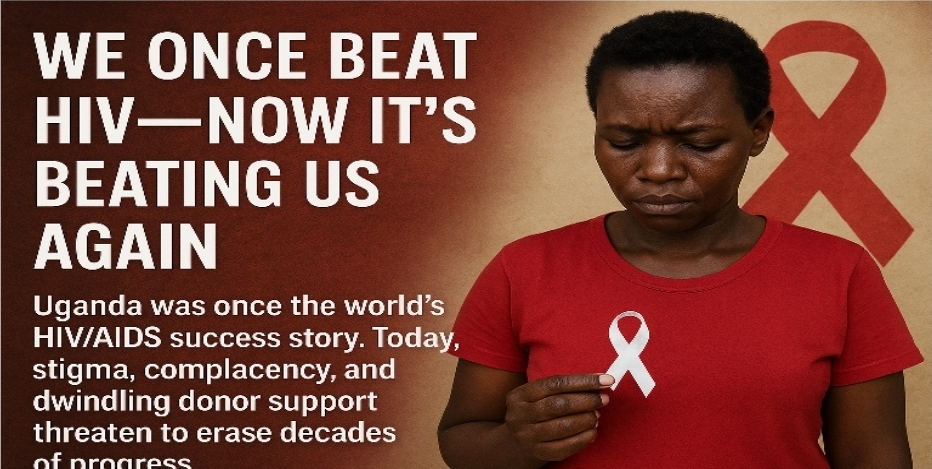
Uganda was once the world’s HIV/AIDS success story. We can be again. But the battle is no longer just biomedical; it is political, social, and cultural. And unless we summon the courage to face our demons, stigma, complacency, corruption, and dependency, we risk erasing decades of progress.
HIV/AIDS is not a distant threat. It is still here, in our homes, our families, our workplaces. The question is not whether we know its address. The question is whether we have the courage to finally lock the door.
Discover more from tndNews, Uganda
Subscribe to get the latest posts sent to your email.