

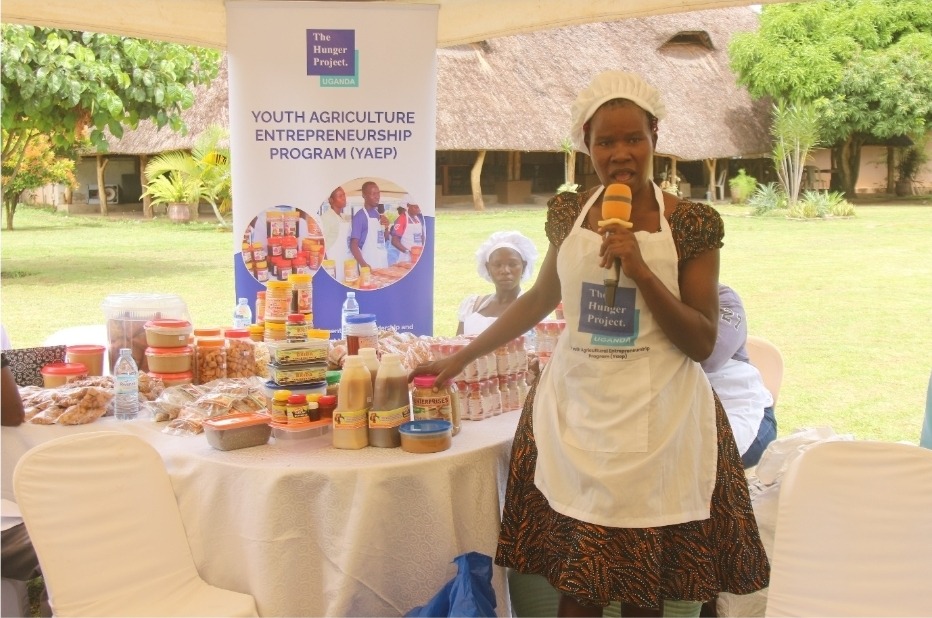
A group of young people in Northern Uganda are turning to agribusiness and value addition as one of the ways of fighting unemployment, and improving their livelihoods.
Isaac Abola, chairperson of Kole Youth Farmers Group in Amuru district, said the group, which comprises 10 members, started a produce business after receiving training from The Hunger Project Uganda.
“We started our produce business by collecting 100 kilograms of maize from each member. Members were willing to contribute and work together, and our produce has continued to grow,” Abola said.
He explained that the members pooled their maize contributions and managed to collect one tonne, which provided the initial capital for their business.
“After each member contributed 10 kilograms of maize, we managed to collect one tonne, which helped us start the business. We have continued recycling the proceeds by buying and selling produce,” he added.
Also read: From cotton to cassava, a Kitgum farmer’s journey to agribusiness success
Abola revealed that all group members have acquired financial accountability skills, which have helped them monitor the performance of their enterprise.
He said the group conducts weekly accountability meetings to review business transactions and assess its financial progress.
Isabella Alanya, a member of Yelle Ki Tic Youth Group in Amuru district, said the group initially ventured into cake-making by hiring an oven from an individual.
However, the increasing cost of hiring the oven affected their operations, forcing them to change their business approach and venture into snack production.
“To keep our enterprise running and avoid getting stuck, we decided to stop baking cakes and hiring the oven. Instead, we started making snacks such as bagiya, groundnut snacks and soya products. The business is now progressing well, and the enterprise is still running,” Alanya said.
Ouma Daniel Mattieos, a poultry farmer and animal feed formulator from Amuru district, said the training he received from The Hunger Project opened opportunities for him to acquire additional skills from other organisations.
Although the enterprise initially started as a group initiative, Mattieos said he is currently managing the business independently.
“I am proud to be a young entrepreneur. We started as a group, but I am now running the enterprise independently. I am also exploring the possibility of venturing into rabbit farming because there is growing demand for rabbit products in the market. This interest has developed as a result of the different trainings I have received,” he said.
Mattieos added that conducting cost analysis has become an important part of managing his business.
“I always conduct cost analysis for my business because our trainers emphasised the importance of understanding business costs, calculating profits and paying ourselves. This has helped me improve my business management and marketing skills,” he added.
Another young entrepreneur, Innocent Amono Ocola, said she initially operated as part of a group known as Rwot Pe Ming, which started a business dealing in agricultural produce such as simsim, millet and other products after receiving training.
However, the group business did not perform as expected, prompting her to venture into value addition.
“I decided to add value to our agricultural products by processing groundnuts and millet into flour and making simsim products. I also decided to leave the group because most members had different decisions and visions, and they were unable to put their ideas into action,” Ocola said.
She said that disagreements, different business ambitions and a lack of commitment among some members affected the group’s progress.
As a result, some members left while others continued with the enterprise.
Ocola appreciated the Nwoya District Commercial Officer for helping her acquire branding skills, which have enabled her to promote her products beyond the district.
“Branding my business by including my name, contact number and location has helped me a lot. For example, during a visit to Ocer Champion Secondary School in Gulu City, I was contacted to prepare simsim paste. Churchill Court Hotel in Gulu also contacted me for a similar order,” she said.
Tadeo Ajuna, the Programme Coordinator for Young Cooperation for Agricultural Development, said young people are increasingly changing their attitudes towards agriculture, recognising it as a business opportunity rather than seeing it as dirty work.
“Many young people have not ventured into agriculture because they think it is dirty work. However, when you look at the young people who are already engaged in the sector, you find that they are involved in agriculture, value addition, branding and other business activities. This shows that interest is growing and the mindset of young people is changing,” Ajuna said.
“Fellow young people have been using social media for dancing and entertainment, but now we need to use these platforms to advertise our products and engage in productive activities.
“We have also realised that many young people need empowerment in communication and financial literacy skills. This can be achieved by connecting them to financial institutions and other stakeholders,” he added.
Denis Bukomas, the Project Officer for the Youth Agricultural Entrepreneurship Programme in Gulu, who is responsible for supporting young entrepreneurs in Amuru and Nwoya districts, said The Hunger Project Uganda is working with different stakeholders to strengthen youth-led enterprises.
“We want the youth to get the learnings from the different stakeholders on how the different stakeholders in agribusiness, the different successful agribusiness personnel have done their business, so that they also learn and improve on their agribusiness undertakings” he said.
“We have had linkages with service providers and business development services stakeholders. For example, we have engaged UNBS, URSB, so that these youths get registered. We have engaged the district local governments, for example, of Nwoya and Amuru, to ensure that the youth groups that they are working with get formalized,” he added.
He said the advice the youth to register their business so that they can benefit from the different services, either from the district or from the other different service providers.
“We are supporting these youths to ensure that we link up them to the service providers who can provide the trainings and technology bit of it, so that they can improve their innovations.
“For example, here now in the boot camp, we have had different stakeholders. Like, House of Ojok, from YPAD International, those people have gone through a series of trainings, a series of experience which our youths are also drawing from them to actually improve their innovative capacity as young agri-entreprenuer” he cited
The biggest challenge that youth face, Bukomasi says, is that most of them are impatient in running their businesses, adding that they are used to quick returns after investing.
“Most of them don’t even think about losses that they can make within their own businesses which can support the development…” he said adding “that has always been a challenge to them”.
Since 2024, THP-U, under its two-year Youth Agriculture Entrepreneurship Programme (YAEP), has trained atleast1,700 youths in agribusiness such as business management knowledge, value addition, branding and marketing as a way of generating income and creating employment opportunities.
The beneficiaries of the project were drawn from seven districts including: Butambala, Iganga, Bugweri, Kabale, Wakiso, Nwoya and Amuru.
Speaking at a recent youth agribusiness bootcamp in Gulu, Evelyn Namubiru Tondo, the Head of Programme at The Hunger Project Uganda, said the programme initially targeted 1,500 young people in each participating district, adding that their focus was increasing female participation.

Due to high demand, however, the enrolment increased to 1,700 young people, Tondo said, adding that limited participation among young women still remains as one of the major challenges facing the programme.
“Looking at that age bracket of 18 to 30 or 35, these are youth who are already in childbearing [age]. They have children at home, they are married or could be, I would say, cohabiting” she explained.
She added that limited access to financial support remains a major obstacle, despite efforts to connect young entrepreneurs to financial institutions and other development partners.

Discover more from tndNews, Uganda
Subscribe to get the latest posts sent to your email.


