Before the rehabilitation, much of the metre-gauge railway between Tororo and Gulu had deteriorated, with rusting bridges, silted culverts and sections of track washed out by floods. Today, a very different picture is emerging along the corridor.
Under a contract signed with Uganda Railways Corporation (URC) on 13 April 2023, China Road and Bridge Corporation (CRBC) is rehabilitating the 375.4-km line, which links 15 stations including Tororo, Mbale, Kumi, Soroti, Lira, Opit and Gulu.

The works span earthworks and drainage, new structures, the supply of modern track materials, and the laying of new track, all supervised by LEA Associates South Asia in association with Denmar Consulting.
Building a stronger foundation
The transformation starts beneath the rails. Along the line and at stations, crews have placed and compacted fill and improved subgrade layers to give the track a firm, stable base.
To keep water away from the formation, new box and pipe culverts have been built, side drains and earth drains excavated, and drains lined and protected with stone pitching.
Quality checked from factory to track
Every major component has been checked before it reaches the line. A joint inspection team travelled to China for pre-shipment inspection, carrying out laboratory tests, factory visits and verification of samples. On arrival, new rails, steel sleepers, track ballast, level crossings and turnouts were jointly verified before use.
Laying the new railway
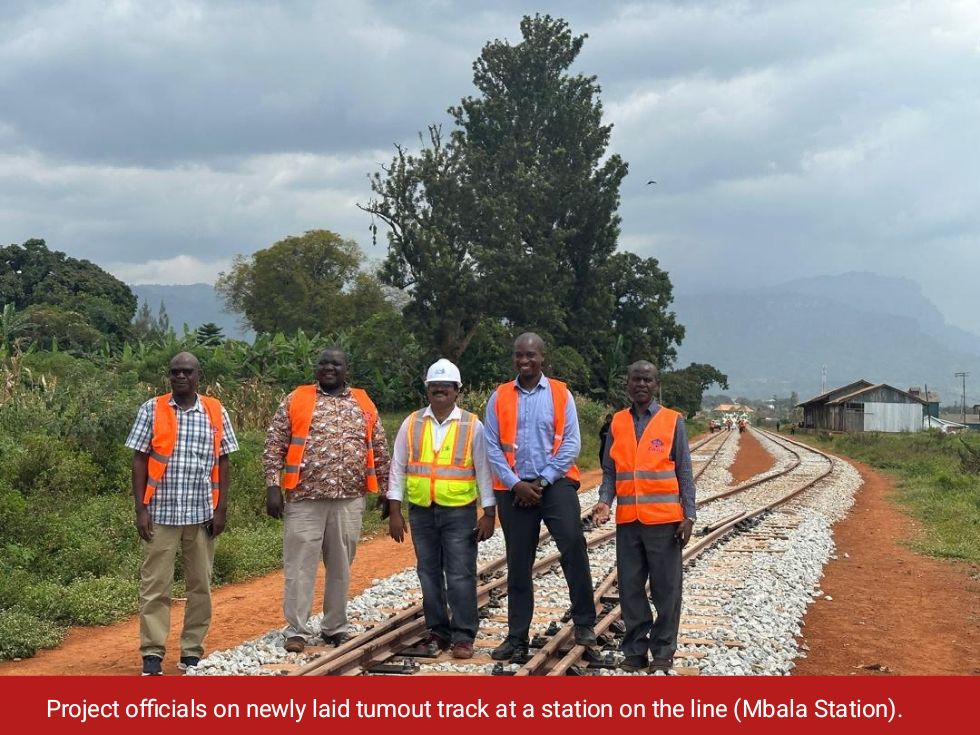
On the ground, the work is visible kilometre by kilometre. Old sleepers have been sorted and refurbished, worn turnouts replaced, and new track laid on a fresh bed of ballast.
Each section is ballasted to its final layer, tamped and dressed to achieve the design top-of-rail levels, then put through detailed final checks.

Road users have not been forgotten. Gravel and concrete level crossings have been built where roads meet the railway, and fabricated level crossing warning signs installed and inspected to keep motorists and pedestrians safe as trains return.
Kapiri Bridge restored
One of the most striking transformations is at Kapiri Bridge (Km 141+200), a steel girder bridge crossing open wetland. The deck panels were removed, the steelwork ground to remove rust, and the whole structure protected with anti-rust paint and two coats of metallic topcoat, giving the bridge a new lease of life.
Taming the floods
Flooding has long been the railway’s greatest enemy. At the flood-prone section between Km 16 and Km 17 (Magodes ), and at Km 48+300, blocked culverts have been reopened, their entrances and exits cleared, and the upstream and downstream channels widened so that water can pass freely beneath the line.
The most complex task has been at Awoja (Km 142+900 and Km 144+300), where the railway had been washed away.
Working inside cofferdams, crews dewatered and excavated the foundations, treated the ground and built large multi-cell box culverts in two halves, complete with wing walls, masonry flow slabs, waterproofing, backfill and stone-pitched slopes.
With the cofferdams removed and new track laid over the culverts, trains can once again cross a section that had been cut off.
A new face for Mbale Station
At Mbale Station (Km 55+600), the station area and its associated works have been rehabilitated, turning a neglected yard into a renewed rail hub for one of Eastern Uganda’s busiest towns.


People, safety and community
The project’s impact reaches beyond engineering. CRBC has run HIV/AIDS and STD prevention and counselling programs, recognized outstanding staff through an Excellence Employee Award, and maintained strict safety management on site.
Through community outreach, donations and charity, and planned corporate social responsibility activities discussed with the Alebtong district leadership, the company has worked to share the benefits with neighboring communities.
Protecting the new assets is a shared effort. UPDF-led security patrols and close collaboration with the Uganda Police Force help safeguard railway materials from theft and vandalism.
Public events at stations along the line bring residents together with URC, CRBC and the security agencies, keeping communities informed about the project and the importance of railway safety as trains return.

Progress under the spotlight
The scale of the transformation has drawn high-level attention. The Minister, the Permanent Secretary and members of the URC Board have all inspected the works, alongside the Supervising Consultant, environmental auditors from the Ministry of Works and Transport, and the consultant for the interfacing road project.
Looking ahead
Step by step, the Tororo–Gulu railway is being rebuilt into a safer, stronger and more reliable route.
With firmer formation, restored bridges, flood-resistant culverts and new track, the line is ready to carry goods and people between Eastern and Northern Uganda once more, supporting trade, cutting pressure on the roads and opening new opportunities for the communities along its path.
Discover more from tndNews, Uganda
Subscribe to get the latest posts sent to your email.