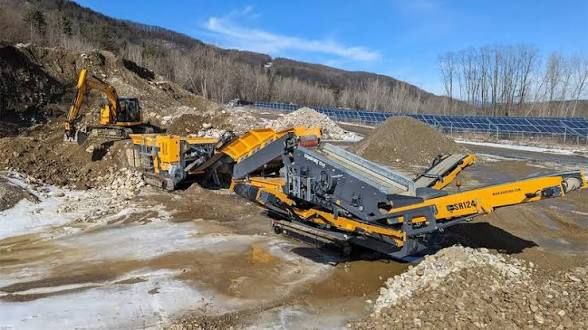
A stone-crushing plant advertised at 150 tonnes per hour may sound like an obvious choice for a road contractor. But what does that number actually describe?
It could refer to the rated capacity of one crusher, the amount of fresh rock entering a processing plant, or the quantity of finished aggregate available for construction. These are different measures, and confusing them can lead to unexpected costs and production problems.
For contractors and quarry operators in Uganda, equipment selection should begin with the project’s material requirements—not simply the largest throughput figure in a supplier’s brochure.
Uganda’s Ministry of Works and Transport published its General Specifications for Road and Bridge Works 2026, providing a useful reference for road construction materials where those specifications apply. Actual project contracts and approved technical requirements must still guide purchasing decisions.
Here are five questions worth asking before ordering a crushing plant.
What rock will the plant actually process?
The first step is to understand the material entering the equipment.
A supplier should be given information about rock type, maximum feed size, particle-size distribution, moisture, fines and clay content. Material hardness, abrasiveness and bulk density may also affect equipment selection.
Not every quarry produces uniform rock. Feed conditions can change between extraction areas and with weather conditions. A machine selected using incomplete material information may perform differently when the actual feed arrives.
Whenever possible, contractors should provide representative samples, photographs and available test results rather than relying only on a general description such as “hard stone”.
Uganda National Bureau of Standards lists US 1846:2017, Standard Practice for Sampling Aggregates, which addresses sampling for source investigation, production control and material acceptance. It is listed as a voluntary standard; its use depends on the project’s applicable requirements.
What finished aggregate does the contract require?
A crusher makes rock smaller, but the project needs aggregate that meets a defined specification.
Before comparing equipment quotations, contractors should identify the required particle-size ranges, expected quantity of each product and applicable quality and testing requirements.
For road and bridge works, the Ministry’s 2026 General Specifications provide relevant technical guidance where applicable. Other construction applications may use different standards or contract requirements.
The project engineer should identify the applicable specification, including any special conditions, rather than assume every crushing plant must produce the same aggregate grades.
This matters because a plant producing a single graded material may require a different screening arrangement from one supplying several aggregate sizes.
The finished products should determine the plant configuration—not the other way around.
What does the quoted tonnes-per-hour figure mean?
A capacity figure should always identify where and under which conditions it is measured.
Three quantities are particularly important:
- Fresh feed: Rock entering the processing circuit for the first time.
- Circulating load: Oversized material returned for additional processing in a closed circuit.
- Finished product: Material leaving the circuit in specified product-size fractions.
For example, a crusher rated at 150 tonnes per hour does not automatically guarantee 150 tonnes per hour of finished aggregate meeting a particular contract specification.
In a closed circuit, oversized material may pass through a crusher or screen more than once. This increases the handling duty of the affected machines, but the returned material is not new production.
Importantly, circulating material is not automatically lost material. Over an appropriate accounting period, a plant’s material balance must distinguish finished products, rejects, dust and other losses, changes in stock and any differences in moisture basis.
Buyers should therefore ask suppliers to distinguish machine throughput, fresh-feed rate and expected finished-product output.
A further distinction is needed between production during stable operation and average output over a working shift, including planned and unplanned stoppages.
Can the screens and conveyors handle the complete material flow?
Installing a larger crusher will not necessarily increase aggregate production.
After crushing, screening equipment separates material into the required size fractions. Its performance depends on factors such as feed distribution, moisture, near-size particles, screen openings and available screening area.
Wet or sticky fines can reduce effective screening performance. Conveyors, chutes and transfer points can also restrict the flow of material.
If the screening system is already operating near its practical limit, replacing only the crusher may transfer the bottleneck rather than remove it.
Equipment manufacturers Metso and McLanahan have both published technical guidance explaining why material characteristics and screening duty must be considered alongside crushing capacity.
Contractors should request a preliminary process flow diagram showing the main stages of the plant and identifying where oversized material returns for further processing, where relevant.
That diagram should be treated as an initial planning document, not a final engineering design.
What is included in the price, and how will performance be accepted?
Two suppliers may quote similar crushing capacities while offering different equipment and services.
One proposal might include a feeder, crusher, screen, conveyors and electrical controls. Another might cover the crusher alone, leaving essential equipment or installation work for the contractor to arrange separately.
Before signing a contract, buyers should clarify the scope of supply and responsibilities for electrical connections, foundations, erection, commissioning, spare and wear parts, training and maintenance support.
The project should also account for site access, safe maintenance space, dust management and applicable environmental requirements.
A sound purchase agreement needs a defined acceptance procedure. It should identify the material to be tested, the required product sizes, the measurement method, operating conditions and the parties responsible for checking the results.

The best crushing-plant quotation is not necessarily the one showing the highest capacity or the lowest initial price.
A more reliable comparison begins with representative material information, clearly defined aggregate products, realistic operating assumptions and a complete understanding of the supply scope.
For Ugandan contractors, these questions can help reduce procurement misunderstandings and provide a stronger basis for evaluating equipment proposals.
Before asking, “How many tonnes per hour can your crusher process?”, buyers should also ask:
“How much aggregate meeting our project specification can the complete plant deliver, under what conditions, and what exactly is included?”
About the author
Ma Junxin represents Zhengzhou Zhongji Machinery, a China-based manufacturer of crushing, screening and mineral-processing equipment.
Discover more from tndNews, Uganda
Subscribe to get the latest posts sent to your email.