Kitgum | When Acayo Monica walked into Kitgum Technical Institute to study plumbing, she carried more than a notebook. She carried years of uncertainty about what her future would look like.
Like many young people from Lamwo and Kitgum districts, formal employment seemed distant. Opportunities were scarce, and without practical skills, earning a stable income appeared almost impossible.
Today, Monica walks away from the institute not only with a certificate, but also with a plumbing toolkit, confidence, and a clear vision of building a career in a profession traditionally dominated by men.
“I chose plumbing because I wanted to prove that women can succeed in technical work just as men do,” Monica says with a smile. “Now I can install water systems, repair pipes and earn my own income. I no longer have to depend on anyone for survival.”
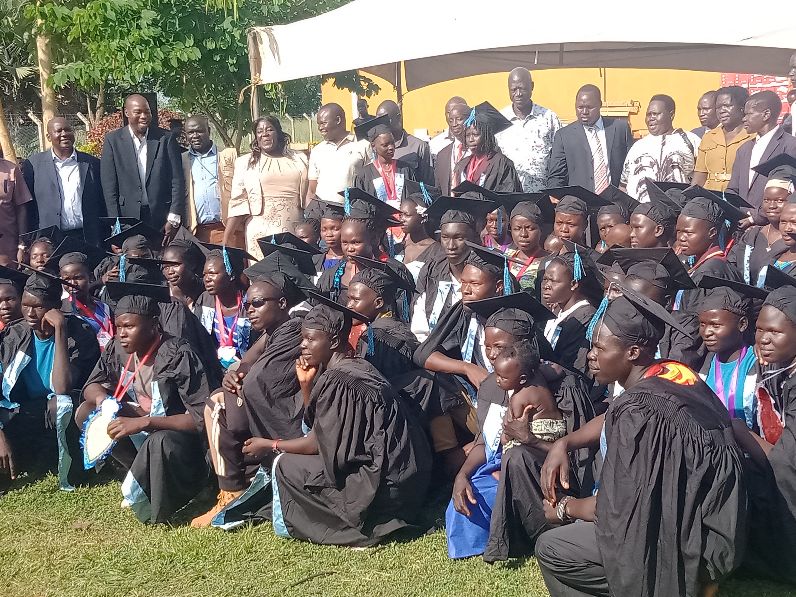
Monica is among 140 young people from the Acholi sub-region’s districts of Lamwo and Kitgum who recently completed vocational training at Kitgum Technical Institute under the Spotlight Initiative.
The training programme is supported by the Ministry of Gender, Labour and Social Development together with the European Union, the Government of the Netherlands and the United Nations Development Programme (UNDP).
For many of the graduates, the certificates represent far more than academic achievement. They symbolise recovery from poverty, school dropout, gender-based violence, teenage pregnancy and unemployment.

A dream repaired with every engine
Across the graduation grounds, Okot Milton, who specialised in motor vehicle mechanics, carefully inspects the toolbox he has just received.
Growing up in rural Lamwo, he watched broken motorcycles remain idle because their owners could not afford repairs or had to travel long distances to find trained mechanics.
“I have always loved machines,” Milton explains. “Whenever a motorcycle broke down in my village, I wanted to know how it worked. Now I have the skills to repair vehicles professionally.”
He believes the toolkit will help him establish a small garage and gradually expand into a fully equipped mechanical workshop.
“My goal is not only to earn money but also to employ other young people. Skills can create jobs for many people, not just the person who trained.”
Beauty with a purpose
For Akwero Jane, hairdressing is about much more than beauty. After completing her training, she says she now sees the profession as a pathway to financial independence and dignity.
“I used to think hairdressing was just about making people look good,” she says. “Now I understand it is a business. If I manage it well, I can support myself and even pay school fees for my younger siblings.”
Jane hopes to open a salon in Agoro, where quality beauty services remain limited. “I don’t want to leave the village to look for jobs. I want to create opportunities where I come from.”
More than certificates
According to Kitgum Technical Institute Principal Aldo Kidega, vocational education succeeds when graduates can immediately translate learning into livelihoods.
He says every graduate received a startup toolkit matched to their trade, enabling them to begin working without the heavy financial burden of purchasing equipment.
“Skills alone are important, but when graduates also receive the tools they need, they can begin earning immediately,” Kidega says.
Depending on the course, graduates received sewing machines, welding equipment, electrical testing kits, mechanics’ toolboxes, plumbing equipment, catering materials, Tallering machines and hairdressing kits.
“The purpose is to ensure they leave not only qualified but also prepared to start work.” Kidega says the institute combines classroom instruction with industrial attachment so trainees gain practical workplace experience before graduation.
“Our responsibility is to produce graduates who are competent, disciplined and ready for the labour market.”
Giving vulnerable youth a second chance
For the Ministry of Gender, Labour and Social Development, the programme is about restoring hope to young people whose education was interrupted by circumstances beyond their control.
Akumu Christine Okot, Principal Gender Officer at the Ministry, says many beneficiaries were selected because they faced serious social and economic challenges.
“Many of these young people are survivors of gender-based violence, teenage mothers or school dropouts,” she explains. “Some had almost given up on education and employment altogether.”
She says the Ministry recognised that awareness campaigns against gender-based violence alone were insufficient. “We realised that economic empowerment is equally important. A young person with employable skills has greater independence, confidence and protection from exploitation.”
Okot says the testimonies from graduates already earning an income demonstrate that vocational education can transform lives. “We are seeing young people repairing motorcycles, running salons, installing electrical systems and starting small businesses. That is exactly the kind of impact we hoped for.”
She adds that another cohort of trainees has already been enrolled to ensure more vulnerable youth benefit before the current programme concludes.
Leadership sees hope in practical skills
Lamwo district chairperson Oyet Sisto Ocen believes technical education is becoming one of the district’s strongest tools for fighting youth unemployment.
“For many years, our young people have waited for office jobs that simply do not exist,” he says. “The future belongs to those who can create opportunities with their own hands. These graduates now possess practical skills that can improve not only their own lives but also the welfare of their families.”
He encourages graduates to use their startup toolkits wisely instead of selling them for quick cash. “Protect these tools because they are your capital. Let them become the foundation of successful businesses that will employ others in your communities.”
Lamwo Resident District Commissioner William Komakech says vocational education is also contributing to peace and security.
“When young people have skills and legitimate sources of income, they become less vulnerable to crime, violence and other risky activities,” Komakech says.
“Government programs like this are investments in both economic development and community stability. We encourage every graduate to become an ambassador of hard work, integrity and self-reliance.”
He urges local leaders and parents to continue encouraging young people to pursue technical education rather than viewing it as a second option to university.
Skills that build communities
Kitgum district chairperson Tolit Tony Blair says vocational training is helping redefine how communities view education. “For too long, many people believed success could only come through academic degrees,” he says.
“Today, we are seeing plumbers, mechanics, electricians, welders and hairdressers building successful businesses that support families and strengthen local economies.”
He says Northern Uganda requires thousands of skilled artisans to support infrastructure development, housing, agriculture and expanding businesses. “Every trained artisan fills an important gap in our economy.”
Beyond employment
Across Northern Uganda, youth unemployment remains one of the region’s biggest development challenges. Many school leavers struggle to continue with formal education due to financial hardship, while others leave school because of conflict, displacement, early pregnancy or family responsibilities.
Vocational training offers an alternative path, one that focuses on practical skills directly linked to employment and entrepreneurship. For Monica, Milton and Jane, graduation is not the end of a course but the beginning of a new chapter.
They return home carrying certificates, toolkits and ambitions that extend beyond personal success. Monica dreams of becoming one of the district’s leading plumbing contractors.
Milton hopes to establish a modern garage that trains apprentices. Jane wants to open a salon that becomes both a business and a place where other young women can learn vocational skills.
Their stories illustrate that when young people are given practical skills, appropriate tools and encouragement, they become builders not only of businesses, but of stronger families and more resilient communities.
In a region where many young people continue searching for opportunities, vocational education is proving that sometimes the most powerful transformation begins not in an office, but in a workshop, a salon, a garage or a construction site one skill at a time.
Discover more from tndNews, Uganda
Subscribe to get the latest posts sent to your email.