A section of private business owners in the Bunyoro sub-region has raised concerns over the denial of access to government programs, including the Small Business Fund (SBF) and Agricultural Financing (ACF).
The above funds are intended to provide financial support to small-scale businesses and the agricultural sector.
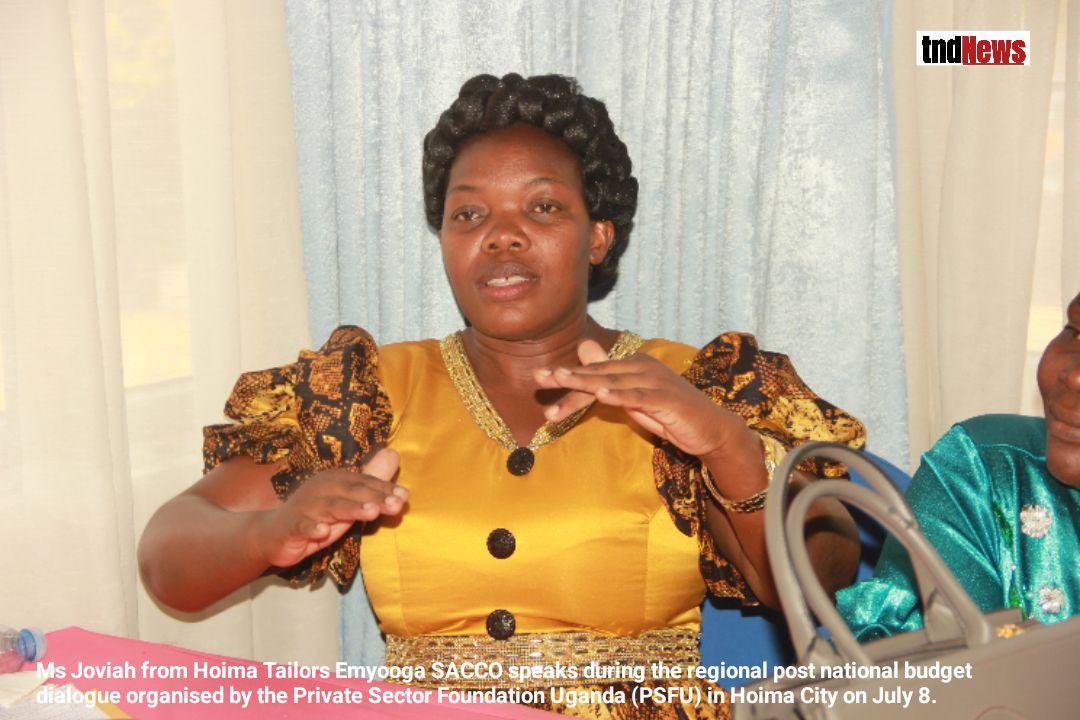
The business owners raised their concerns during the regional post-national budget dialogue organised by the Private Sector Foundation Uganda (PSFU) in Hoima City on July 8, aimed at identifying the existing opportunities for small businesses.
During the dialogue, ACF, SBF, GROW project funds and Emyooga were some of the key financial opportunities identified “as aimed at helping small businesses thrive.”
However, the business communities said that despite the existence of the opportunities, it has always been a challenge for them to access the funds, making it difficult to believe in government programs.
Joviah, the executive director of Hoima Tailors Emyooga SACCO, also a leader of USSIA in Bunyoro, highlighted the bureaucracy involved in applying for different government funds, including Emyooga and GROW funds, as a bigger challenge facing them, especially through commercial banks.
According to her, they have always been denied access to different funds, especially GROW project funds, because they do not meet the requirements.
“It’s now about three years since we applied for GROW project funds, but we haven’t received any money. We submitted every requirement to UDB but still nothing has been done,” she revealed.
Another participant said despite the government’s efforts to elevate low-income earners, most of the funds remain beneficial to some government officials.
Ashif Ahmed, one of the business owners, called for grassroots community sensitisation on different government programs before implementation.
According to him, despite inaccessibility to the funds, it is also crucial to train communities on financial management skills in order for them to know how to manage finance and tax obligations.
Collins Agaba from Private Sector Foundation Uganda said that the engagement was aimed at identifying existing opportunities within the recently passed 2026/2027 financial year budget.
Agaba, in his communication, said they have always ensured advocating for the progress of small-scale enterprises by engaging government-allocated support funds, efforts which have still failed to effectively benefit the targeted individuals.
However, he said that PSFU remains committed to continue engaging different government entities, including URSB, UNBS and financial institutions, to ensure that business communities have easy access to government funds.
Yahaya Kobwemi, the ED of Kitara Community Seed Bank for Social Transformation (KISE), remained concerned over the extreme rise in the cost of business operations, citing an increase in taxation, which he said paralyses most businesses.
Kobwemi called upon PSFU to have customised and designed interventions which can help in giving long-lasting solutions to the private businesses, with major targets to give relief in taxation rates.
While addressing the same engagement, Edward Bigirwa, the head of administered funds at Bank of Uganda (BoU), said that currently, the government has special funds like the Agricultural Credit Facility (ACF) under the Agricultural Financing and Small Business Fund (SBF).
ACF, he said, aims at boosting the capacities of both agriculture and small businesses owned by either individuals or groups.
Bigirwa noticed that the funds channelled by BoU through different financial institutions, including commercial banks like Centenary, SACCOs, among others, remain unbeneficial to the communities.
Meanwhile, he attributed the challenge to business owners’ failure to register their businesses, keep financial records, and use banks in making transactions, which, according to him, are requirements for accessing loans.
Another official from BoU – Prossy, said, BoU provides loan capacity of up to shs500 million at an annual interest rate of 10 percent for eight years to large scale businesses and a three year period for light small scale businesses.
“For large-scale businesses like beverage companies, we give you an eight-year grace period to make refunds, whereas only one to three years are given to light small-scale businesses,” she said.
“However, as you’re applying for loans, stop engaging in multiple loan sources. This will make you fail to access some of these funds,” she warned.
“We realised that some of you have loans from multiple sources, and that’s the reason why BoU denies you loans,” she added.
She urged the PSFU to prioritise community training on financial literacy with more emphasis on record-keeping.
Discover more from tndNews, Uganda
Subscribe to get the latest posts sent to your email.