Gulu City | Before dawn breaks over Gulu City, when most homes are still asleep, a small fire is already burning in Goan Quarters, Kasubi ward, Bardege-Layibi Division.
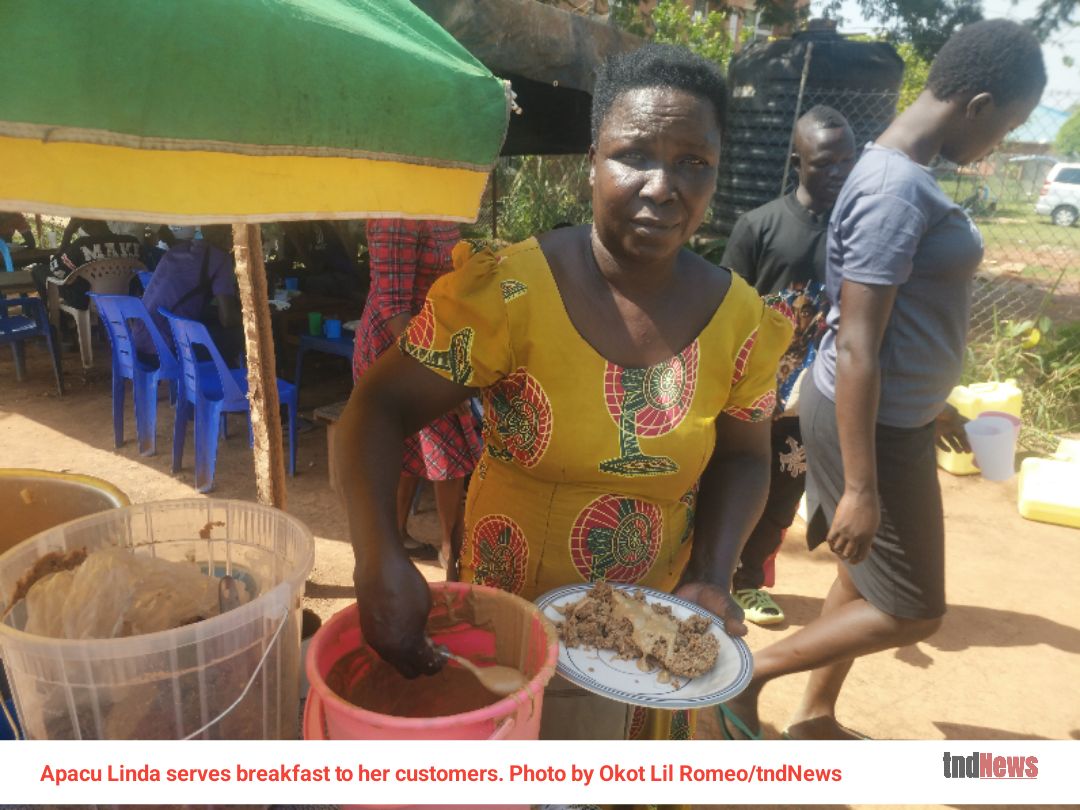
At Goan Quarters, a large saucepan of porridge sits, marking the foundation of a business that has transformed one widow’s life and inspired hundreds of women across northern Uganda.
For Linda Apaco, 43, porridge and tea vending is more than a daily routine; it is survival, healing and empowerment rolled into one; a widow, survivor of war-related trauma and mother of five orphaned children.
Apaco has spent over a decade turning a modest street-side business into a source of income, employment and hope.
Linda’s life story mirrors that of many women in post-conflict northern Uganda and as a survivor of the 1996 Atiak massacre, an experience that left deep psychological scars in her life.
Seeking safety and stability, she married early and moved away from her home area but tragedy struck in 2011 when her husband died, leaving her alone with five children.
“Life became worse after my husband died; he was our only support, I had no option but to run to my uncle in Palabek, Lamwo district to look for survival,” Linda recalls.
She worked briefly in a restaurant but the job ended abruptly. In search of social acceptance and support, she remarried but the relationship collapsed. With no job, no capital and children to feed, Linda borrowed cooking utensils and wheat flour from neighbours and began selling porridge along the streets of Palabek.
Starting again in Gulu
After another failed relationship and job loss, Linda returned to Gulu City, initially staying with her parents in Kirombe Ward. However, supporting a large family in her parents’ home proved unsustainable; hence, she rented a small house and resolved to start anew, even without capital.
During the COVID-19 pandemic, Linda launched her porridge business with just 10 litres a day, but gradually, customers grew, and today she sells up to 120 litres of porridge daily alongside breakfast tea and chapati.
“I sell tea in the morning and porridge in the evening. What started small has now become my golden life,” she explains.
 From survival to stability
In just two years, Linda’s business has yielded tangible results, and she has bought five acres of farmland in Patiko-Paicho and one acre of land in Coo-Pee village near Gulu City, where she plans to build a permanent home.
Beyond supporting her own family, Linda has become a community employer offering jobs to about 150 young women, many of them teenage mothers and unemployed youths from across the Acholi sub-region.
“Some of the girls I employed later got married, others saved money and started their own businesses,” she says proudly.
Yet the journey is not without challenges; weekly operational costs remain high, about shs450,000 for food supplies and shs130,000 for charcoal, and despite earning good profits, she says support is still needed to expand and stabilise the business.
However, Linda credits much of her success to group savings since she has been a member of Dano Pa Dano Savings Group for six years, saving shs65,000 weekly.
“I appeal to all widows and single mothers not to lose hope and stop beginnings; join savings groups and that is how you get capital,” she urges.
Linda’s next goal is to use her third savings disbursement to construct a permanent house and escape the burden of monthly rent.
NGOs promoting a culture of investment
Civil society organisations are increasingly recognising the power of grassroots entrepreneurships. Judith Agnes Okot, CEO of SIWA Uganda, says her organisation is shifting away from handouts to promoting savings-led investment.
“Free things have killed the culture of saving; we now focus on financial literacy, mindset change and long-term investment,” Judith explains.
Since 2022, SIWA Uganda has registered over 1800 members across Omoro, Nwoya, and Gulu districts and plans to reach 2000 more over the next 5 years.
However, she warns that daily quick loans are trapping many urban poor in stress and debt, advocating instead for pooled community savings.
Gulu City’s Principal Commercial Officer, Kidega George Nicholas, says the government is channelling funds through programs like PDM, Emyooga and NUSAF to support small businesses at the household level.
“The challenge is misinformation and fear; people must embrace formal banking, savings through SACCOs and avoid superstitions and fake prophecies,” he says.
So far, over 890 market vendors in Gulu have received training in financial literacy and business registration.
At the national level, Dr Kenneth Omona, State Minister in charge of Northern Uganda, confirms that NUSAF IV funding has been approved and will focus on household income, intensive agriculture, and micro-enterprises rather than infrastructure.
“We want money to reach people directly; if we are to move from poverty to a money economy, we must invest in household production,” Omona says.
Standing beside her cooking pots one afternoon, watching her children play nearby, Linda reflects on her journey.
“I have come very far,” she says softly.
Discover more from tndNews, Uganda
Subscribe to get the latest posts sent to your email.