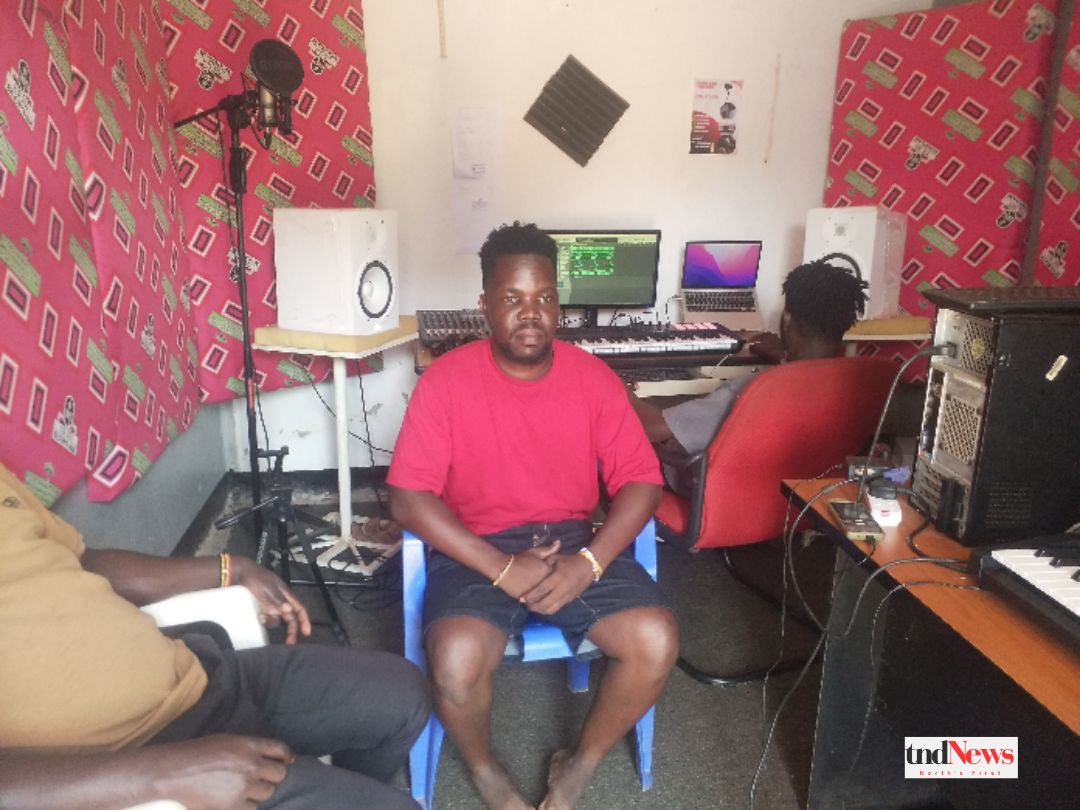
Breaking the silence and promoting unity while using music as a tool for justice has started with Gulu Disabled Persons’ Union (GDPU) taking the lead with a studio to advance music production.
The project aims to address the challenges disabled children and women in rural areas face, including compounded barriers to education, health, and labor opportunities in the community.
“Joining music industry trends for the disabled community in Gulu is a good way to advocate and break the biggest silences of injustice toward persons living with disabilities. Identifying talented musicians to showcase their talent will break the negative attitudes toward persons living with disabilities,” said a union representative.
The 20-year-old Onen Joel known by his stage name King Joel, a resident of Corner-Ranch village, Angagura sub-county in Padre district, has been in the music industry for more than three years.
He is a well-known local artist in his village with more than six different songs to date.
Onen joined the music industry to reduce barriers for disabled persons in the Acholi sub-region. However, challenges continue to emerge as he still lacks a music promoter to make his songs reach the market.
“I am still stuck with my songs up to date. No shows to earn money from my songs. This calls for efforts from our leaders to lobby for us and identify promoters. Joining the Union will break financial barriers which in the past made me struggle to raise money for recording, even begging relatives for support,” he said.
“I pray to God to bless my future with good songs that will educate the public and change their mindset about disabled persons. Many local artists today have turned their songs in the wrong direction. They are not producing songs that educate the public; instead, they praise drugs and use bad language, which encourages children to abuse drugs,” Onen narrated.
“I got motivated and inspired in music by the legendary artist Foxy Boy Commando, who sang educative songs without bad language,” he added.
Onen further noted that the majority of disabled people live under harsh conditions. “I do not have a smartphone to digitalize my talent on social media and showcase my music to the world. We are trying to improve ourselves, but we are calling upon any well-wisher to support us by buying smartphones.
“Vulnerable, talented disabled musicians will use this studio to educate and showcase to the world that disability is not inability; we can do what others do,” he revealed.
He plans to continue his education by earning from his music to improve his English so that he can sing in English, not just Lango.
“I stopped in Primary Six (P6) because of mental distress, and I do not know how to speak English, which limits my career in music as the world becomes more digital,” he explained.
Another 19-year-old female disabled musician from Loyo-Boo village, Unyama sub-county in Gulu district, Lady Brenda, joined the industry to heal from the pain and struggles caused by her disabilities.
“I feel relief and happiness when singing. The pain forced me to stop school for many years. I believed I was wasting my time in school because of my disabilities and pain. Joining music makes me feel better,” Brenda highlighted before an interview.
“I got motivated and inspired in music by legendary artists Odong Romeo and Jenneth Prisca. Their educational songs help relieve pain without using bad language. In five years, I want to be like them in Northern music,” she disclosed.
Brenda further expressed disappointment with the current music industry in Northern Uganda, noting that it promotes songs with bad messages while ignoring educational content. “We need to change our mindset in music,” she emphasized.
A 17-year-old female artist, Lucky Promise joined the Union after completing Primary Seven because her parents could no longer afford her school fees. She is learning how to sing and write songs to earn money and improve life in her village, Lebi, Angagura sub-county in Padre district.
“Legendary national artists Eddy Kenzo, Pallaso, and Mixzola inspire me to join the music industry. I plan to return to school and finish my studies to advance my skills and knowledge in music,” Lucky revealed.

Meanwhile, Bedmot Andrew, known as R Andrew, the music instructor and coordinator of the new VIVA-LA-VISA Studio installed at the Union, said they have reached out to about 15 different disabled artists who have recorded over 56 songs.
“This has created a positive impact in the community as we support talented PWDs in music. We are not only focusing on disabled people; outside artists are welcome to support the functioning of the studio financially by paying affordable fees between 150,000–200,000 shillings,” he said.
Bedmot further urged support for talented disabled people, noting that many had missed opportunities to record songs that could bring peace, educate the public, and develop the Northern music industry.
“We hope to train four more students in production, recording, and songwriting. Afterwards, we will conduct community outreaches to identify more talented vulnerable people to record their songs,” he added.
The music studio is funded by Brand Music, based in the UK. It will be supporting music development under a two-year project to showcase talent among disabled persons.
Patrick Ojok, Gulu Disabled Persons’ Union center coordinator, noted the community imposes many barriers on disabled people, including inaccessible structures, rough compounds, lack of assistive devices, and negative attitudes.
“Installing this studio is part of fighting for justice. It is the most organized studio in Northern Uganda, where many top artists, like Romeo Odong, record their songs. The main objective is to identify and bring talented disabled persons closer to music and change public attitudes,” Ojok noted.
Ojok further appealed to young talented disabled individuals to use this opportunity responsibly. “Showcase your talent without using bad language. Use your skills to challenge the world positively,” he urged.
However, the real data on disabilities in Gulu District and Gulu City is not accurate. Current estimates put the total population of disabled people at about 10,000–12,000.
Discover more from tndNews, Uganda
Subscribe to get the latest posts sent to your email.