

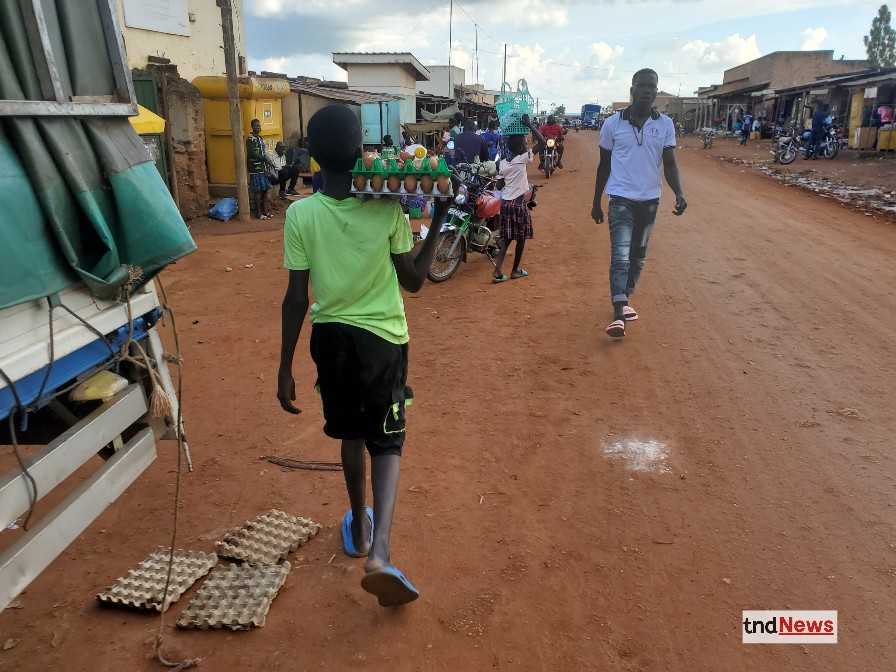
Amuru | On the dusty road of Pabbo town council in Amuru district, 11-year-old Okello Sam [not real name] stands in the hot sun, holding a tray of eggs perched precariously on his shoulder.
As he weaves through a busy street and a crowd of adults, his handcrafted sandal leaves prints in the dirt.
While other children his age attend school, Sam’s classroom is the marketplace, and his daily lesson is “survival.”
Many children in northern Uganda, like Okello, have had their futures exchanged for the brutal realities of child labour. In his world, the sound of chalk on a blackboard is replaced by customer calls, and the prospect of education fades with each egg he sells.
The region has long struggled with the aftershocks of poverty, war, and displacement, and while the guns have fallen silent and the Lord’s Resistance Army conflict is no longer an immediate threat, the scars left on communities remain raw.
Many families in the region are now facing the question of survival, and for children like Okello, this often entails taking on responsibilities far beyond their age.
Despite laws against child labour, economic hardship forces families to rely on their children as breadwinners.
Okello’s father died when he was four, and his mother, a farmer, struggled to support their family of six. Sam’s earnings from selling eggs are significant, as they help him buy food and meet his basic needs.
“Every egg that rolls off my tray represents a fraction of the money needed to keep my family afloat. I do not care about education now,” Okello told tndNews.
Okello is enrolled in a government primary school, but he rarely attends. The school fees, while small, are still out of reach for his family.
While public primary education is officially free under the Universal Primary Education, the hidden costs such as uniforms, books, and meals often exclude the poorest children.
As a result, instead of learning to read and write, Okello spends his days selling eggs to passersby, hoping to earn a few thousand Uganda shillings by sunset.
Lost childhood
The consequences of child labour in Uganda are profound. Education is widely regarded as the path out of poverty, but for children like Okello, it is obstructed by pressing needs.
“Without an education, these children are locked into the cycle of poverty and we lose an entire generation to labour instead of learning and the future of our country suffers as a result,” Geoffrey Ojok, head teacher of Holy Rosary Primary School in Gulu City.
Okello feels the impact not only financially, but also emotionally and physically. He begins his day before dawn by going to a nearby egg store to buy and prepare his eggs.
By 8 a.m., he is walking through the dusty streets, trying to attract customers; the work is exhausting, especially under the scorching sun.
“On good days, he can sell all the eggs and bring home enough money to help us buy food but on bad days, a spill or a fall might mean lost profits or even a scolding from home,” Alum Ventorina, his mother reveals.
According to the latest Child Labour Global Estimates, 160 million children: 63 million girls and 97 million boys were in child labor globally at the beginning of 2020, accounting for almost 1 in 10 children worldwide.
“53 million of these children are not in school, amounting to 28 percent aged 5 to 11, and 35 percent aged 12 to 14,” the estimates revealed.
This is especially concerning given that the majority of those in child labour who are excluded from school are young children, within the age range for compulsory education. As a result, all of these children’s future employment and life opportunities will be severely limited.
Even for those children in child labour who get to attend school, most struggle to balance the demands of education and their work. They generally do not attend school full time and lag behind their peers in grade progression and learning achievement, and are more likely to drop out prematurely.
Hazardous child labour creates an even greater barrier to school attendance.
According to the report, there is no single reason why children end up in child labour and are unable to fully attend school. In many cases, the work requires so much time and energy that it is impossible for children to enter, persist, and succeed in school.
Furthermore, it stated that family perceptions of the importance of children’s education can influence decisions, and that girls bear the double burden of doing unpaid work-household chores and family care-which prevents many from attending school full time.
While the world has focused on northern Uganda’s recovery from conflict, the issue of child labour remains a silent crisis. According to a UNICEF report from 2023, over 2 million Ugandan children work in some capacity, with many of them living in semi-urban areas like Okello’s.
The agricultural sector, where children work in fields, tend animals, or sell goods such as eggs, is especially rife with child labour as families struggle to make ends meet.
The links between child labour and education are obvious: children who lack access to education have little choice but to enter the labour market, where they are frequently forced to work in hazardous and exploitative conditions.
As a result, increasing access to free and compulsory education, as well as providing quality education, is critical to reducing this problem. However, access to education is a necessary but insufficient component because the challenge is to keep children in school and equip them with relevant skills.
Apollo Onzoma, Assistant Commissioner of Industrial Relations at the Ministry of Gender, Labour, and Social Development, revealed that there are more cases of child labour and forced labour in supply chains.
Onzoma, on the other hand, revealed that, despite the fact that Uganda has ratified international conventions and adopted national laws and policies on child labour, enforcement is still weak due to a lack of resources, corruption, and limited inspections.
“We have all the laws in place, but if the government can provide more resources to enhance the inspections at the different sectors. We have inspectors but we do not have the resources to facilitate them to go to the field,” Onzoma noted.
He also mentioned that Uganda has committed to Sustainable Development Goal 8.7, which focuses on eradicating child labour by 2025, and he believes that working together, they can achieve some of it.
“Labour sector is very critical for national development and the government is putting a lot of investment in relation to employment opportunities so as to ensure that employees are working in a decent environment. To achieve this commitment, we need a joint action,” Onzoma explained.
Uganda made significant progress in efforts to eliminate the worst forms of child labour in 2015, when they introduced a bill prohibiting hazardous work for children and establishing a 16-year-old minimum work age.
Onzoma went on to say that slavery, child trafficking, debt bondage, forced labour, children in armed conflict, and children working in illegal activities are some of the worst forms of child labour.
According to the Uganda Employment Act 2006, the minimum age for workers or employees working commercially is 16 years, and children over the age of 14 can be employed for light work under the supervision of an adult over the age of 18.
Jacqueline Banya Acayo, the National Programme Officer at the International Labour Organization project: Accelerating Action for the Elimination of Child Labor in Supply Chains in Africa-[ACCEL-Africa], explained that in 2015, the Ugandan government introduced a bill to align the Children Act with existing child protection laws.
“The bill prohibits employment of a child in any activity harmful or hazardous to health, or physical, mental, spiritual, moral, or social development, and establishes a minimum age for work of 16 years,” Acayo said.
The National Plan of Action [NAP] for the Elimination of Child Labor (2020/2021 – 2024/2025) seeks to create an enabling environment for the prevention, protection, rehabilitation, and reduction of the risk of children being removed from work and pushed or pulled back into child labour.
“The law does not sufficiently prohibit commercial sexual exploitation because the offering of a child for prostitution and the use, offering and benefiting from a monetary or in kind transaction involving the sexual exploitation of a child for the production of pornography and pornographic performances are not criminally prohibited.”
However, according to the Uganda Bureau of Statistics’ 2023 thematic report on child labour, 86 percent of children aged 5 to 11 years were in school, while 68 percent worked.
The report cited that 47 percent of children were in other subsistence work with 42 percent in agriculture and 11 percent were in other forms of work.
According to Acayo of the ILO-ACCEL Africa project, there is a need to combat and advocate for stronger labour law enforcement and greater access to education. However, progress is very slow in Uganda.
“The government has policies in place, but implementation is the challenge. Until we address the root causes-poverty and lack of opportunity, families will continue to depend on their children’s labour,” Acayo stated.
She further noted that only quality education can ensure that children are enrolled and stay in school and this means that teachers are recruited in adequate numbers to avoid high student or pupil to teachers’ ratios in classrooms.
The ILO/UNESCO Recommendation on the Status of Teachers (October 1966) and the ILO/UNESCO Committee of Experts on the Application of the Recommendations concerning Teaching Personnel has specified that teachers are to be paid fairly and their status as professional recognized.
Both the recommendation on the Status of Teachers and the Committee of Experts on the Application of the Recommendations Concerning Teaching Personnel state that teachers and educators must receive the necessary training to be effective, and that the curriculum and the school itself must be relevant.
Thus, while child labour may help families in the short term, it stunts the potential of a whole generation in the long run. As a result, without effective intervention, children like Okello will continue to trade their childhoods for the responsibility of adulthood, while the promise of education becomes increasingly unattainable.
Discover more from tndNews, Uganda
Subscribe to get the latest posts sent to your email.

