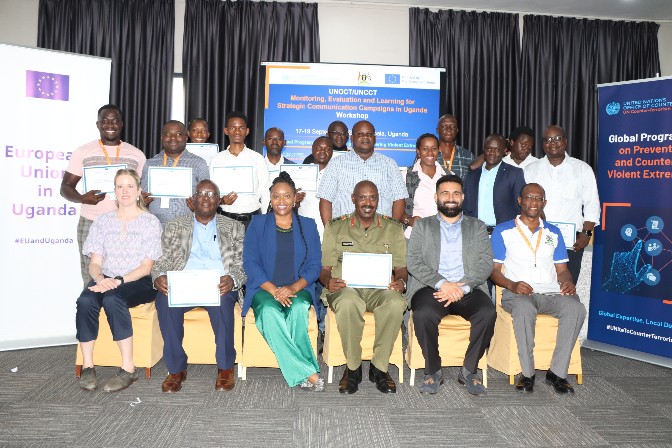
Kampala| On September 19, the United Nations Office of Counter-Terrorism (UNOCT), in collaboration with the European Union and Uganda’s National Counter-Terrorism Centre, completed a three-day workshop.
The United Nations Counter-Terrorism Centre (UNCCT) organized the workshop, which provided technical training on monitoring and evaluating strategic communication campaigns aimed at preventing and countering violent extremism (PCVE).
The United Nations Counter-Terrorism Centre (UNCCT) organized the workshop, which provided technical training on monitoring and evaluating strategic communication campaigns aimed at preventing and countering violent extremism (PCVE).
He emphasized the importance of raising awareness, changing perceptions, and increasing engagement, stating that the Ugandan government would continue to refine its approach to optimizing communication strategies and campaigns.
Sylvia Kabaki, acting Head of the UN Office of Counter-Terrorism’s Nairobi Programme Office, emphasized the importance of long-term engagement and continuous learning in strategic communications.
Kabaki reaffirmed the United Nations’ commitment to promoting interagency coordination and community-led government initiatives.
Discussions with media practitioners revealed challenges in incorporating PCVE issues into news, emphasizing the importance of strategic communication involving the media and other stakeholders.
Concerns were also expressed by participants regarding bureaucratic roadblocks in government communication procedures and the dearth of government specialists accessible for media engagement.
The workshop is a part of a larger project called “Strengthening Efforts to Prevent Violent Extremism and Enhance Human Rights Safeguards in Uganda,” according to the UPDF and its parent ministry, MODVA.
The project’s goal is to support the Ugandan government in preventing violent extremism and bolstering its resistance to radicalization.
Discover more from tndNews, Uganda
Subscribe to get the latest posts sent to your email.