

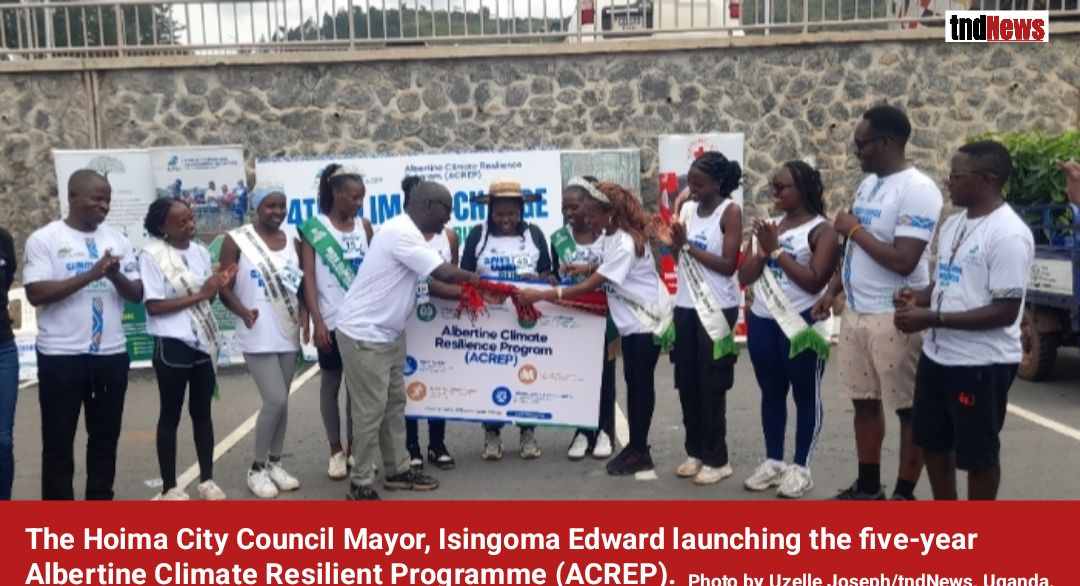
Hoima City Council Mayor, Edward Isingoma, has challenged environmentalists over poor implementation of beneficial programmes, despite better ideas and systems Uganda government has put in place.
Isingoma was presiding over the launch of a five-year “Albertine Climate Resilient Programme (ACREP)” by Africa Tourism and Environment Initiatives (ATEI) in Hoima City last week at Hoima City Stadium.
Mayor Isingoma noted that oftentimes, initiatives are put in place but with poor implementation, which he said is a waste of time.
“We do have good ideas, but with poor implementation in Uganda, we continue to live a confused life engaging in what pushes us backwards after failing the system,” the mayor said.
The politician emphasised the need for commitments and consistency in the implementation of an environmental conservation initiative that will help restore degraded landscapes.
He noted that having fully restored the environment will help the country regain critical natural basic needs of man like water which he said has gone into scarcity due to irresponsible use of the environment.
“We had so very many forests, but we worked very hard to destroy them all, and that’s why we are facing these harsh climatic conditions,” he said.
These calamities, he said, are going to be very bad for the generations to come unless we work very hard to overcome them.
Bisman Moses, team leader at Africa Tourism and Environment Initiatives (ATEI), said that the initiative aimed at addressing Hoima’s harsh climate change as the region emerges as one of the key centres of economic transformation.
He said the region has unlocked dry spells that drive food insecurity and environmental degradation, thus putting pressure on biodiversity.
“We launched this program under six pillars, including environmental restoration, wetland protection, promoting green livelihoods, promoting green climate in partnership with green schools, and promoting climate justice,” Bisman said.
He said tree growing is the greatest priority in the program.
“Don’t just be tree planters but rather tree growers and nurture them because we are tired of planting trees for ceremonial purposes,” he emphasised.
The program will be implemented in partnership with Good Forest Foundation Uganda (GFFU), Nature Talk Africa (NaTA), Jane Goodall Institute, among others.
Opio Christopher, from Nature Talk Africa (NaTA) wonders how harsh climatic conditions are currently affecting economic growth of the country, citing unpredictable change in weather patterns, agriculture, thus causing famine and poverty.
As climate change becomes real in the community, Christopher says they have also resorted to other initiatives of empowering communities to venture into different economic activities, including apiculture, for their livelihoods restoration.
Junior Ampumuza, a forestry field coordinator at Good Forest Foundation Uganda (GFFU), urged communities to be responsible citizens while handling nature, noting that proper exploitation of the environment will leave a better environmental footprint for the next generations to come.
GFFU who also issued free indigenous tree seedlings, both wood and fruits like jackfruits, avocado, muvule to the participants, emphasised the need for communities to grow more trees in order to overcome climate change.
“We must be tree growers rather than planters so we can succeed in this fight against climate change,” Ampumuza emphasised.
A representative from the Ministry of Water and Environment (MoWE), blamed the cause of climate change to human’s irresponsible use of natural resources punctuated with tree felling, encroaching protected areas like wetlands, which exposes grounds to direct sun hits.
Discover more from tndNews, Uganda
Subscribe to get the latest posts sent to your email.


