Thousands of farming households in Agoro sub-county in Lamwo district are expected to benefit from renewed government efforts to strengthen agricultural production following the distribution of hand hoes under a program aimed at improving food security, increasing household incomes and reducing rural poverty.
Among the latest beneficiaries is Agoro sub-county, where 2,813 hand hoes have been distributed to households under an initiative spearheaded by the Ministry of Agriculture, Animal Industry and Fisheries (MAAIF).
The exercise forms part of a wider district program to equip smallholder farmers with basic agricultural tools needed to increase production.
Agriculture remains the backbone of Lamwo district’s economy, with the majority of households relying on crop farming and livestock keeping as their primary sources of livelihood.
Farmers in the district mainly grow simsim, beans, cassava, groundnuts, maize, sorghum and millet, while others engage in livestock rearing and cross-border trade with neighboring South Sudan.
However, limited access to essential farm tools, quality inputs and modern farming technologies continues to constrain agricultural productivity for many rural households.
Local leaders say the government intervention is intended to bridge that gap by providing vulnerable households with the basic equipment needed to prepare lan, increase acreage under cultivation and improve food production.
Speaking during the distribution exercise in Agoro sub-county, LC III chairperson Onyango Charles urged beneficiaries to use the hand hoes for their intended purpose and avoid selling or diverting them for personal gain.
“This support is meant to strengthen household farming and improve livelihoods,” Onyango said. “If the tools are put to proper use, families will be able to cultivate larger gardens, harvest more food and generate higher incomes from agriculture.”
He said agriculture remains the most reliable source of income for many families in Agoro and called on residents to embrace farming as a pathway to economic empowerment.
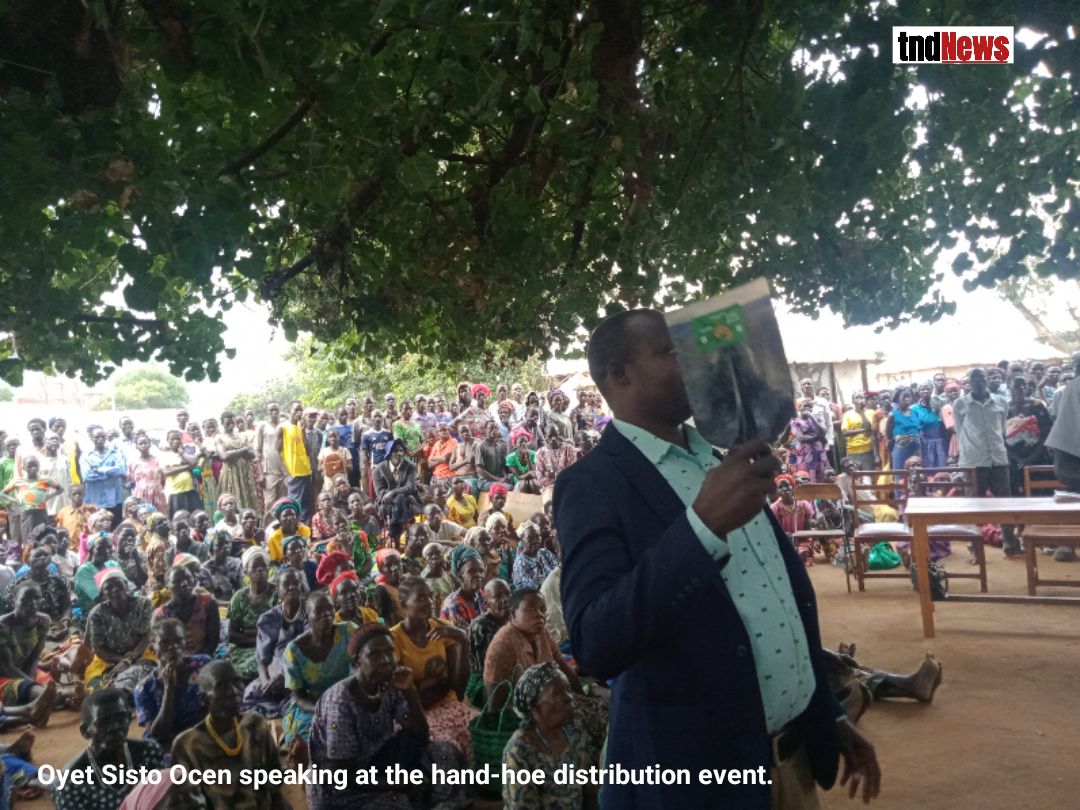
Lamwo district chairperson Oyet Sisto Ocen described the distribution as part of a district-wide government program designed to support smallholder farmers and strengthen household resilience through increased agricultural production.
According to Oyet, similar distributions are taking place across different sub-counties in Lamwo as the government seeks to promote commercial agriculture and improve household incomes.
He noted that while the district has fertile soils and favorable climatic conditions, many farmers still struggle with limited access to basic farming equipment, making government support essential for improving productivity.
“The objective is to ensure that every household has the opportunity to participate in agricultural production,” Oyet said. “When farmers have the necessary tools, they are able to produce more food, improve nutrition at household level and earn income from surplus production.”
He cautioned beneficiaries against selling hoes, saying the program was intended to contribute to long-term economic transformation rather than provide short-term financial relief.
Residents welcomed the intervention, describing it as timely, particularly as many households prepare their gardens for the planting season.
Sarah Lakot, one of the beneficiaries from Agoro sub-county, said the hand hoe would enable her to expand the size of her garden and improve food production for her family.
“For many of us, buying quality farm tools is difficult because of limited income,” she said. “This support will help us cultivate more land and increase the amount of food we harvest.”
Another beneficiary, Peter Ojara, said the program had relieved many farming families who depend almost entirely on manual labour to prepare their gardens.
He observed that although agriculture remains the district’s main economic activity, many rural households cannot afford even basic farm implements, making such government support both necessary and impactful.
Jane Ayaa, another beneficiary, appreciated the initiative but appealed for additional support in the form of improved seed varieties, agricultural extension services and access to affordable markets.
She said while hand hoes are important, farmers also require quality inputs, technical guidance and reliable buyers if they are to increase production and improve household incomes sustainably.
Lamwo district secretary for production, Lubangakene Nelson noted that increasing productivity among smallholder farmers requires a combination of appropriate farm tools, improved technologies, extension services, irrigation where possible and better market access.
The government’s continued investment in agricultural support programmes is aimed at addressing these challenges while promoting commercial agriculture as a driver of rural development.
The distribution of hand hoes complements broader national efforts to modernise agriculture under Uganda’s development agenda by enabling farmers to increase production, improve food security and participate more effectively in agricultural value chains.
For Lamwo district, where agriculture supports the livelihoods of the overwhelming majority of residents, investments in basic farming equipment are expected to contribute to improved household welfare, greater resilience against food insecurity and increased local economic activity.
As beneficiaries begin using the new tools, district leaders say the long-term success of the program will depend on responsible utilisation, continued government investment in agriculture and complementary interventions such as improved seeds, extension services, rural roads and access to markets.
They maintain that equipping farmers with the right tools is an important step towards transforming subsistence farming into a more productive and commercially viable enterprise capable of improving livelihoods across Lamwo district.
Discover more from tndNews, Uganda
Subscribe to get the latest posts sent to your email.