Lamwo | The war ended years ago. The guns fell silent. Families left crowded camps and returned to their ancestral homes. Schools reopened and markets came back to life.
Later, children born after the conflict grew up hearing stories of war from their parents and grandparents.
To many people, peace had finally arrived in Northern Uganda. But beneath the fertile soil where families grow food and children play, remnants of the conflict remain hidden.
They wait silently underground. For Oteka Benedick, 12, a Primary Two pupil at Katum Primary School in Lamwo district, that hidden danger exploded into reality on an ordinary Saturday morning.
On June 13, 2026, Benedick accompanied family members to their farming area in Tegotlumido, about seven kilometres from Katum Trading Centre in Katum sub-county. Like many rural children, he spent the morning helping adults with small chores while they worked in the garden.
As lunchtime approached, he began preparing a fireplace where food would be cooked. According to family members, the boy dug a small hole in the ground and started arranging firewood. Moments later, a deafening explosion shattered the calm of the farming area.
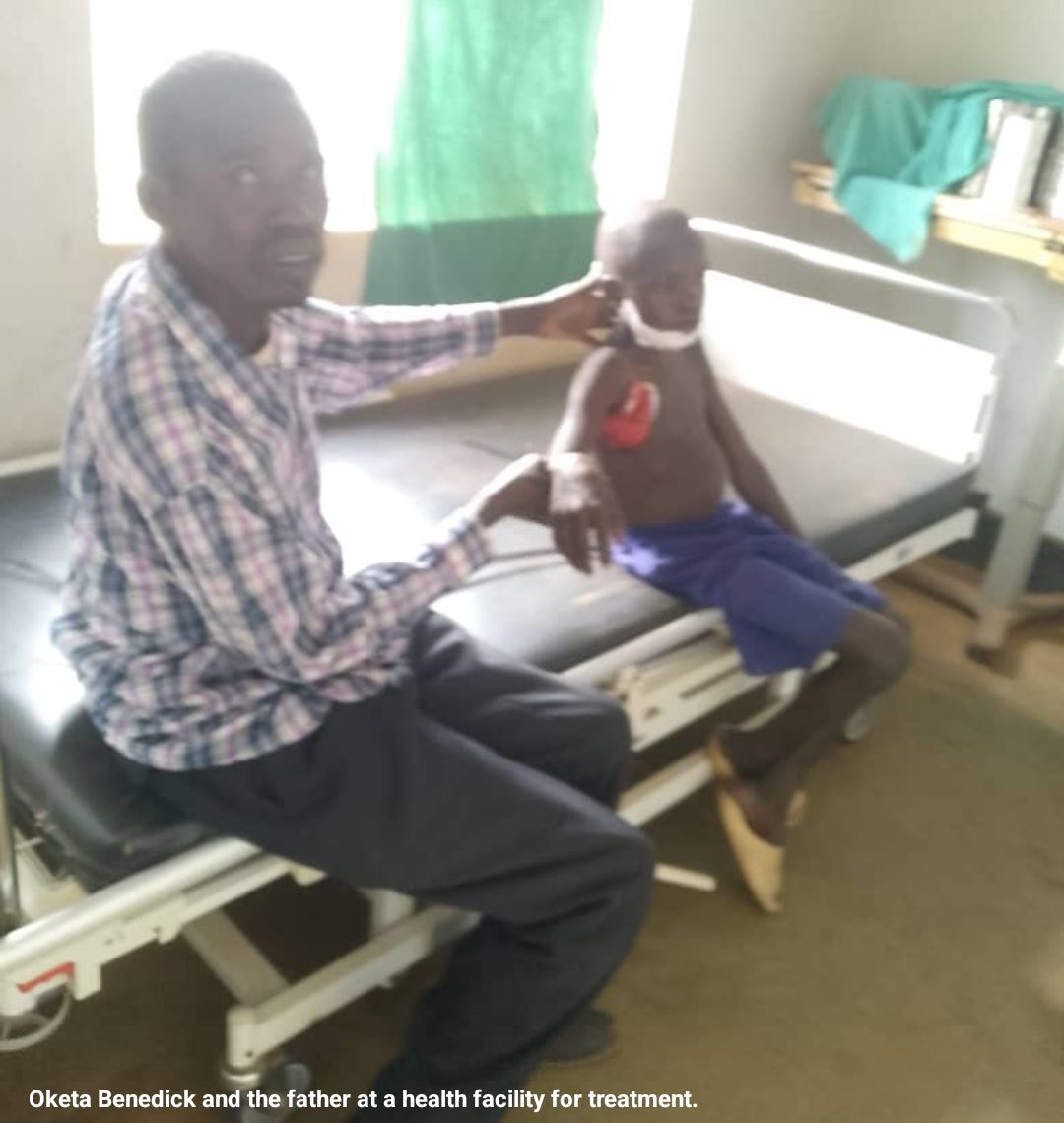
The blast threw him to the ground. His cries echoed across the field as terrified relatives rushed to his aid. “I found my son badly injured and bleeding,” recalls his father, Onen Patrick Okech.
“He was only trying to help prepare food in the garden. We heard a loud explosion and rushed to the scene. I never imagined that something left behind from a war years ago could harm my child.”
Also read: Suspected ordnance explosion kills 3 children in Lamwo
Villagers quickly carried the boy to Katum Health Centre III for emergency treatment. Due to the severity of his injuries, he was referred to Padibe Health Centre IV before being transferred to St. Joseph’s Hospital Kitgum for specialised care.
Local authorities suspect that heat from the cooking fire triggered an unexploded ordnance buried beneath the soil.
Police recorded the incident under SD Ref. 15/13/06/26 at Padibe Police Post while security agencies and the Uganda People’s Defence Forces (UPDF) Bomb Disposal Unit were notified to inspect the scene.
For Benedick’s family, however, the investigation cannot erase the trauma. “We thought the war ended long ago,” says Okech. “Our children were born in peace. But now we realize that some dangers were left behind. No parent should have to watch their child suffer because of a war they never experienced.”
Unfortunately, Benedick’s story is not unique.
A deadly discovery
Three months earlier, another tragedy unfolded in Pawich village, Palabek Gem sub-county, Lamwo district.
On March 7, 2026, a group of children left their homes to harvest palm fruits in a nearby bush. While gathering the fruits, they came across what appeared to be an old rusty metallic object.
To them, it looked harmless. Perhaps it was scrap metal that could be sold. Perhaps it was simply something interesting to carry home. What they did not know was that the object could kill.
According to police reports, the children carried it back to their village. Their mother reportedly noticed the object and advised them to return it to where they had found it.
A short while later, a loud explosion ripped through the compound. Three children were critically injured. They later died.
The victims were identified as Odoch Lawrence, 14, Walegugum Sunday, 12, and Comboni Daniel, 13, all pupils of Unity Primary School.
Police investigators later recovered fragments believed to be from an explosive remnant of war. The tragedy sent shockwaves through the community.
For many parents, it raised painful questions. How could children born long after the conflict still become its victims? How many hidden explosives remain buried across the region? And how many more children will suffer before they are found and destroyed?
The conflict that refuses to disappear
Northern Uganda endured more than two decades of armed conflict that displaced millions of people, destroyed livelihoods and disrupted education for an entire generation.
Families were forced into Internally Displaced Persons camps where life was marked by uncertainty and fear. When peace eventually returned, communities focused on rebuilding.
Roads were repaired. Schools reopened. Trading centers expanded. Farmers reclaimed their land. Children born after the conflict inherited a region determined to move forward. Yet while homes and schools could be rebuilt, explosive remnants of war remained scattered across former conflict zones.
Unexploded grenades, mortar bombs, ammunition and other military devices were left buried beneath the ground. Years later, some continue to pose a deadly threat.
Boniface Odoch, the Gombolola Internal Security Officer of Katum sub-county, says many residents mistakenly assume the danger disappeared with the conflict. “Many people believe that because the war ended, all the dangers ended too,” he explains.
“Unfortunately, unexploded ordnance may still exist in some locations. Whenever residents encounter strange metallic objects, they should never touch them. They should immediately report them to local authorities or security personnel.”
He warns that children are particularly vulnerable. “Our greatest concern is children because they are naturally curious. They may not understand the danger posed by these objects. Community sensitization remains critical.”
Children paying the highest price
For many families in Northern Uganda, the threat of unexploded ordnance has become an invisible burden. Parents send children to fetch firewood, collect water and help in gardens every day. Yet beneath the soil may lie dangers hidden for decades.
Akello Beatrice, a farmer and mother of five in Katum sub-county, says the recent incidents have renewed fears among parents. “We send our children to help in the gardens every day,” she says.
“After hearing what happened to Benedick, I became afraid. You never know what could be hidden beneath the ground. We are trying to rebuild our lives, but these incidents remind us that the past is still with us.”
Village elder Ocen Jackson believes today’s generation faces risks they do not fully understand. “Many children were born after the war,” he says. “They do not know what a grenade looks like. They may see it as a toy or scrap metal. That is why awareness is very important.”
He believes schools, parents and local leaders must work together to educate children. “If we teach children to stay away from suspicious objects and report them immediately, we can prevent many tragedies.”
Security experts share similar concerns
According to a senior officer attached to the UPDF Bomb Disposal Unit, explosive remnants of war can remain active for decades. “What appears to be an old piece of metal can still explode when disturbed, struck, heated or handled improperly,” the officer explains.
“The safest action is not to touch the object. Mark the location if possible and inform local authorities or security personnel. Trained bomb disposal experts have the equipment required to safely manage such situations.”
Community leaders are now calling for expanded clearance operations, increased public awareness campaigns and school-based education programs to help children identify and avoid suspicious objects.
When does a war really end?
For many people, war ends when peace agreements are signed and guns stop firing. But in villages across Northern Uganda, another answer exists. A war truly ends when children can play safely. It ends when farmers can cultivate their gardens without fear.
It ends when families no longer discover explosives hidden beneath their land. It ends when no child loses a limb or a life to weapons abandoned by history.
As seven-year-old Benedick continues his recovery in hospital, his story joins a growing list of children whose lives have been altered by a conflict they never experienced.
For the families of Lawrence, Sunday and Daniel, there is no recovery. The war claimed their children years after the last battle was fought. Their stories reveal a painful truth: peace is more than the absence of gunfire but Peace is the presence of safety.
Until every hidden explosive is found and destroyed, Northern Uganda’s children will continue to walk across a battlefield they cannot see. The war may be over, but beneath the soil of Northern Uganda, its deadly legacy remains alive.
A call for action
Lamwo Resident District Commissioner William Komakech describes the recurring incidents as a serious public safety concern. “It is heartbreaking that children continue to lose their lives or suffer severe injuries from explosive remnants of war,” he says.
“The government and security agencies have made significant efforts in post-conflict recovery, but incidents such as these remind us that more work remains.”
Komakech urges communities to remain vigilant and prioritise safety. “We appeal to parents, teachers and community leaders to educate children about the dangers of unknown metallic objects. A simple decision to report a suspicious item can save lives.”
He also called for strengthened clearance operations in former conflict-affected areas. “Our goal is to ensure that every child in Northern Uganda grows up without fear. No family should continue paying the price of a conflict that ended many years ago.”
Discover more from tndNews, Uganda
Subscribe to get the latest posts sent to your email.