Before most of her pupils arrive, Betty Amwony has already done hours of work.
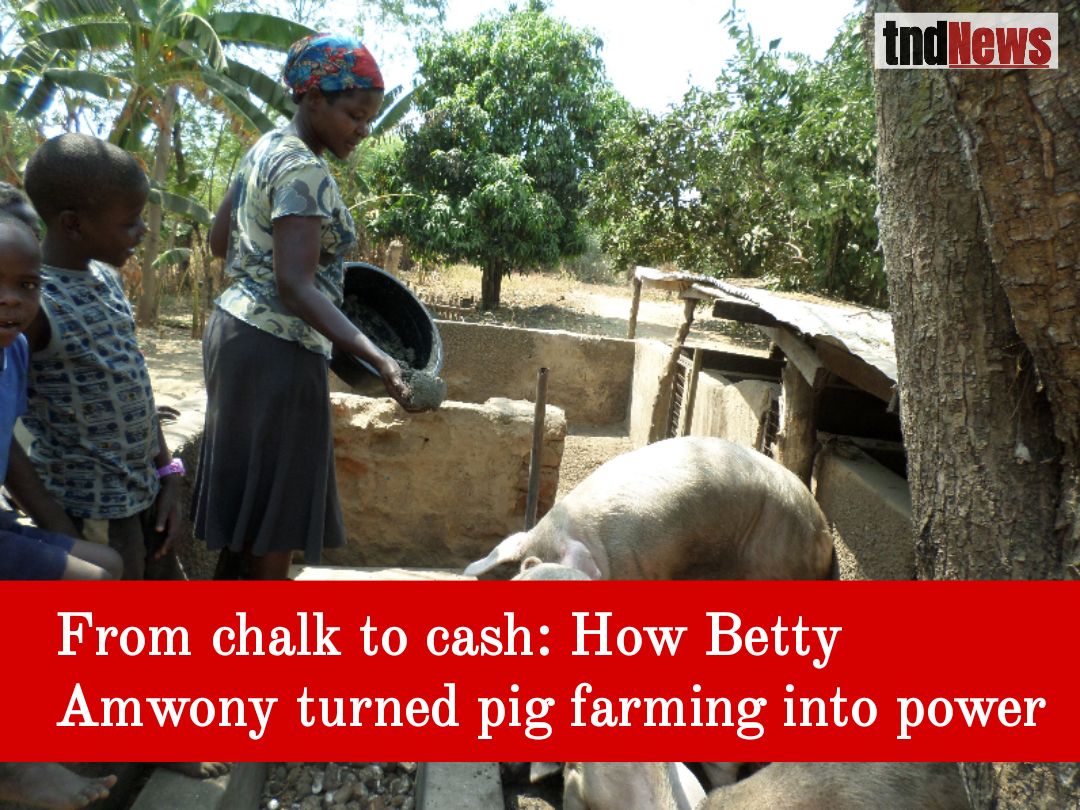
The morning air is cool, the ground still damp, and from behind her modest home comes a chorus of restless grunts.
Dressed in gumboots and a faded sweater, the primary school teacher moves from pen to checking on her animals with the precision of someone who has learned, through trial and error, that survival depends on discipline.
By 8 a.m., she will be in front of a blackboard, chalk in hand but long before that, she has already tended to the enterprise that has transformed her life.
“I realized early that my salary alone would not change my story,I had to think beyond the classroom,” Betty says.
Fifteen years ago, Betty made a decision that would redefine her future. With just shs140,000, she could barely spare; she bought four piglets at shs35,000 each.
She had no formal training in agriculture; instead, she relied on advice from fellow farmers, radio programs, and newspapers.
What she lacked in technical knowledge, she made up for with persistence.
Today, that small gamble has grown into a thriving enterprise. Betty now rears dozens of pigs while also cultivating cassava, sweet potatoes, and groundnuts.
Her farm generates about shs16 million annually income that supports her family, pays school fees, and even enabled her to buy a motorcycle to ease movement between home, farm, and school.
A quiet shift in power
In many parts of northern Uganda, women still depend heavily on their spouses for financial support and Betty’s success is quietly challenging that reality.
“I sell piglets at affordable prices so that others can also start, and if I grow alone, it does not help the community,”she explains.
Farmers travel from across the region including Lira, Gulu, Pader, Agago, and Lamwo to buy from her.
She specialises in Large white pigs, a breed she adopted after realising her initial stock was not competitive.
The improved breed grows faster and produces larger litters often 10 to 15 piglets, twice a year making it more profitable.
On weekends, her home becomes an informal training space and under a mango tree, young women gather as she teaches them pig rearing and, just as importantly, how to earn independently.
She also trains girls in knitting, offering an additional source of income.
“She is showing us that we can stand on our own, and farming is not easy, but it can change your life,” says Auma Brenda, one of the young women she mentors.
Discipline behind the growth
Betty’s success is rooted in careful management. Her pigsties are clean, well-ventilated, and fitted with cemented floors to maintain hygiene.
She separates piglets, mature pigs, and pregnant sows to prevent accidents, especially the risk of sows crushing their young.
Feeding is equally deliberate. In the morning, she uses a mix of sunflower residues and maize flour.
In the evening, she turns to cassava peels, leftover posho, and other locally available resources.
It is a system built on efficiency where little goes to waste.
Equally important is her record-keeping. Betty tracks every expense and sale, a habit she credits for her steady progress.
“The biggest challenge is feed, especially during the dry season, and diseases can come anytime you have to be ready,”she says.
Her current pigsty cannot support the expansion she envisions,then there is the constant threat of theft, a reality that keeps her vigilant.
Despite these hurdles, she remains focused on growth.
Her goal is to expand to between 150 and 200 pigs and increase her annual income to at least 25 million shillings. She is also seeking formal training to sharpen her skills and scale her impact.
A model worth copying
Agricultural experts say Betty’s approach reflects what many small-scale farmers lack: discipline and planning.
District Production Officer Alfred Omony emphasizes the importance of proper management and disease control.
“Success in piggery depends on good management, and prevention is always better than cure,”he says.
Community members see her as a role model with many coping skills and want to learn from her.
“What Betty is doing should open the eyes of others, women should not just sit and wait,” says Opio Simon Peter.
In areas where land disputes and economic uncertainty often limit opportunities, piggery is increasingly seen as a practical and profitable option. It requires relatively small space and offers quick returns.
For Betty, the lesson is simple but powerful and urges community members to start small but will definitely grow and they will earn big.
“You start small, but you start, and what matters is consistency,” she says.
Soon after speaking, she prepares to head to school returning to the classroom where her journey began.
But even there, her work continues and because in Betty Amony’s life, the chalkboard and the pigsty are not separate worlds thus, together, they tell a story of resilience, independence, and quiet transformation built one piglet at a time.
Discover more from tndNews, Uganda
Subscribe to get the latest posts sent to your email.