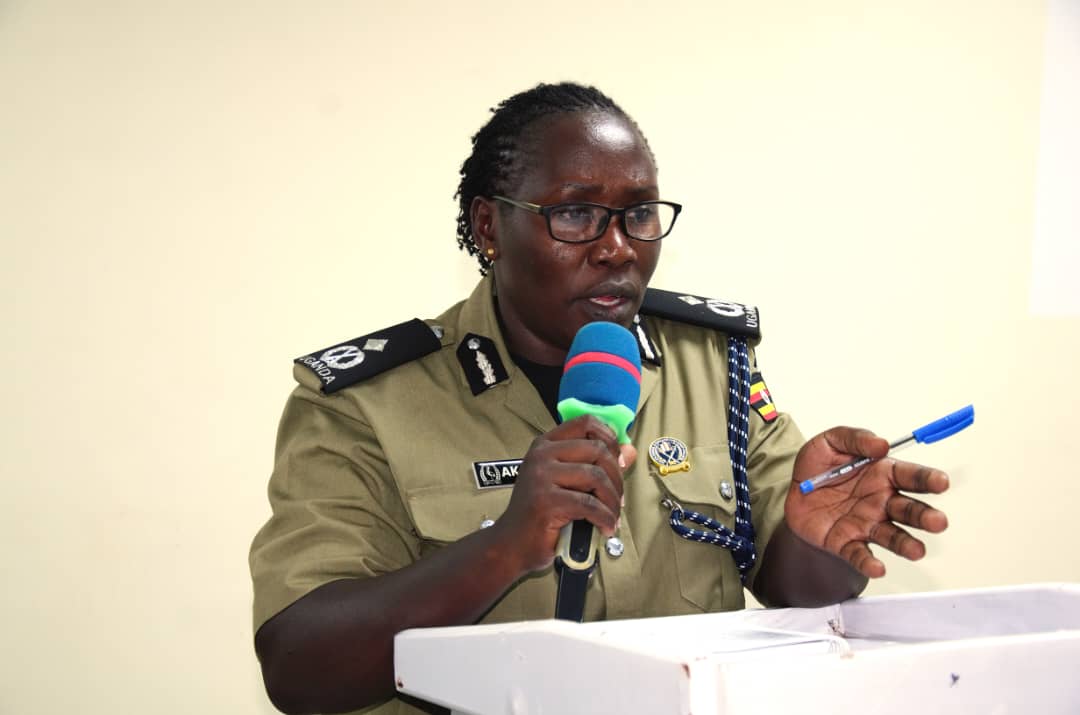
The Acting Commissioner of Police in the Department of Women Affairs at the Police Headquarters, Kampala, ACP Caroline Akoth, has emphasized the crucial role male police officers play as allies in advancing gender equality in policing.
This, she says, can be possible by providing and equipping male officers with professional knowledge and leadership skills.
She made the remarks while addressing male officers during a workshop held on December 2 at the UMA Show Grounds, Nakawa in Kampala.
 ACP Akoth revealed that the Police Council Gender Committee is currently reviewing the proposal to change the department’s name from Women Affairs to Gender and Women Affairs to further enhance gender-responsive policing and budgeting.
She noted that the department was established in 2014 to eliminate gender imbalances, enforce adherence to gender policy especially zero tolerance to sexual harassment, exploitation and abuse and expand career opportunities for female officers who at the time were largely confined to crossing guard duties.
The department’s mandate includes promoting gender equality and women’s empowerment within the Force, fostering unity among female officers, and supporting their professional and career advancement.
Its activities range from capacity building and mentorship of junior officers to managing workplace sexual harassment cases and championing gender-responsive policing.
During the workshop, facilitator ASP Jane Auma delivered an insightful presentation on gender concepts and harmful stereotypes that undermine women’s progress.
She cited assumptions such as men being more capable in tactical roles, women being suited only for administrative tasks, beliefs that female officers cannot balance work and family, and perceptions that women are emotional or viewed as sex objects.
She urged individuals, MDAs and private sector actors to tackle stereotypes by strengthening gender-responsive budgeting, mentorship and sponsorship programs, and ensuring merit-based, transparent recruitment processes using diverse panels.
Another facilitator, Ghanaian national Emmanuel Kodwo Mensah, extensively discussed toxic masculinity and its negative effects, as well as positive masculinity and its benefits. He stressed the need to address toxic masculinity at internal, ideological, interpersonal and institutional levels to promote an inclusive and gender-balanced police force.
He further encouraged men to create support networks to confront harmful norms such as the belief that men should not cry, that a man is only valued if he provides financially, that men are always right, or that men are free to engage in irresponsible sexual behaviour.
Citing recent American 2025 research, Mensah highlighted that men facing financial instability are 16.3 times more likely to have suicidal thoughts compared to women at 7.3 times, calling for mutual love, respect and support among partners.
SP Isabella Ameja presented on sexual harassment, exploitation and abuse within the workplace, warning both male and female officers against engaging in such misconduct.
She emphasized the Force’s zero-tolerance stance and noted that sexual harassment against male officers is often downplayed and labelled as operational stress.
Ameja encouraged male officers to report cases promptly. Ameja added that female clients tend to sexually harass male officers more frequently than female officers do.
She explained that sexual harassment severely affects an officer’s service record and may result in dismissal, demotion, or removal from office pending investigations.
Participants of the workshop were drawn from 32 policing regions and selected specialized units including CT, FFU, and Oil and Gas.
On behalf of RPC Kiira SSP Charles Nsaba, SP James Mubi, PRO Kiira region committed further sharing the knowledge gained and ensuring effective implementation of the gender policy across the region.
The workshop brought together facilitators with notable professional expertise and hands-on experience in promoting gender equality within the policing environment.
During the engagement, officials clarified that the Police Department of Women Affairs operates independently from the Child and Family Protection Unit.
While the Women Affairs Department strictly addresses welfare, rights, and professional concerns affecting police officers, the Child and Family Protection Unit focuses on cases involving both officers and members of the public.
Discover more from tndNews, Uganda
Subscribe to get the latest posts sent to your email.