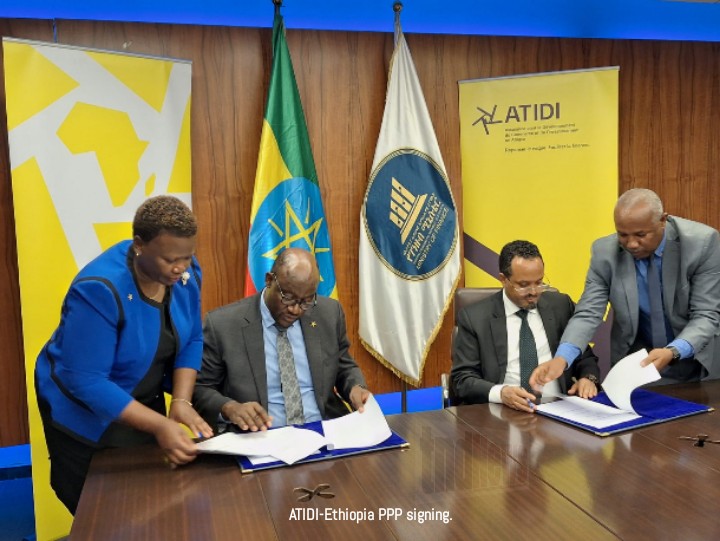
Addis Ababa, Ethiopia | The Federal Democratic Republic of Ethiopia, represented by the Ministry of Finance and Ethiopian Electric Power (EEP), has signed a Memorandum of Understanding (MoU) with the African Trade Insurance Agency (ATIDI), a major pan-African trade and investment insurer.
This landmark agreement aims to accelerate Ethiopia’s transition to clean energy by attracting foreign investment in renewable energy projects via ATIDI’s Regional Liquidity Support Facility (RLSF).
The MoU establishes a framework for collaboration between Ethiopia and ATIDI, ensuring that Independent Power Producers (IPPs) or Public-Private Partnerships can benefit from RLSF, a liquidity support mechanism developed by ATIDI in collaboration with KfW Development Bank and Norad.
RLSF provides financial protection to IPPs/PPPs by obtaining and expediting payments owed by state-owned utilities, addressing a critical issue in the energy sector by improving payment security and financial stability.
“We are honored to partner with the Government of Ethiopia and Ethiopian Electric Power to support the development of the country’s renewable energy sector. Through our liquidity support, this collaboration will not only reduce financial risks but also attract more investment into Ethiopia’s energy infrastructure,” said CEO of ATIDI, Manuel Moses.
Manuel added that ATIDI believes that this collaboration will help Ethiopia’s renewable energy capacity grow faster and contribute to the larger goal of sustainable development across the African continent.
In his key message, Ethiopia’s Finance Minister, H.E. Ahmed Shide, stated: “Through this partnership, Ethiopia aims to facilitate timely payments to developers, mitigate financial risks, strengthen the bankability of power purchase agreements (PPAs), and enhance the creditworthiness of EEP.”
Ahmed further strengthened his message by stating that “these efforts will create a more attractive investment environment for renewable energy projects”.
Ethiopia becomes the 11th ATIDI member state to sign the RLSF MoU joining Benin, Burundi, Côte d’Ivoire, Ghana, Kenya, Madagascar, Malawi, Togo, Uganda and Zambia.
Since its inception, USD24.7 million in guarantees have been approved under the RLSF portfolio, allowing for USD373.1 million in investments and the development of 181.95 MW of installed renewable energy capacity across Africa.
“Ethiopia has embarked on a comprehensive economic reform agenda known as the Homegrown Economic Reform Agenda (1&2). This initiative aims to address structural challenges and promote sustainable economic growth,” Shide said.
The key aspects of the reform, he said, are creating Macroeconomic Stability: Investment and Trade. “Efforts are being made to enhance the investment climate and promote trade by simplifying regulations, improving infrastructure, and encouraging private sector participation.
“The Regional Liquidity Support Facility (RLSF) is expected to play a great role by enhancing the bankability of PPP projects and the sustainable implementation of such projects.”
Ethiopia has made significant strides in developing its energy sector, with hydropower serving as the primary source of electricity generation. The Ethiopian government intends to diversify its energy mix by leveraging its vast renewable resources, such as wind, solar, and geothermal energy, to improve reliability and sustainability.
“The reform also aims to boost productivity in key sectors such as agriculture, manufacturing, and services to drive economic growth and create jobs,” the Minister added. “Investment Attraction too focuses on creating an improved investment climate that has already attracted foreign direct investment, particularly in sectors like energy, manufacturing, and agriculture.
“We look forward to expanding this positive collaboration with ATIDI to cover additional sectors other than energy.”
This collaboration represents a significant step toward Ethiopia’s more resilient and investor-friendly renewable energy landscape, and with ATIDI’s assistance, the country is well-positioned to achieve its energy transition goals while ensuring financial stability for its power sector stakeholders.
Discover more from tndNews, Uganda
Subscribe to get the latest posts sent to your email.