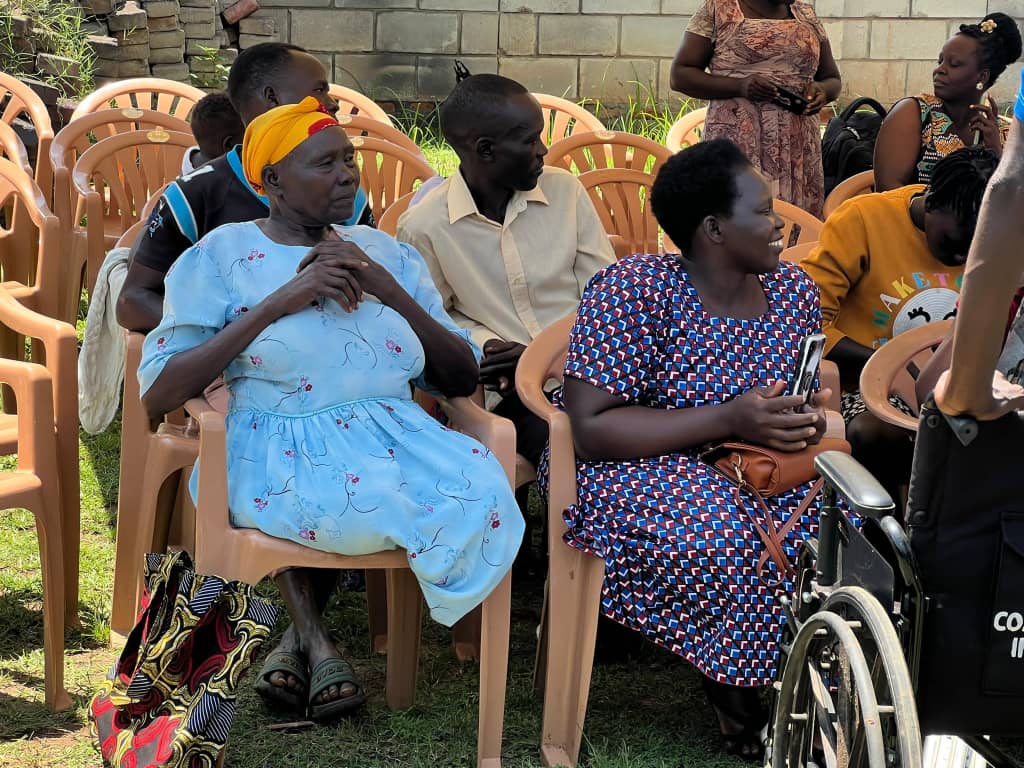
Kitgum I In the previous war-ravaged and tightly knit community of Locomo, in Kitgum district, Northern Uganda, the Acholi community has a saying: “The land belongs to the dead, it is under the care of the living, and it is being held in trust for future generations.”
There is an innate connection between the tiny rural population of about 300 people and the land they work and see around them.
Largely, it is used for subsistence farming and animal husbandry and for decades, the wider region witnessed war and atrocities as government forces battled with the infamous Lord’s Resistance Army. In recent times, the residents have also had to face the violence of cattle rustlers from neighboring districts of Karamoja.
In a fortuitous twist of fate, the Locomo community now stands to benefit from a world class discovery of high quality graphite, a mineral that is key to lithium-ion batteries found in smartphones and electric vehicles.
The development of the Orom-Cross project by London-listed Company, Blencowe Resources Plc is awaiting the final go-ahead of investors. The company which has issued a new tranche of shares on London’s Alternative Investment Market Stock Exchange boasts that returns will be extremely profitable. If the project proceeds to production, it could generate hundreds of millions of dollars in revenue.
Although the locals of Locomo are custodians of the land for their ancestors and their future generations, they are not sure they will receive a fair slice of the pie.
They are by far the least powerful of the actors that have now come into play with such a prize up for grabs.
At the State House in Entebbe, the project is being watched carefully as President Museveni eyes a potential large export earner for the country and a handy negotiating card that can be leveraged in negotiations with foreign powers, in particular China and the US.
Thus, it is the competing geo-strategic interests of those two countries who have also entered the fray. They are desperate to get their hands on graphite to spur the clean energy transition away from fossil fuels.
Intriguingly, both countries are involved in the project. In recent weeks and especially since the re-election of Donald Trump, the superpowers have also ramped up the rhetoric on trade wars.
China has threatened to target America’s mineral-critical supply chains with graphite, one of the products high on their list. China controls a major part of the minerals needed for the energy transition.
It is in this context that Blencowe seems to have sided with the West. Its recent pronouncements on X (formerly Twitter) suggest that their products are vital for Europe and the US to diversify from reliance on China’s reserves. Invest in us is the tone of their rallying cries.

The people of Locomo may not know it, but it could soon be at the sharp end of a global whirlwind. For the present, however, the promise of money seems to have created its own divisions in the area.
Although Blencowe agreed to pay significant sums to the local community to boost skills, education, health, and general infrastructure, there have been loud murmurings of discontent. Where is the money we were promised? Some asked.
In mid-2024, our reporter began to investigate by carefully examining the company’s annual accounts and other financial statements and set about tracking some of the promised funds.
However, what the reporter then found was not, as some had suspected, without foundation egregious wrongdoing by the company but instead wrangling among the so-called representatives of the community itself over who was to get what and when.
The rows, which included a threat by a local council to immediately halt the operations of the company in the district, center on a private “surface rights agreement” that mining companies often sign with owners of the land in return for digging into the ground.
Blencowe has promised prosperity, but the ordinary people of Locomo may be the ones to lose out on the promise.
Rising from the ashes
After decades of war and strife in the last decade, Uganda’s northern regions have begun to recover from the trauma caused by Joseph Kony and the Lord’s Resistance Army (LRA).
Approximately, 60 kilometers east of the town of Kitgum lies the village of Orom and it was in this isolated part of the world in 2013 that large quantities of graphite were found.
Though the timing could not have been better, as a mineral seen as essential to supporting the transition away from fossil fuels to cleaner energy sources, graphite is particularly valuable in the manufacturing of lithium-ion batteries which are used in devices like smartphones and electric vehicles.
Studies done thus far estimate the Orom-Cross deposit contains as much as 2-3 billion tonnes of graphite flakes, most of which are near the surface and can be mined relatively easily and cheaply. The size of the area being explored is about 20 square kilometers, affecting 10 villages and about 300 people.
Blencowe Resources estimates that an investment of $130 million over the next few years will yield the company returns of $482 million over the next decade and a half. Blencowe is in the final stages of a detailed study and it will be used as the basis on which to approach investors for further money.
In the interim, the company attracted interest from both superpowers. The Development Finance Corporation, an arm of the U.S. government, recently provided a $5 million grant towards the studies that will determine whether a final investment decision is made by the end of the year.
Further, the company also recently tested bulk samples from the mine with Chinese customers, whose government is building the largest renewable energy projects in the world.
For the community of Locomo, and the surrounding districts of Kitgum, these developments have raised hopes that the associated economic benefits will be a step-change in modernizing the region and materially improving the lives of its citizens.
In the Blencowe’s annual accounts for 2023; Under Note 15 for long-term creditors, the figure was revealed; some 1.4 million pounds in total to be paid in several installments over several years and many of the locals had an idea what kinds of sums had been promised.
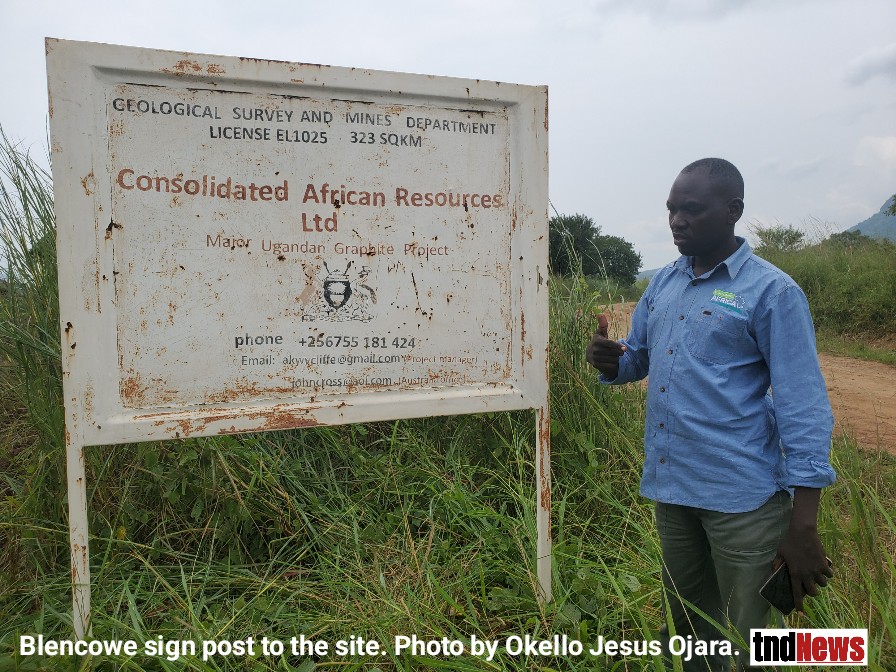
This was the surface rights agreement with the Locomo Communal Land Owners Association and it had originally been signed in front of the community and then lodged at the Ministry of Energy in Kampala in May 2018, before Blencowe’s arrival on the scene. The rights at that time were held by Consolidated African Resources (Uganda) Ltd (CARU).

The agreement granted CARU a 49-year lease over the prospecting area in return for compensation. Payments became due at the point where the company would require access to different sections of the prospecting area, so the timing of the payments was entirely at the discretion of the company.
The association, in turn, was responsible for making disbursements to individual community members and administering a student scholarship scheme the company agreed to fund.
While a land valuer was used in the process of drafting the agreement when asked by our reporter, no one could explain how the actual rates were determined.
Therefore, this investigation was unable to assess whether the agreed rates were fair. The issue is also compounded by the fact that the land in this part of the country is predominantly used for subsistence farming.
Blencowe, whose executive chair is Cameron Pearce, an Australian and a founder of the company, acquired CARU and the surface rights agreement in 2020.
In the wake of the COVID-19 pandemic, the company and the land association decided to revise the agreement in September 2022. The amounts to be paid were not altered, but the second version shortened the period between payment installments.
Blencowe will now make a further eight equal installments at defined dates with final payment due in 2035.
The revised consensus agreement requires provision of local education and sensitization of the local communities in Akurumo parish on the opportunities and advantages of mining graphite, including provision of employment priorities to the local capable members of Akurumo parish.
In response to questions raised to him, Blencowe CEO Mike Ralston said considering the size of the mineral area and the fact that the payment structure was based on access, the next payments would not have been due for a long while and this was something both parties considered “unreasonable”. Blencowe was therefore happy to respond to the association request.
According to a letter addressed to the land association by lawyers representing Blencowe in 2022, the community will be paid approximately 142,000 pounds sterling [at current exchange rates] each of the eight installments left on the agreement, or approximately 1.13 million pounds (Shs5.3 billion) in total between now (2024) and 2035.
However, Blencowe firmly maintains it is up to date with the payments, as per the revised consensus agreement in 2022.
“All payments owing as per the agreement have been paid. The first tranche (of ten) payment was made, as scheduled, following the revised agreement in 2022. Blencowe has not been informed of any payment as delayed or owing,” Mike Ralston, CEO Blencowe Resources Limited, replied.
Adding that, “The next scheduled payment is not due till the company completes the Definitive Feasibility Study and makes an investment decision to develop the Orom-Cross mining operation.”
Felix Ayella, the Vice Chairperson Lucomo Land Owners’ Association, disclosed that there have been issues with the processes of compensation and the communities had gone for over 5 years without their installments.
Ayella, however, admitted that there were issues with its own processing of compensation to individual residents which has made some residents lose trust in the company.
Nelson Bruno, a project affected person, and also doubling as the Orom Sub County LC III Chairperson of Oromo says following negotiations between Consolidated African Resources and the Locomo Land Owners Association, it was agreed that UGX 400,000 (USD 107) would be paid for one acre at every section; this means that if a project affected person has one acre, they would earn UGX 4 million (USD 1000) over the lifecycle of compensation until 2035.
However, different projects affected shared that they were paid different amounts not commensurate to the land value and market rates and other disturbances such as planned destruction of crops, trees and other assets were catered for but at a minimal rate.
Bruno received his first payment of UGX 1.2 million (USD 322) in 2019, and expects a full payment of UGX 13 million (USD 3490) by 2035 for his three and half acres affected by the project.
He says the second payment was supposed to kick off in June last year, 2023, according to the agreement signed in 2018 at the onset of the project. However, that is yet to happen.

Community members interviewed revealed there was also a discrepancy in compensation rates. John Lupiri, 38, shares Bruno’s frustrations and questions the fairness of the compensation process.
“My 3 acres of land with my maize, simsim and cassava were destroyed and only paid UGX 250,000 (USD 67) per acre,” Lupiri explained.
However, with communication gaps between the local communities and the company, some residents said they had not received any money, and that there had been delays. They were under the impression this was the fault of the company.
Further, Mike Ralston, CEO Blencowe, confirmed that the community agreement that had been shared with the Locomo community is satisfactory and the locals are not complaining.
“The Community Agreement is a document that we share with the Locomo Community; it is our business and theirs, no one else’s. I met the community chairman two weeks ago in Uganda and he was very comfortable where things stand,” Ralston replied.
Adding that, “obviously, he would like payments as early as possible but the nature of mining and developing projects is time consuming, and he accepts that. The community is supportive and our relationship is strong.”
He, however, faults parties who try to exploit situations to throw false information around to create leverage, but Blencowe is not interested in petty politics and they have both the community and government aligned and working closely with Blencowe and that is all they need.
‘’Our predecessor/original owner made one payment when they signed the original agreement and we have made one payment since, on the re-signing of the revised agreement; the next payment is due on us and an investment decision to mine Orom-Cross,” Ralston said.
Mismanagement of funds
As well as the processing delays, our report was told there had been allegations of mismanagement against the landowners association. It therefore seems that the discontent among the community was such that the then, Kitgum District Resident District Commissioner became involved and instructed processes to be followed, particularly around the handling of funds.
A source familiar with the issues said that the association spent 240 million Ugandan shillings (51,303 pounds) acquiring two tractors for communal use and which were to be rented out on commercial terms.
Further, it was agreed that any money generated from doing so would be banked on a monthly basis. However, in 2020, only UGX 1.6 million (342 pounds) was banked and nothing the following year.
Therefore, it appears that the association’s chair had had UGX 2.3 million (491 pounds) in his custody for the whole year. The RDC said such monies should be held by the treasurer.
However, with repeated calls, WhatsApp messages, emails, the land association and the association chair did not respond to questions submitted to them to clarify on the allegations.
On the other hand, Blencowe says it has no say in how the funds are distributed by the land association and indicated it had no intention of trying to influence the decision.
In response to questions over mismanagement of funds at the landowners association, Blencowe stated it would work with any relevant authorities to ensure compensation continues and should it be made aware of any improprieties or legal proceedings against the association or any of its members.
District council land grab
The difficulties with the association are not the only problems plaguing community relations in the area.
In December 2023, the Kitgum District Council under which the village of Locomo sits moved to suspend operations of Blencowe after councilor, Charles Oryem tabled a motion that alleged, “Numerous irregularities.”
Oryem, in a document read out at the district council meeting, noted that, “no information or formal documents had been made publicly available to the district council, despite ongoing activities within the explored area.”
He further listed a host of other gripes, including that the agreement reached with the landowners association favoured only one parish. Separately, Oryem believed there has been a lack of transparencies about how students would be selected for scholarship schemes and that the area could miss out on wider economic benefits.
Christopher Arwai Obol, Chairperson LCV Kitgum district, revealed that his office made several requests to the company to grant them access to the surface rights agreement but had since been unsuccessful.
“We are now investigating because why is the community not satisfied? It is a question that we need to look into critically, yes. But the chances of having the community being exploited is very eminent,” Arwai said.
In the council’s move, it was not clear what authority the district could have to suspend or call for the suspension of operations of a mining company because under the Uganda’s Mining and Minerals Act of 2022, the Department of Geological Survey and Mines takes the lead in regulating mining companies.
Blencowe has also not yet formally started mining operations; it is still in the exploration phase, and as such had only paid $100 to the central government for royalties on the bulk samples it had taken from the area.
The company said that it was certainly not aware of any royalties that should have been paid to the district and certainly not prior to mining operations commencing. It also pointed out that it only sought an agreement for compensation on the land in one parish, as the entire Orom-Cross prospecting area is located within the parish of Akurumo.
Blencowe described the incident by the council as an “interference” created by certain local parties for their own agenda. It said this was quickly shut down by senior Ugandan government authorities once they learned of these activities.
The reaction of the government also underscores the strategic importance of the project to the country. President Museveni imposed a ban on raw exports of minerals in 2015, as part of its development of the Orom-Cross deposit.
Blencowe plans to build a processing plant that will purify the graphite to a 99.95% concentrate, thereby uplifting its value and increasing the potential for the operation to generate valuable foreign exchange for Uganda.
Therefore, the issue of community relations is an important factor in early stage mining operations and companies are adept at highlighting their efforts in their corporate and social responsibility reports.
In its 2023 strategic report, the company reports have agreed to help provide local education and sensitization of local communities in Akurumo parish on the opportunities and advantages of mining graphite. CARU will give employment priorities to the local capable members of Akurumo parish.
“Since the acquisition of CARU, the Group has donated to local causes such as scholarship schemes, donated learning materials to Locomo Primary School, drilled boreholes, and fought against COVID-19. The Group will continue to donate to the local communities around the region of Uganda in which the Project Licenses are located,” reports reads in part.
However, none of the rows within the community are mentioned-although there is no reason why they should be unless they are deemed to have a financial effect on the company.
Further, there is no suggestion of any wrongdoing by Blencowe and it insists it has a good public relations operation in effect in the Locomo area. But as the importance of the mine and its fortunes comes nearer to fruition, it remains to be seen whether it is able to ensure the local residents are treated fairly.
Vincent Kedi, Commissioner of Licensing and Administration at the Directorate of Geological Survey and Mines, said it was important that Blencowe ensures community relations are good, and that there is no information gap.
“When you are going to develop a mining project in a community, you must have a social license to operate. The community must understand what you are doing; they should be appreciative,” he said.
Blencowe owns 100% of the project and has a 21-year mining license in place, as well as all the necessary permits, approvals and community agreements to bring Orom-Cross into production.
A combination of debt and equity will fund Orom-Cross project implementation, with the majority being debt financing. It is envisaged that, once the DFS is completed, the DFC will cornerstone a funding solution via debt and one or more other institutions will combine to deliver the remaining debt and equity.
According to the company, graphite demand is forecast to accelerate over the next decade in response to its non-replaceable role within lithium-ion batteries that are used to store renewable energy thus Orom-Cross will play a key role in fulfilling that demand in the future.
The world is transitioning from fossil fuels to renewables, which requires lithium-ion, sodium and vanadium redox batteries to store energy, and graphite is a non-replaceable input to all of these. This therefore, means that graphite demand is set to soar, with predictions between two to three times the current levels by 2030.
This story was produced with support from Finance Uncovered-UK.