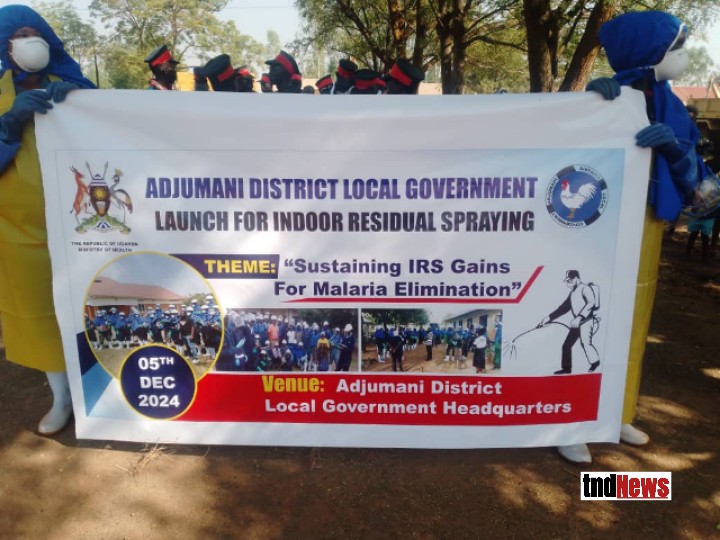
Adjumani district is set to target more than 140,000 households during the third round of the Indoor Residual Spray (IRS) campaign.
The IRS, a government initiative, aims to combat malaria, Uganda’s leading public health threat, by spraying chemicals in residents’ homes.
This campaign will cover refugee and host communities across the district.
Norbert Dragule, the Malaria Focal Person for Adjumani District Local Government, revealed that malaria prevalence in the district remains high despite ongoing interventions.
Significant reductions in mortality and severe cases have been observed since the implementation of the first and second IRS campaigns, Dragule added.
“For the last three years, we have reduced malaria cases by 49%. Previously, 40% of severe malaria cases required hospitalization, but this has dropped to 33%.
“At first, we used to lose around 70 people annually to malaria at our health facilities, but this has now reduced to 32 deaths. This intervention has proven very effective,” Dragule explained.
Richard Edema, Senior Assistant Secretary for Adjumani district, highlighted the district’s geographical location along the River Nile as a major factor contributing to the high malaria burden.
He urged the Ministry of Health to develop more effective scientific approaches for malaria prevention and control, alongside existing methods.
“Being along the Nile belt, Adjumani District experiences high levels of malaria outbreaks due to mosquito bites. Sensitization alone is not enough; we need better methods to address this challenge comprehensively,” Edema noted.
David Olanya, who is a commissioner at the Ministry of Health, urged local communities to embrace government-led malaria interventions, including the distribution of treated mosquito nets and IRS campaigns.
“We have several interventions in place: mosquito net distribution every three years, routine nets for pregnant women and newborns, case management, and now IRS. None of these interventions alone is a magic bullet, but together they effectively reduce the malaria burden,” Olanya explained.
The IRS campaign, launched on December 5, is expected to run for 25 days.
According to the Ministry of Health, 96% of Uganda experiences high malaria endemicity, with the West Nile and Acholi sub-regions recording malaria transmission rates exceeding 450 cases per 1,000 people.
Adjumani’s efforts to combat malaria reflect a commitment to improving public health outcomes for both host and refugee populations, showcasing a unified approach to tackling one of the region’s most pressing health problems.
Discover more from tndNews, Uganda
Subscribe to get the latest posts sent to your email.