Lira | Dr Jane Ruth Aceng Ocero, the Health Minister, has told Lango cultural leaders that they must speak out against AIDS.
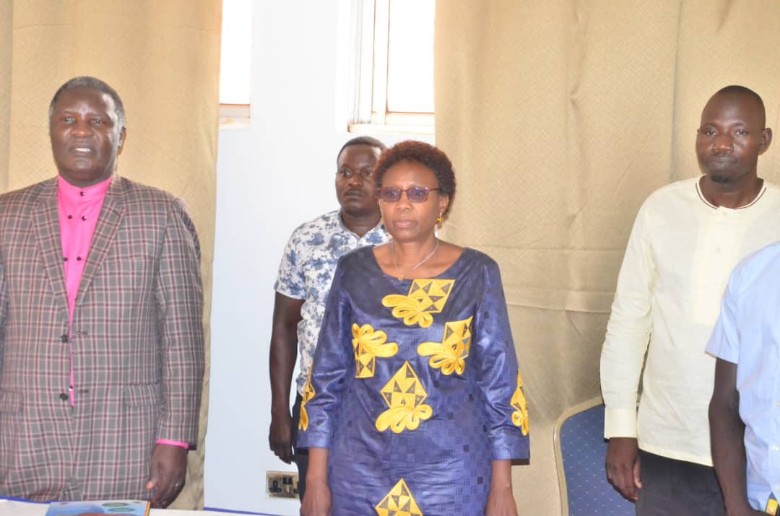
Dr. Aceng, who doubles as Lira City woman MP, was speaking at an “enagement meeting with Lango cultural and religious leaders on HIV/AIDS in the sub-region.”
The minister informed the Friday meeting that AIDS drugs are extremely expensive. “We are buying these drugs in cents, we are buying drugs for sickle cell disease – the cheapest is shs700,000. Can a local person buy? It’s not affordable.
“The survey shows that (by the way, sickle cell disease goes hand in hand with malaria) where there is a high prevalence of malaria, sickle cell is also prevalent because malaria parasites are typically – it has a way of changing the genes. We must fight it together,” Dr Aceng stated.
She told the meeting that the lesson “we are learning from here is very important, and I want us to take it seriously because if you are not annoyed, AIDS will continue to spread.”
“If we are not annoyed, our children of today have not seen ‘slim disease’. I don’t know how many remember slim. When I say slim, how many people have seen those who were sick of the ‘slim disease’ and were too weak, underweight, and so on? Fortunately, many people saw it.”
Dr. Aceng stated that ‘slim disease’ could recur. “It is not re-emerging due to the availability of drugs. Our children today regard HIV/AIDS as a common disease that can be contracted and treated with medication. People believe that even if I get it, I will medicate and be healthy.
“However, these drugs are bought by the government and its partners.”
If partners say they do not have money, the health minister says the government will have to buy them.
“There are 1.3 million people on medication. Is it possible for them if partners leave it to the government? It means we are going back to square one. However, if there were no new infections and we allocated the money used to treat and fight AIDS to build more hospitals, our hospitals would be in a different state.
“So we are preventing development by allowing HIV/AIDS and other diseases to spread. However, the world has agreed that by 2030, AIDS should no longer be a public health issue that requires our attention. When we say public health issue, we do not mean it does not exist, but “it is not important and our focus is not on it” – because the number of people infected is insignificant.”
If only 10 people in Uganda become infected each year, it means it is no longer an important issue, but it does not mean AIDS will be eradicated, she added.
“In Lango here, in Lira City (but I do not want to scare you because all cities have the same problem), because a city is an urban area that accommodates all types of people: business people, prostitutes, drunkards; all types live in the city with their different thoughts, intentions, and knowledge, and a city is where better living conditions are available.
“Even if you go to Fort Portal, you will find the prevalence there, as will Masaka, but other cities have a higher prevalence than others. Lira City, for example, leads other cities because we, too, faced the unfortunate situation of having IDP camps. Camps caused a spike in prevalence, so when it combined with the city (because our (Lira city) is for business), it brought together all types of people in northern Uganda, and the prevalence increased slightly,” Dr Aceng explained.
People are dying, let’s work!
She demanded: “It is now a work, and cultural leaders have subjects who understand what they say. When each of you speaks, they pay attention. Tell your subjects that AIDS still exists and will continue to kill people.
“Those who are still dying are many and majority are men, because they fear going to the hospital, women get there early. Women, whether sick or not, go for HIV testing when an announcement is made. Men are fearful. They fear hospital, they fear sickness. When you go to the hospital, women care for the patients; when you go to church, women pray. Women witnessed Jesus (Christ)’s resurrection from the dead. Where were the men?”
Dr. Aceng revealed that there is a certain level of fear that men must overcome in order to undergo testing.
“Because if you die, who will multiply the population?” “TB, Lango, HIV Lango. Who is dying? Men. We need to wake up and address this issue, and only cultural leaders can do so. Religious leaders can speak; cultural leaders must speak without fear.”
“Earlier, I heard Dr. Hillary say that people are afraid to follow advice on tests and marriage. It is true. Many of us grew up without our parents discussing sex or marriage. Nobody tells you until you bring home your boyfriend and tell them you are ready for marriage. It is our fault that our children become pregnant without realizing why.
“A number of pregnancies that occurred during Covid-19 were our fault as parents; we let our children down because we did not teach them; we need to talk with examples and lead by example,” the minister stated.
Lango has to fight hard
Dr. Aceng, a key figure in Lango, stated that the sub-region needs to fight hard. “I can not be a Minister of Health and Lango will fail to end AIDS. That would be a big shame. I am asking that we stand up and begin talking about AIDS.
“There is nothing lacking in Lango here that prevents us from eradicating AIDS,” Dr. Aceng stated.
Immunisation
Dr. Aceng stated in April 2025 that the Ministry will deliver malaria vaccines to Lango and across the country. Malaria, she said, kills a lot of people in northern Uganda.
“People die in Eastern Uganda not because malaria is prevalent, but because they contract severe malaria, causing them to pass blood as urine. In northern Uganda, we have two types of parasites: seasonal (out during the dry season) and perennial (existing all year). This has increased the prevalence of malaria.
“I urge you, once the vaccines arrive, to embrace it, and charity begins at home,” she told stakeholders.
Stigma
Dr. Hillary Okello, Lira City’s Public Health Specialist and HIV Focal Point Person, urged love and coexistence between HIV/AIDS patients and “healthy ones.”
Many people, he said are living denial stat. “You hear someone saying ‘malaria, typhoid, brucellar’, even those tested and found to be having HIV/AIDS still refuse because of stigma. When you begin medication early, the cost of treatment is reduced.
“We know that drugs are free, but if the virus spreads, it can cause other illnesses known as opportunistic infection. This forces you to return to the hospital on a regular basis, wasting money on treatment each time.
“It is important to let people know this truth in our different clans so that people start to medicate, know their health status so that he or she does not waste money on malaria yet treating a different disease. Fighting stigma is important, and if we do, many people will come out, and when they do, they will be aware of their situation and begin treatment.”

Dr. Okello stated that once these people begin taking their medication, their viral load will decrease, and they will no longer pose a risk of infecting one another.
“As we said earlier, this is a multi pronged approach. It’s not only our work as medical workers but a collective responsibility. You, as a cultural leader, have a role to play, as do your subjects. If we join hands, it means we can reduce the level of HIV/AIDS prevalence.”
According to Tom Etii, Acting Director of Partnership at the Uganda AIDS Commission, 104 people in Uganda contract HIV/AIDS every day, which he describes as a “large number.”
He added that the virus infects eight people per hour in Uganda. “There are many infections among girls. Who is causing this? We, men.”
The Uganda AIDS Commission, he said, has developed a “National AIDS Action Plan,” noting that the Lango sub-region has 94,600 people living with AIDS, Acholi 77,000, and Ankole 148,000. Of course, Buganda leads with 312,200.
Poverty
Poverty is one of the main causes of infection, according to Qunito Rwotoyera, Director of Finance at the Uganda AIDS Commission. He stated that the Commission uses a multisectoral approach to reduce AIDS in Uganda.
Cultural institutions are among the most important stakeholders in reducing AIDS. In 2017, the President launched the Presidential Fastrack Initiative, which aims to eliminate AIDS as a public health threat by 2030.
According to Rwotoyera, there are 1,472,000 people in Uganda living with AIDS, with approximately 19,000 dying each year.
Meanwhile, Bishop Luwere Joshua, the National Overseer of the Born-Again Pentecostal Churches of Uganda, told the meeting that “unity is power,” but that it must be “practical,” urging both cultural and religious leaders to be “peacemakers” as the Bible states.
Bishop Luwere stated that God recognised Lango as a tribe and that He chose leaders. “You need your leadership when divided; every time you divide, you are fighting each other; you take the enemy’s guns and bullets and do what you want, you face each other.”
Discover more from tndNews, Uganda
Subscribe to get the latest posts sent to your email.