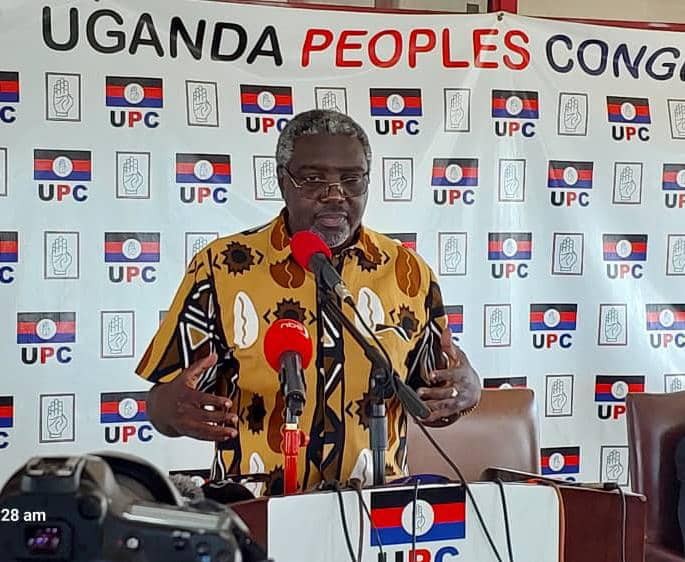
Kampala | Even as the country’s national budget grows year after year, ordinary citizens continue to feel vulnerable. This trend concerns some political leaders.
According to Jimmy Akena, President of the UPC, our struggling economy has forced the ruling government to implement new tax policies and programmes in order to collect the targeted UGX31.574 trillion in taxes in FY 2024/25, with taxpayers hoping for good service delivery returns.
“…of late, is a tall order, especially in health, education, and social welfare programmes, resulting in increased tension!
“UPC holds the view that such government policies should be fair to the citizens and there must be equitable access to opportunities and services,” Akena said on Wednesday.
For instance, in 2018, Akena reminded the country that UPC opposed the infamous Over-The-Top (OTT) tax on data as it was very unfair to the tax payer and a hinderance to the growth of the digital economy in Uganda.
The ‘digital data tax’ was later abandoned by the government. “Our view was and still the same on the mobile money tax! Much as the government is trying to enhance the tax revenue, it is a bad idea to over stretch the tax payer!
“UPC has been keenly following with concern the discrepancies in the issue of tax waivers, which has highly favoured foreign investors at the expense of the local traders.
“Much as we need to influence foreign investment as a country, we should not allow to sacrifice our local companies,” the 2026 presidential hopeful, Akena, urged.
He believes that favouring foreign companies will undermine the efforts of Buy Uganda Build Uganda (BUBU). “UPC therefore, demands for fairness and equity in the implementation of such policies (tax waivers) without discrimination to reduce on the impasse in the trade sector.
“The Party believes that involving stakeholders in formulating policies is key and educating them about the same is very paramount! All along, Uganda has been registering industrial unrest especially in the health and education sectors.”
URA, city traders at war
Until today, a number of Kampala City traders have closed their doors, blaming URA’s tax enforcement policies. Uganda has lost millions, if not billions of dollars as a result of the ongoing anti-EFRIS protest.
“Today, it is the trade industry having concerns with the implementation of the new Electronic Fiscal Receipting and Invoicing Solution (EFRIS) initiative by Uganda Revenue Authority (URA) under the Domestic Revenue Mobilization Program whose aim is to record business transactions and share the information with URA in real time,” Akena noted.
Also read: Regressive tax policies hurt citizens, says Rev. Father Okello
“This has increased tension between the traders and URA leading to business closure in Kampala and other parts of the country at a time when businesses are just recovering from the consequences of Covid-19 lockdown.
“This does not only affect internal business transaction and collection of government revenue, but also put regional trade at stake!”
According to him, the party has noted that EFRIS started with big business establishments like industries and super markets, among others.
Extending the policy to medium sized business establishments has been a challenge as our business community lacks sufficient knowledge on this new tax initiative, the Congress leader stated.
“UPC calls upon URA to go slow while implementing EFRIS program. The focus and emphasis should be put on educating and engaging the business community about such policies on a regular basis.
“In readiness for 2026 general elections, we are in preparations of working on our manifesto and such tax policies shall be revised to place the best interest of our people at the center of everything.”
Discover more from tndNews, Uganda
Subscribe to get the latest posts sent to your email.