The evening air is settling over Gulu’s Awach Central Village as 9:30 pm approaches and from a grass-thatched hut emerges Mercy Acan (not her real name, as she requested anonymity to protect her identity).
Dressed in a blue skirt, white shirt, and black sandals, the 34-year-old single mother offers a gentle smile, welcoming a visitor into her parent’s compound and she gestures to a seat under a tree, a fleeting moment of peace in a life that has become a form of captivity.
Acan was once a successful businesswoman, running a small enterprise in the nearby Awach central market, just four kilometers from her home but her life took a catastrophic turn last year in July 2025, she was misled by a friend to a club – a place she had never visited before.
On that Thursday evening, as she walked home from the center and reached the road junction at Ajulu-Barrack-Mission road, she was ambushed by six men, between the ages of 25 and 30. They grabbed her and dragged her into the bush, where three of them took turns raping her.
However, the physical trauma was only the beginning and three months later, the full weight of the ordeal crashed down on her.
“I thought I was only just sick, not pregnant; I had contracted candida, and my first symptom was a fever after a week and when the results came, it felt like a joke,” Acan revealed, recalling the moment her test results came back.
But the news was no joke and like wildfire, word of her rape spread through the community and the stigma was swift and brutal not only for her, but for her family and her mental health began to unravel.
“At the moment, if I disagree with a colleague or neighbor, they try to find a way of mentioning something about my rape incident in the past and my own children are facing the same dilemma,” Acan told tndNews, Uganda.
She describes her life as being in “captivity” with the stigma and the realization that no one would take responsibility for the child she was carrying pushed her to a desperate decision.
“I asked myself, ‘Should I remove the baby?’” she recalls and with no one to turn to, she decided to terminate the pregnancy using a local concoction.
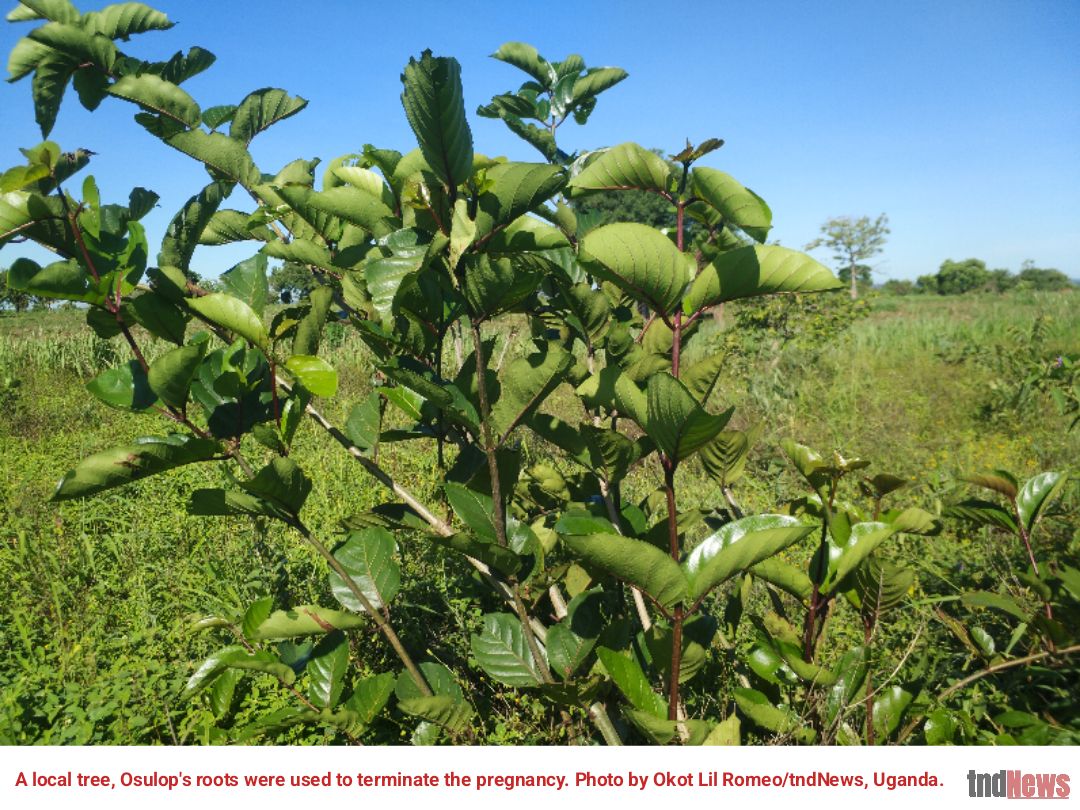
She mixed two traditional substances –Atakorach- (Aloe Vera) and the roots of an indigenous tree called – Osulop-in a cup of water and drank it.

However, even then, relief was not immediate and upon arrival at the emergency ward, she says no doctor came to her aid but it was only when she was near death that a nurse intervened, stabilized her and referred her to Gulu Regional Referral Hospital where she remained for two days before being discharged.
In addition, when she finally returned home, she was forced to confess to her mother and she was questioned about where she had been for the past two days.
“I was afraid to tell her because sometimes she can be arrogant and I finally told her everything but I begged her not to tell my father or brother because they would kill me if they knew,” Acan said.
Acan’s story is not an isolated incident and she claims that in Awach town council, rape is a weekly occurrence with the perpetrators often not apprehended.
“Every Thursday, one of two girls is raped by criminal gangs along the way home and last year, over 15 girls were raped but few cases were reported due to ignorance and poverty,” she says, noting that it often leads to abortions.
“One girl lost her life in the process of procuring an abortion and I spent over 500,000 shillings on post-abortion care and treating candida,” she added.
Her plea is simple, “I am appealing to all girls to distance themselves from procuring abortion and it is a risk to your life and avoid moving at night, take a boda-boda or move in groups to prevent such incidents.”
 Richard Jamisco Akena, the LCIII chairman of Awach town council, condemned the incidents but pointed to broader societal issues.
“The issues of human rights as presented to our children have spoiled our youth. They are misinterpreting human rights in the community and we need massive capacity building on human rights,” Akena said.
He added: “Last year and this year, we have been affected during the election period and many youths have been misled and used for criminal activities by politicians for money; and for me, I blame the central government and they should have heavily deployed security officers.”
Akena also noted that he has not received any formal reports of the abortion or rape cases in his office, attributing this to ignorance and poverty within the community that prevents victims from coming forward.
The deep wounds of stigma
Freddy Odong, a psychiatrist, explained that the social stigma surrounding rape and abortion is a public health crisis in itself.
“The impact of social stigma is detrimental and it leads to physical deterioration, distress, and depression, which affects the victim’s productivity and mental health,” Odong said.
“Someone who is stigmatized has a lot of fear to associate with others and to avoid that, they usually keep to themselves,” Odong added.
Dr. Pebalo Pebolo Francis, an obstetrician and senior gynecologist at Gulu Regional Referral Hospital (GRRH) and lecturer at Gulu University, provided a stark medical perspective.
“The deaths you see in the hospital are just the tip of the iceberg and thousands of women are dying silently in the community after using toxic local herbs to terminate pregnancy,” Dr. Pebalo stated.
 He further noted that “this is fueled by the restrictive law on abortion and the fear of public stigma.”
He warned that the use of rudimentary methods causes intense uterine contractions, cuts off blood supply, and can lead to the uterus dying completely.
“Only the poor suffer more than the rich in this situation and the poor resort to local herbs because they have no alternatives for safe abortion,” he noted.
Dr. Pebalo called for comprehensive sexual and reproductive health education for young girls and for post-abortion care to be made available to all citing a Ministry of Health report from 2021-2022, he noted that over 800 abortions are procured daily in Uganda, with GRRH admitting 5-10 women daily for post-abortion complications.
Cinderella Alimocan, a human rights lawyer, clarified Uganda’s restrictive legal framework on abortion.
“Under the constitution and the Penal Code Act, any attempt to procure an abortion is criminalized and a woman who attempts an abortion, even if unsuccessful, faces up to seven years in prison,” Alimocan explained.
She noted that the confusion surrounding the law creates fear among both patients and health workers, even though providing post-abortion care is not prohibited.
“Denying post-abortion care would violate a woman’s right to health and life,” she stressed.
Discover more from tndNews, Uganda
Subscribe to get the latest posts sent to your email.