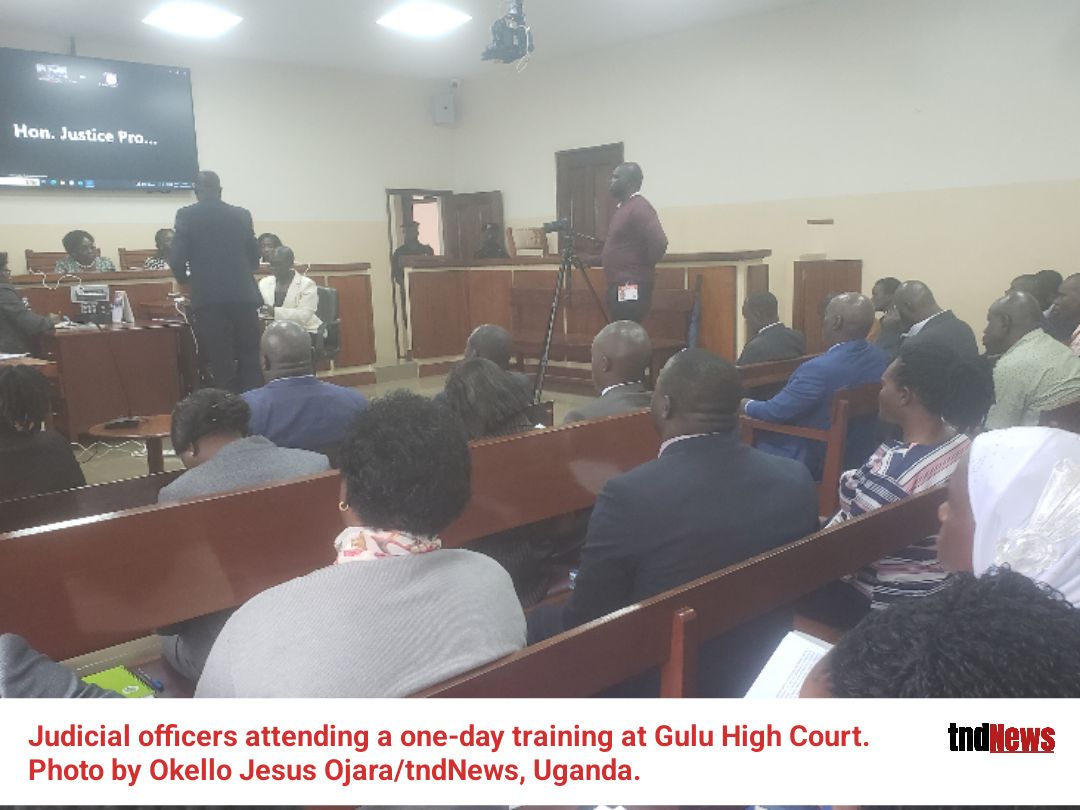
The Head of the Gulu High Court Circuit, Phillip Odoki, opened a one-day “Justice for Her” training aimed at improving the handling and expedited disposal of Sexual and Gender-Based Violence (SGBV) cases in northern Uganda.
The training, held at the Gulu High Court, brought together judicial officers, prosecutors, defence lawyers, court clerks, and interpreters from the four magisterial areas under the circuit. It serves as a preparatory session ahead of an upcoming SGBV criminal session.
In his opening remarks, Justice Odoki welcomed participants to Gulu jokingly referred to as “the Dubai of Uganda” and underscored the urgency of the initiative.
“We really want this programme to work and we have no room for failure,” he said.
Justice Odoki noted that northern Uganda’s history of prolonged conflict has left deep social scars, with women and girls disproportionately bearing the brunt of sexual violence.
“This region suffered a long period of war. The culture of the people was affected. War brings many challenges, and women have faced the biggest burden,” he said.
Confusion over what constitutes SGBV
One of the key issues flagged during the training was a lack of shared understanding among justice actors about what qualifies as an SGBV case.
Justice Odoki revealed that during a recent joint case-listing exercise, officials disagreed on classification.
“We discovered that we did not have a common understanding of what sexual and gender-based violence cases could be,” he said.
He further cited an instance where a murder case involving a man accused of killing his son had been categorized as gender-based violence.
The training, he added, is intended to build conceptual clarity around SGBV offences, legal definitions, and procedural requirements.
Chief State Attorney Sherifah Nalwanga said the training is critical for strengthening prosecution standards, particularly in cases involving vulnerable victims.
“SGBV cases are unique and they require strict adherence to the law, especially on elements such as proof of penetration, identification of the perpetrator, and proper handling of exhibits,” Nalwanga said.
She noted that inconsistencies in charge framing, interpretation, and evidence presentation can weaken cases and delay justice.
“When the law requires proof of penetration, that element must be clearly brought out in court and if interpretation is inaccurate or key terms are watered down, it affects the integrity of the proceedings and can result in acquittals,” she explained.
Nalwanga added that prosecutors must work closely with investigators and court staff to ensure survivors, many of whom are children, are protected from secondary trauma during trial.
“We must balance the rights of the accused with the rights and dignity of survivors. That is the essence of justice,” she said.
On the defence side, Counsel Ladwar Walter emphasized the need for fairness, clarity, and adherence to due process in SGBV trials.
“As defence counsel, our role is to ensure that the accused person receives a fair trial, as guaranteed under the Constitution,” Ladwar said.
“This includes ensuring that charges are properly framed and that evidence meets the required legal threshold,” Ladwar added.
He welcomed the training as an opportunity to align all actors on definitions and procedure.
“When there is confusion about what constitutes gender-based violence, it affects everyone the prosecution, the defence, and ultimately the court; a shared understanding helps avoid misclassification and ensures cases are handled appropriately,” he noted.
Ladwar also highlighted the importance of accurate interpretation in court, particularly in cases involving juveniles.
“If key terms are mistranslated, especially in sensitive offences, it may distort the record and prejudice either side. Precision in language is not a luxury, it is a necessity,” he said.
Justice Odoki acknowledged that interpretation remains a practical challenge in SGBV trials and some court clerks and interpreters, he said, shy away from explicitly translating sexual terms in open court.
“Some clerks fear to mention certain words, raising concerns about how mistranslation can affect proof of critical legal elements such as penetration,” he observed.
Participants are expected to explore the legal and evidentiary consequences of inaccurate translation, particularly in cases involving juvenile offenders and child survivors.
The training forms part of broader efforts under the “Justice for Her” initiative to improve coordinated case management, reduce case backlog, and promote survivor-centred justice within the Gulu High Court Circuit.
The “Justice for Her” project was first launched in Gulu last year by the Principal Judge following discussions between the Judiciary of Uganda, the Austrian Development Cooperation, and UN Women.
Its implementation in the region now marks a renewed push to address persistent gaps in the prosecution and adjudication of SGBV cases.
Discover more from tndNews, Uganda
Subscribe to get the latest posts sent to your email.