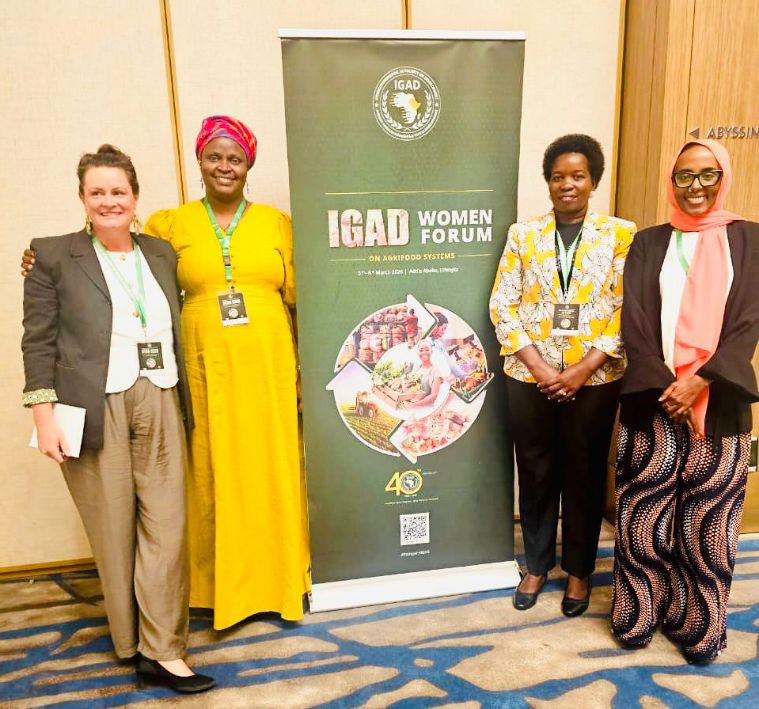
Lira District Woman Member of Parliament, Linda Agnes Auma, has called for increased funding and support for Ugandan women in agribusiness.
Auma emphasised that Uganda is committed to collaborating with IGAD to accelerate priorities and close the gender productivity gap across the region.
The MP was speaking while representing the Parliament of Uganda at the IGAD Women’s Forum held at the African Union Headquarters in Addis Ababa, where she presented a paper on the establishment of the IGAD Women’s Forum on Agrifood Systems.
Auma, who currently serves as chairperson of the committee on agriculture, animal husbandry and fisheries, vice chairperson of the national women’s council under the Ministry of Gender, Labour and Social Development, and publicity secretary for the Uganda Women Parliamentary Association (UWOPA), made the statement on Tuesday, March 10, 2026.
In her remarks to the chairperson, distinguished delegates, and colleagues, Auma stated: “In Uganda, women constitute approximately 70-75% of the agricultural labour force. They are central to food production, processing, and household nutrition.
“However, they continue to face structural barriers in land ownership, access to finance, extension services, and climate resilience resources.”
She added that Uganda has established a strong policy foundation for gender-responsive agriculture, citing several frameworks:
“The Uganda National Gender Policy mandates gender mainstreaming across all sectors. The National Development Plan IV integrates gender equality as a cross-cutting priority. The Agricultural Extension Policy emphasises the inclusion of women and youth.
“Furthermore, the Land Act provides for spousal consent and recognises customary tenure rights. Despite these frameworks, only 10-16% of registered land titles are held by women.”
The MP lamented that women farmers are still less likely to access high-value extension services, mechanization, and commercial value chains. “The gap between policy and implementation remains our core challenge,” she noted, while highlighting encouraging cutting-edge work currently underway.
Auma highlighted several government initiatives, including the Parish Development Model launched in 2022, which aims to transform household incomes and improve financial inclusion at the grassroots level by prioritizing women within the parish SACCO structure.
She also cited the GROW Project (Generating Growth Opportunities and Productivity for Women Enterprises), which aims to increase access to entrepreneurial services. The initiative supports women-owned enterprises to grow from micro to small and medium-sized enterprises, including those in refugee-hosting districts.
“We also have the Uganda Women’s Entrepreneurship Program, providing interest-free, revolving credit to women’s groups to enhance entrepreneurship, value addition, and market access, focusing on vulnerable women including unemployed women, single mothers, and widows. The Land Act (Cap 227) recognises spousal consent and protects customary tenure rights,” MP Auma said.
“Uganda is also rigorously researching and piloting joint land titling or co-titling, which is important because land serves as the collateral gateway for inputs, irrigation, mechanization, and finance.
“Civil society organizations and local initiatives are actively advancing practical solutions to improve women’s access to land and productive resources.”
The MP further outlined additional policy frameworks: “The Gender and Equity Budgeting Framework requires Ministries, Departments and Agencies to demonstrate gender responsiveness in budget allocations. The National Agricultural Extension Policy promotes inclusive advisory services targeting women and youth.”
“Under the Uganda Climate-Smart Agriculture Programme, emphasis has been placed on promoting drought-resistant crop varieties, scaling water harvesting and small-scale irrigation, and targeted resilience programming for women smallholders. Given Uganda’s vulnerability to climate shocks, women-focused Climate-Smart Agriculture investments are reducing production risks,” she explained.
Uganda launched the National Climate Change Gender Strategy and Action Plan (2026-2031) on March 8 during the International Women’s Day celebrations. The action plan aims to ensure all climate actions in Uganda are gender and equity responsive.
Addressing priorities for empowering women in agriculture, Auma outlined both near-term and mid-term priorities.
“Scale practical pathways for women to secure land rights, including documentation support, co-titling incentives, legal aid, and land dispute resolution support. Land rights gains directly translate to credit and input access.
“We need gender-responsive extension services by making women’s access to extension measurable through setting coverage targets, establishing women-friendly delivery times and locations, and building the capacity of Community Development Officers on agro-entrepreneurship.
“We must prioritise stronger enforcement of GBV prevention and response in rural and agriculture value chains, with survivor-centered access to services. There is also a need for production of a standard set of sex-disaggregated indicators for land documentation, extension reach, yields, income control, and enterprise growth.”
“Closing the gender productivity gap in agriculture requires secure access to productive assets, particularly land and finance. Therefore, strengthening women’s land security and asset ownership remains a key priority.
“Secondly, women must transition from being labour contributors to productive entrepreneurs, and this requires targeted investments in skills development, female-friendly labour-saving technologies, and financing for women-led agribusinesses.”
Discover more from tndNews, Uganda
Subscribe to get the latest posts sent to your email.