As Uganda continues its phased electoral roadmap with the upcoming youth elections scheduled for Thursday, June 19, security in the Eastern region has been tightened, particularly in Jinja and the greater Kiira policing zone.
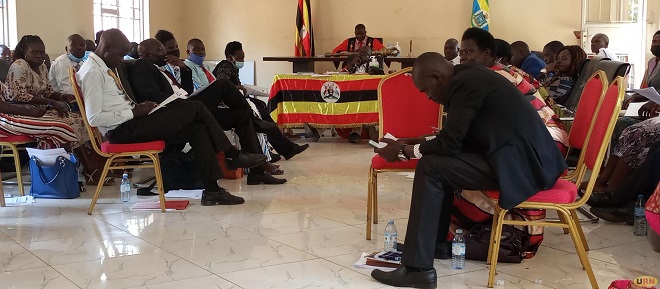
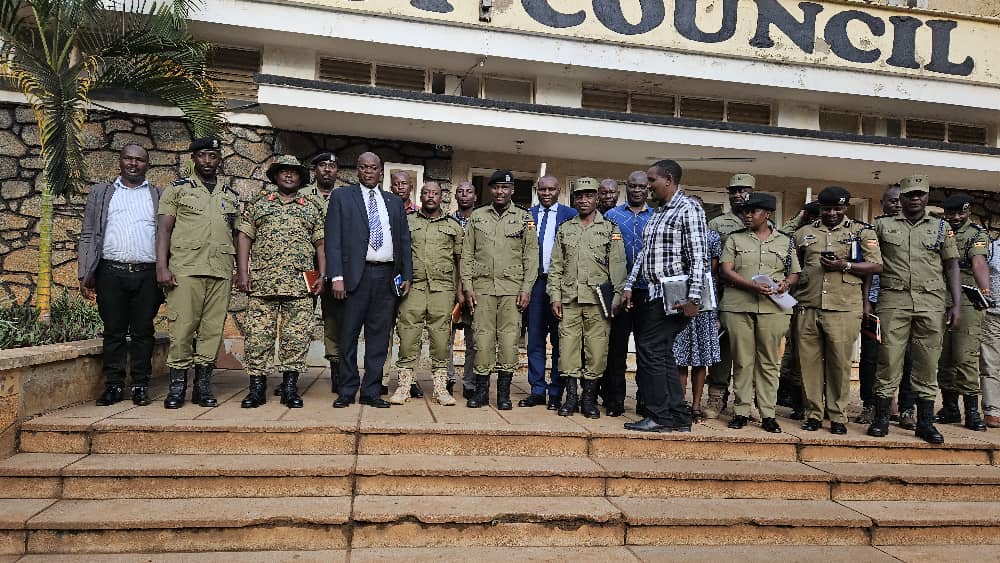
The Regional Joint Operations Committee (JOC) convened a high-level meeting on Tuesday, June 17, 2025, at Jinja City Hall to assess and plan for potential electoral threats and ensure peaceful participation in the ongoing electoral process.
The meeting, chaired by the Resident City Commissioner (RCC) of Jinja, Richard Gulume, brought together key security stakeholders, including the Uganda People’s Defence Forces (UPDF), Uganda Police Force (UPF), Electoral Commission (EC) officials, and city leadership.
The gathering sought to strengthen inter-agency coordination and develop robust strategies to maintain law and order throughout the three critical phases of the electoral process—before, during, and after polling.
In his opening remarks, RCC Richard Gulume commended the joint security team for their efforts during the just-concluded National Resistance Movement (NRM) grassroots elections.
He particularly noted the high level of professionalism exhibited in handling potential disruptions and safeguarding the democratic space. However, he issued a stern warning to political aspirants and their supporters against the formation of illegal militia-style groups, commonly referred to as “Gaali,” which he said pose a serious threat to public safety and the integrity of the electoral process.
“We have observed the emergence of loosely organized groups with intentions to intimidate or cause public disorder under the guise of political support. I want to caution all political actors that any attempts to form militias or incite unrest will be dealt with decisively,” Gulume said.
Gulume emphasized that the conduct of security personnel must remain above reproach, especially in the highly charged pre-election environment.
Officers were reminded to maintain impartiality, uphold the rule of law, and strictly follow the Electoral Commission’s guidelines while handling political events and campaigns.
“Candidates might attempt to malign your character or accuse you of bias. Do not be swayed or distracted. Consult your superiors, and never act alone. Teamwork is the bedrock of effective security enforcement,” Gulume told the officers.
Brig. Gen. Emmanuel Kanyesigye, the Cantonment Commander for the Busoga sub-region, echoed the RCC’s sentiments, calling for regular joint security meetings and real-time reviews of operational strategies.
He stressed that proper coordination and inter-agency cooperation were vital in neutralizing threats before they escalate into actual violence.
“Regional JOC meetings serve not just as planning platforms but as avenues for synergy between agencies. We must continue to work together intentionally, share intelligence, and adapt our tactics in real-time,” Brig. Gen. Kanyesigye stated.
He urged political leaders and the general public to refrain from using hate speech, especially in campaign rhetoric, cautioning that such behavior undermines national unity and the values of a democratic society.
“Freedom of speech is a constitutional right, but it must not be abused. Any form of incitement or inflammatory remarks against ethnic or political groups will be treated as a threat to national security,” the commander warned.
The Regional Police Commander (RPC) for the Kiira Region, Senior Superintendent of Police (SSP) Charles Nsaba, reassured the public and the Electoral Commission of a dominant and visible security presence throughout the electoral period.
He directed District Police Commanders (DPCs) under his jurisdiction to hold divisional JOC meetings without delay and to monitor their areas with increased vigilance.
“We are leaving nothing to chance. I’ve instructed the three DPCs to convene immediate security reviews and finalize area-specific deployment plans. Unlawful processions, unauthorized gatherings, and street demonstrations will not be tolerated,” SSP Nsaba declared.
He further emphasized the need for preventive policing anticipating potential unrest and intervening before it unfolds. He said crowd control units had been briefed and equipped, and community liaison officers had been activated to engage youth and vulnerable groups ahead of Thursday’s youth elections.
The Regional Returning Officer for the Busoga sub-region, Deo Natukunda, provided an update on the Electoral Commission’s preparations.
He said the commission had reached the midpoint in its electoral roadmap and was currently conducting intensive civic education sessions at district and regional levels.
“Every polling station has been mapped, and no location will serve more than 600 voters. We are reducing logistical bottlenecks and avoiding crowding to ensure efficient polling. Our message to the electorate is clear: know your rights, understand the voting procedures, and participate peacefully,” Natukunda explained.
He acknowledged past issues around candidate nominations, particularly errors and omissions that have historically led to disputes, appeals, and petitions. To that end, he said the commission was prioritizing accuracy, fairness, and transparency in the vetting and registration processes.
“We’ve put in place a rigorous verification mechanism to minimize technicalities that may lead to disqualifications or post-election litigation,” Natukunda added.
He also appealed to security forces for targeted deployments at vulnerable polling stations and high-risk zones, noting that the EC’s operational success is heavily reliant on the prevailing security environment.
In a strongly-worded warning, Jinja City Returning Officer Flavia Nakasi addressed concerns over identity manipulation among youth candidates.
She disclosed that the EC has encountered a few incidents where nominees attempted to tamper with their National Identification Numbers (NINs) or misrepresent their date of birth; likely in an effort to fit within the eligibility criteria for the youth elections.
“The EC data system does not permit alterations once registration is complete. Any attempt to forge NIN numbers or alter biographic data is a criminal offense. We are ready to apprehend and prosecute any individual found culpable,” Nakasi declared.
She revealed that Jinja City comprises 141 registered villages, each of which has undergone EC verification and voter sensitization campaigns.
Nakasi urged local leaders to report any suspicious activities related to nomination or voter fraud.
Uganda’s youth elections are widely viewed as a gateway to fostering democratic engagement among young people, who make up over 70 percent of the national population. The upcoming village-level elections are especially significant because they provide a foundation for youth councils and representatives who will influence both local and national policy debates.
The current political environment, however, remains delicate, with security agencies concerned about misinformation, intimidation, and politically motivated violence. Several civil society organizations have also raised alarms over possible voter apathy due to fears of insecurity and lack of awareness.
To counteract these challenges, the Electoral Commission, security agencies, and community leaders have intensified grassroots engagement through public dialogues, media campaigns, and partnership with religious and cultural institutions.
Tuesday’s Regional JOC meeting ended with a unanimous call for unity among security forces, election officials, and the general public. Participants agreed that Uganda’s path to credible elections depends on adherence to lawful processes, mutual respect among political contenders, and a culture of nonviolence.
RCC Richard Gulume closed the meeting by reminding all present of their constitutional mandate: “Our duty is to protect life, property, and the sanctity of the ballot. We are not here to take sides, but to ensure that every citizen, regardless of their political affiliation, has the right to vote in peace and safety.”
As Uganda marches towards key national and local elections in the coming months, the spotlight will remain firmly fixed on different regions, where the interplay between politics, youth, and security presents both opportunity and risk.
Discover more from tndNews, Uganda
Subscribe to get the latest posts sent to your email.