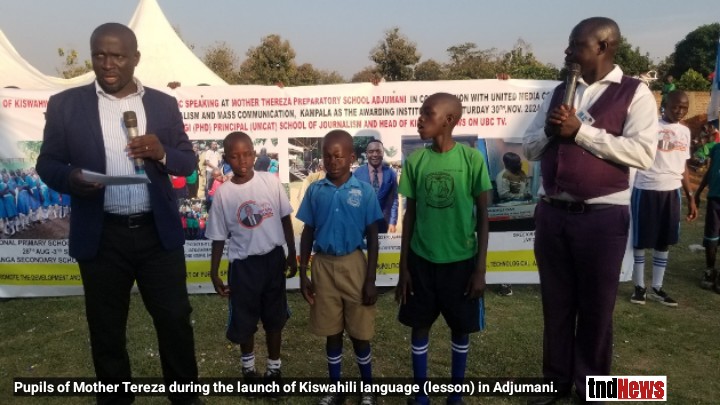
Adjumani I Mother Tereza Preparatory School’s achievement demonstrates Adjumani’s linguistic potential.
The introduction of Kiswahili in the district is expected to increase cultural diversity, improve communication, and strengthen economic and social ties with Kiswahili-speaking countries in the East African Community (EAC).
During the launch, Edwin Nyachwara, Principal of the UMCAT School of Journalism and Mass Communication and Head of Kiswahili News at UBC TV, praised Mother Tereza Preparatory School for pioneering the program before the government implemented it.
He announced that Kiswahili lessons would begin early next year for professionals in the Adjumani district, with a 12-month course costing shs300,000.
“We plan to teach Kiswahili across Adjumani district. I appreciate the Inspector of Schools, the District Education Officer (DEO), and other stakeholders in the Ministry of Education for their support.
“The program is already gaining momentum with backing from the President and the EAC Secretariat, and we are committed to supervising its successful implementation,” Nyachwara said.
President Yoweri Kaguta Museveni launched the national Kiswahili program at Kyambogo University, where 350 students completed Kiswahili courses. The program is part of Uganda’s overall strategy to improve regional integration through language.
Farida Kasimu, a Primary Five pupil at Mother Tereza Preparatory School, shared how learning Kiswahili has transformed her communication skills.
“When I started learning Kiswahili at Mother Tereza, I began greeting my family at home in Kiswahili. I would say, ‘Habari?’ and my mother would respond. I also tell my siblings, ‘Mama anaenda shule.’ I wish all schools in Adjumani would introduce Kiswahili teachers,” she said.
Edea Sunday, Adjumani District’s Inspector of Schools, emphasized Kiswahili’s role as a unifying language in the East African community.
“Kiswahili is now one of the official languages in Uganda because it connects us with other East African countries. Not all member states use English, but Kiswahili can serve as a bridge for communication, enabling free movement and integration within the region,” she explained.
The success of this program will be dependent on the combined efforts of educators, administrators, and local leaders.
With dedication and collaboration, Adjumani district could become a regional hub for Kiswahili language learning in Northern and West Nile Uganda, empowering its residents to thrive in an interconnected world.
Discover more from tndNews, Uganda
Subscribe to get the latest posts sent to your email.