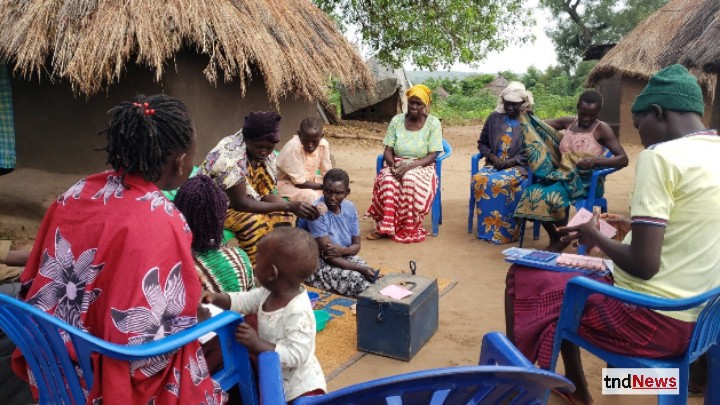
Northern Uganda| In a refugee settlement, a group of 14 women and 2 men sit in a circle in the compound of a homestead of mud huts on a sunny Saturday in the Palorinya refugee settlement in Itula sub-county, Obongi district in Northern Uganda.
At the mention of their name, each individual reveals how much money they have with them and hands it over to one of the women, the treasurer. She counts it, makes a record in a ledger book, and puts it in the box that is in the middle of the circle.
The amount is mostly shs5,000. This is a regular Saturday practice for the members of the Budri Refugee Camp and Host Communities Village Loan Saving Association.
Cilcia Kiden, one of the congregants, started this journey by saving only shs1,000 in 2018 when she joined the group. Today, the 52-year-old widow is the proud owner of a poultry farm and a vegetable vending business in the settlement.
She explained that her group members used to save between sh1,000 and shs10,000 a week.
For Kiden, who lost her husband in 2019 to diabetes, VSLA has been more than just a means to boost her economic well-being but also key in her overcoming domestic violence in her family. Being the third wife, Kiden has shouldered the burden of raising five children alone.
When Kiden and her husband first came to Uganda in the 1990s, they settled in Elema camp in Ajumani District where she earned her income through brewing alcohol, vending, and collecting firewood to fund her children’s education, healthcare, and other essential needs.
Unfortunately, she recounted, her husband and his friends would consume her alcohol without payment. An argument would then ensue, often leading to physical abuse.
“One day, he returned home drunk and beat me very badly with a piece of wood. I got eight stitches and was bedridden for over six months. I could not work for that period,” she narrates.
A turning point came in the aftermath of a cholera outbreak during that period. Her husband, recovering from the illness, abandoned his drinking habits and established a small business. The physical abuse also subsided and there was an improvement in financial stability but Kiden still faced restrictions on her economic activities.
Despite the challenges, she persevered, ensuring her children received education.
“Cholera was my savior. Our well-being improved. My children could have fish or even meat once in a while. I was not battered, whether I had the money for upkeep or not, all I wanted was to see my children go to school like others did. By then we had better health centers and medication was not a challenge at the camp,” recalled Kiden.
With the encouragement of the 2004 peace agreement signed in South Sudan, the family returned to South Sudan in 2008 with hope for a new life at home. Unfortunately, war broke out in their country a few years later, prompting them to flee to Uganda yet again in 2016. This time they settled in Budri refugee camp, one of the camps in the Palorinya Refugee Settlement.
Upon arrival, they were provided with plots of land for settlement and farming. However, as the refugee population grew, the size of these plots reduced, making it difficult for many to cultivate their food.
The domestic violence started again. Her husband had taken up farming and started suppressing her because she was fully dependent on him. The frustrated Kiden sought solace in other women at the camp and soon learned about the village savings and loans group.
“I did not tell him about the savings group but kept taking any money I got for savings. At the end of that year, I had shs250,000. This is when I decided to tell him about the saving group,” she reveals.
His reaction surprised her. He was so excited about the idea that he went on to join a similar group for the betterment of the family’s economic welfare.
“Initially, I hardly sat with my late husband. However, planning our savings helped us communicate and plan better for our family. I can say the group became like a tool for conflict resolution for married couples like me,” says Kiden.
She started her charcoal vending business with her first saving; 15 sacks of charcoal, which earned her shs450,000. This became her capital for a vegetable vending business which has enabled her to support her family. She now only lives with two children and her father-in-law.
The three adult children moved to a nearby town. The savings, and later loans, that the group enabled her access made it possible for her to take care of her husband’s medical bills when he fell ill although he unfortunately passed on.
Harriet Joyo, the team leader of Palm Corps, a local NGO that supports refugees in the settlement noted that the VSLA groups like Kaden’s formed in the refugee camps and host communities aim at empowering the group members economically so they can afford basic needs like food.
Initially, on arrival, refugees were provided with plots of land for settlement and farming, however, as the refugee population grew, the size of these plots reduced, making it difficult for many to cultivate their food.
Development aid agencies like The World Food Programme and other partners implement programs such as food distribution for refugees and school feeding initiatives for the children in the camps.
However, these rations are often insufficient to meet the nutritional needs of families, leading to malnutrition and health issues among children and vulnerable populations.
The high dependence on monthly food rations from the World Food Program, which typically includes staples like beans, maize flour, salt, and oil has forced many refugees to engage in casual labor or other informal work to supplement their livelihoods.
This situation has led to a cycle of poverty where individuals must prioritize survival over education or long-term stability.
“Currently, because of the rationalization, most of these refugees are being fazed off from food ratio. The economic hardship often leads to heightened stress within families because when resources are scarce, conflicts may escalate, resulting in increased rates of intimate partner violence (IPV),” Joyo explains about the connection between poverty and increased domestic violence and exploitation in the camps.
She adds that some families have subjected their children to early marriage or sexual exploitation to secure resources.
According to the 2016 Uganda Demographic and Health Survey, 64% of women aged 15-49 within the refugee-hosting West Nile sub-region reported experiencing physical, sexual, or emotional violence inflicted by their current or most recent spouse or partner.
The refugee populations in Uganda, primarily consisting of women and children, face a heightened risk of gender-based violence (GBV). Data from the Gender-Based Violence Information Management System (GBVIMS) reveals a concerning number of GBV incidents reported between January 2022 and December 2023 with 5,851 cases in 2022 and 5,222 in 2023.
A separate assessment conducted by the World Bank in 2020 on gender-based violence and violence against children in Uganda’s refugee-hosting districts indicates that in approximately 80% of the 12 refugee-hosting districts in Uganda, children and women are particularly vulnerable to gender-based violence.

Ms Florence Abao, the founder of the Village Saving Loan Association to which Kiden belongs, believes that the association has contributed greatly to reducing gender-based violence in the refugee settlement.
Abao noted that before the formation of the group cases of domestic violence and suicides were rampant both among the host communities and refugees.
“In a week we could hear at least two cases of gender-based violence, and after a while, cases of suicide started cropping in, all this happened during COVID-19 when the economy was locked, so I thought of forming the savings group to bring women together and we started sharing our challenges and helping each other and gradually things changed,” said Abao who now runs two VSLAs with 30 members each and an annual average saving of shs12million for the last 3 years.
They have also benefited from partnerships with organizations such as the Lutheran World Federation (LWF) and GIZ.
“Our target is to upgrade and become a SACCO if all goes well as planned. When we grow into a SACCO it will empower many refugees and members of the host community. We are faced with many challenges of reduced food ratio, and we don’t have access to land for digging,” Abao says.
Currently, Obongi District has the Moyo SACCO, which provides financial services to a hundred VSLAs in the district.
Ernest Onyango, Obongi District Community Development Officer, agrees that the VSLA is a methodology of wealth creation that is sustainable since one of the drivers of gender violence is poverty because it makes women more vulnerable to GBV.
“Village Savings and Loan Associations (VSLAs) provide women with access to savings and credit since they don’t require collateral, enabling them to start small businesses and generate income. This financial independence reduces their reliance on potentially abusive partners or family members for economic support, thereby decreasing their vulnerability to Gender-Based Violence,” he says.
He emphasizes that the financial literacy and skills gained through VSLAs improve decision-making and reduce instances of intimate partner violence, as women are better able to negotiate their needs and assert their rights.
They also serve as platforms for discussions on gender equality, non-violence, and the importance of mutual respect in relationships. This education helps challenge existing social norms that condone violence against women and girls.
Ms Harriet Puru, a refugee and member of Abao’s group, who joined the VSLA in 2018 has benefited from the advice and loan opportunities provided to its members. Puru used a group loan to start a poultry business, layer chickens at the beginning, and later venturing into broilers. Her business has stabilized.
She now sells mature broiler chickens for shs40,000-shs45,000.
“With advice from the members, I started a poultry project and a small produce business. Now I don’t wait for UNHCR food. I can buy food, pay school fees, and even pay for medical treatment,” Puru says.
Mr Scopas Modi, a local community leader at Morobi refugee camp within the settlement commends the VSLAs for the support it has given families, especially single mothers and widows.
“The loan money has been invested wisely by most of them. Many women grow vegetables for sale and have opened small businesses, and this has reduced conflicts in families,” he says.
However, VSLAs have not been without controversy as Gloria Konyia, Obongi District Commercial Officer, reveals that some members of VSLAs often took to reckless spending and alcoholism when they received their savings.
“We had to do a lot of financial literacy and sensitization of the members, to avoid lavish spending of the money at the end of the year. Most of the groups used to divide the money in December and spent all the money during the festive seasons but we advised them to invest the money into the right use so that it does not expose or fuel Gender-Based Violence,” Konyia says.
Another challenge VSLAs face is the lack of banking services in Obongi, forcing them to rely on the district SACCOs that charge high interest rates on loans thus affecting the growth and development of businesses.
Members of Abao’s VSLA Savings Group converge for their weekly Saturday SACCO Collections in Obongi District/Credit Marko Taibot.
The high costs of renting farmland from host communities and losses caused by climate disasters like floods, drought, and hailstorms are also challenges faced by members who invested in agricultural projects.
The local leaders appeal to organizations supporting livelihoods in Obongi District to support women with alternative income-generating activities to help them repay their loans.
According to a report published by Care International, by joining a VSLA, a woman can improve multiple areas of her life including educating her children, increasing her income, improving her access to healthcare, engaging in collective action, and so much more. “The savings box is just the beginning of her journey towards resilience” the report adds.
The report reveals that VSLA members are 50-60% less likely to experience food insecurity than non-members adding that a woman in a savings group is 54% more likely to own an asset and 37% more likely to sell the asset without asking for anyone’s permission. One in five families who join savings groups eat one more meal every day, and women in VSLA are 15% more likely to be in leadership positions.
Under the economic inclusion programs, the VSLAs in the settlement are being supported financially by the Ministry of Foreign Affairs through the Stromme Foundation to implement activities like financial literacy and solar-powered irrigation machines to improve agricultural practices, among others.
“Through the various partners, we are empowering the women to be economically viable to be able to support their families, right most of the women do not depend entirely on their husbands and now the cases of gender-based violence have come down, we can hardly receive five cases unlike in the past before the onset of the VSLA where our office was overwhelmed by cases,” says Titus Jogo, The Refugee Desk Officer under the Office of Prime Minister.
VSLA has become a vital tool in promoting economic independence and financial literacy, fostering social networks, and increasing awareness and resources for women.
This story was funded with the support of Aga Khan University’s Graduate School of Media and Communications under the Advancing Gender Equality in Media and Communications (AGEMCS) fellowship project.
Discover more from tndNews, Uganda
Subscribe to get the latest posts sent to your email.