The world is not on track to reach Sustainable Development Goal (SDG6) – safe drinking water and sanitation for all, says the World Bank Water, a member of the World Bank Group.
Oyam, Uganda—21, December 2021: According to the Global Water Security and Sanitation Partnership (GWSP), 2021 ‘was a year’ of triple crises: “Intensified effects of Climate Change, Long-term impact of Covid-19 and Delayed progress on achieving SDGs.”
The [three] crises are key themes in the GWSP’s annual report of 2021.
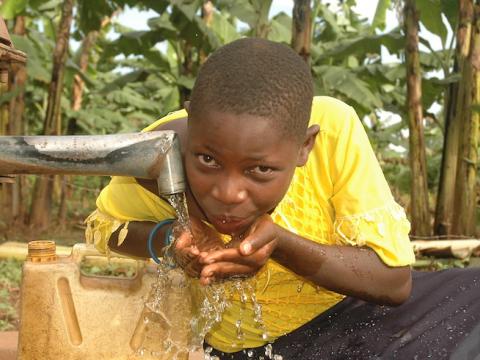
Currently, the World Bank Group (WBG) says about 2 billion people lack safely managed drinking water, and 3.6 billion lack safely managed sanitation.
“If nothing changes, we will not have enough water to meet demand by 2030, making it impossible to achieve SDG6 – safe drinking water and sanitation for all.”
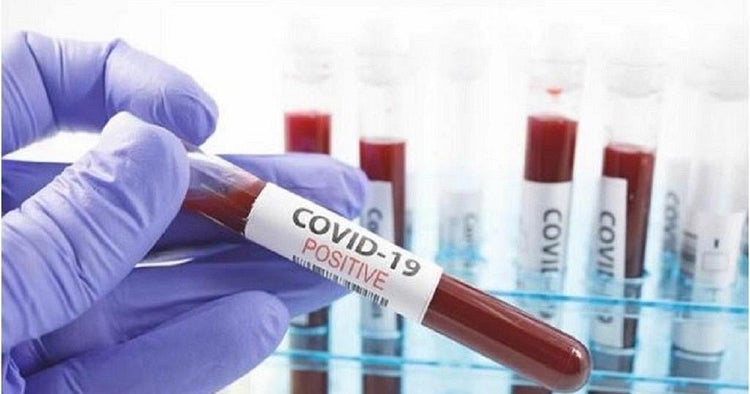
In 2020, the Bank says the situation was further exacerbated when COVID-19 hit its peak. Clean water, sanitation, and hygiene are vital for curbing infectious diseases. “We need water and sanitation as we work to recover from the significant declines in human health and development resulting from the pandemic.”
The GWSP Annual Report 2021 reveals extensive efforts to address climate change, urban sanitation, water supply, sanitation and hygiene in health care facilities were paramount.
“In the past year, GWSP was able to demonstrate the value of continuity, consistency, patience, and persistence. Despite the real impact of the pandemic, work continued and even intensified as we found ways to overcome constraints, work closely with clients, and build on the work of the previous year,” Jennifer Sara, Global Director, Water Global Practice, World Bank Group wrote in the report.
Uganda’s attempts toward SDG6
The WaterAid study of 2014 revealed that girls in schools suffer most from stigma and lack of services and facilities to help them cope with physical and psychological pains they undergo during menstrual periods.
The study additionally showed that inadequate access to clean water to clean and wash the body and lack of materials for managing menstrual hygiene are among other problems.
“About 40% of the girls (then) undergo menstruation but with no provisions for private or washing rooms and disposal places of materials for sued pads. That aside, the Universal Primary Education (UPE) capitation grant does not have a provision for menstruation and hygiene management (MHM) whose costs are largely met by the schools already constrained with operational costs including the provision of safe water, sanitation and hygiene,” the WaterAid study further revealed.
Preventable diseases caused by unsafe water and sanitation kill approximately 10,000 people every day, Uganda Parliamentary Forum on WASH (UPF-WASH), said in its WASH Briefing Paper No.001 of 2020.
Speaking at a conference in Kampala during the 2nd e-Conference on WASH in 2020, Denis Kayiwa, Program Advisor of WashAid said: “No resources have been allocated by the government to WASH as far as Covid-19 interventions into long-lasting solution in addressing WASH is concerned.”
ALSO READ:
- World Water Day: How the WASH landscape has changed in the Covid-19 era
- The ill costs of not giving WASH priority in national planning
- Uganda charges Nigeria’s Ezeh with money laundering worth US240,000
- G7 ministers meet as new Covid strain spreads around the globe
- China promises Africa 1b doses of vaccines in 2022
A year earlier, Uganda Parliamentary Forum on WASH (UPF-WASH) said, “Investing in WASH remains critical in achieving Uganda’s Vision2040; a transformed Uganda society from a peasant to a modern and prosperous country within 30 years.”
In making this possible, UPF-WASH said it’s conceptualized by strengthening the fundamentals of the economy to harness the abundant opportunities in the country.
2021 in focus
At a recent conference convened on 17, December under the theme, “Re-thinking the Water, Sanitation, Hygiene, Environment and Climate Change Financing Priorities amidst the different shocks”, Dickson Kateshumbwa [MP Sheema Municipality], says apart from access, communities in his constituency cannot afford to pay water bills.
“We need to deal with poverty,” he adds.
Donny Ndazima, Policy and Advocacy Coordinator at UWASNET, wants updated data on WASH at all district local government headquarters to enable proper planning and effective service delivery.
Alfred Okidi, Permanent Secretary (PS) in the Ministry of Water and Environment, says water and environment resources are key strategic resources that are vital for sustaining life, promoting development, and maintaining the development.
“It’s not poverty, but an attitude problem. Some say water is expensive yet spends shs5000 everyday on sports betting,” PS noted, in what seems to be a response to MP Kateshumbwa’s concern.