Lira City, in northern Uganda has positioned itself at the forefront of Uganda’s clean energy transformation following a landmark engagement held on Tuesday, June 17, 2025.
The engagement saw government officials, energy experts, and community leaders rallying behind a national campaign to abandon firewood and charcoal in favour of safer, modern cooking solutions.
Hosted at the Lira City Council Hall, the event was spearheaded by the Ministry of Energy and Mineral Development through its National Renewable Energy Platform (NREP), with backing from development partners including UKaid, the Uganda National Alliance on Clean Cooking (UNACC), and Modern Energy Cooking Services (MECS).
The initiative is part of Uganda’s broader national strategy to phase out the use of biomass fuels in homes and institutions by 2030, with an interim target to reduce biomass reliance from over 80% in 2020 to 50% by the end of 2025.
The Lira engagement highlighted both the urgency and potential of this transition, as deforestation, indoor air pollution, and fuel costs continue to burden households and public institutions across the country.
Uganda’s energy landscape remains heavily reliant on firewood and charcoal, despite mounting evidence of their long-term economic, health, and environmental costs.
According to Maria Kizza, an official from NREP, 88% of Ugandans still cook using traditional biomass fuels. Only 2% rely on electricity, while 10% use fossil fuels such as Liquefied Petroleum Gas (LPG) and kerosene.

Kizza presented a troubling statistic noting that the country’s annual wood fuel and charcoal demand stands at 53 million tonnes; double the estimated sustainable supply of 26 million tonnes.
This unsustainable consumption has accelerated deforestation, exacerbated climate change, and increased the health risks associated with smoke exposure, especially for women and children.
“The overreliance on biomass fuels is not just a sustainability issue, it’s a public health crisis. We must reimagine how we cook. Clean cooking is safer, healthier, and more economical in the long term,” Kizza warned.
She cited studies showing that exposure to smoke from open-fire cooking contributes significantly to respiratory diseases, eye infections, and complications during childbirth.
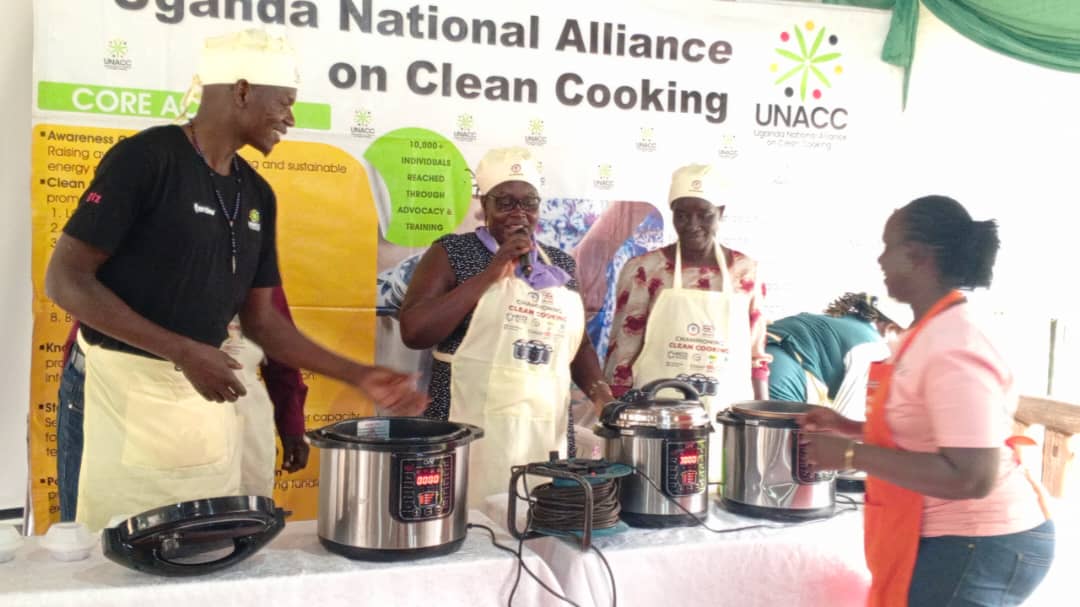
Kizza and other speakers advocated for a shift toward electric pressure cooking, also referred to as e-cooking, as a transformative alternative.
The electric cookers on display at the event, including the EKOPOT 6L 1000W pressure cooker, showcased how modern appliances can save energy, reduce cooking time, and lower household expenditure on fuel.
“With half a unit of electricity, costing about shs400, one can cook a complete family meal using an electric pressure cooker. This is not only affordable but also cuts down on carbon emissions and health hazards,” Kizza noted.
The campaign is designed to build awareness, shift social behaviour, and improve access to clean technologies through institutional partnerships, subsidies, and community mobilization.
To demonstrate public sector leadership in the clean cooking movement, several Lira City officials received electric pressure cookers during the campaign.
These included the Resident City Commissioner, Mayor, Town Clerk, Police Public Relations Officer, and the City Environment Officer. The symbolic handovers were meant to encourage government institutions to lead by example.
Vincent Okurut, Lira City Council Town Clerk, issued a strong call to action: “The time has come for households and institutions to embrace clean energy for our health, economy, and environment. Each citizen must take personal responsibility for reversing the damage caused by deforestation.”
He attributed the increasingly extreme weather in the region marked by severe droughts and heatwaves to deforestation driven largely by charcoal and firewood consumption.
Okurut described the clean cooking campaign as a vital strategy in Uganda’s fight against climate change.
The environmental backdrop of the Lango Sub-region, once blanketed by lush indigenous forests, amplifies the urgency of the clean cooking campaign.
Over the past two decades, the region has suffered severe forest loss due to population growth, agricultural expansion, urbanisation, and the lingering impacts of the Lord’s Resistance Army (LRA) insurgency.
Leonard Otika, Lira’s City Environment Officer, painted a stark picture citing that the trees are gone.
“We are now sourcing firewood from as far as Masindi because our local supply has been exhausted,” he noted.
Otika, who also serves as the focal person for Lira’s energy transition program, revealed that four prominent institutions including St. Gracious Schools, Saving Grace Nursery and Primary School, Lango College, and St. Catherine Girls Secondary School have expressed interest in adopting clean energy solutions such as electric pressure cookers and biogas systems.
“This is a welcome sign. We hope more institutions will follow suit because institutional uptake is key to accelerating behavioural change in communities,” he added.
Many schools in the region are grappling with the high financial cost of firewood and the health risks associated with its use.
Thomas Otema, Director of St. Thomas Primary School, said his school spends approximately shs4.5 million every term to purchase three truckloads of firewood.
“These trucks now travel from as far as western Uganda due to tree depletion in our region,” he lamented.
Otema also underscored the health impact on school cooks, who spend long hours inhaling smoke in poorly ventilated kitchens.
“Our cooks suffer from persistent coughing and eye irritation. Moving to electric cooking would not only save us money but also improve their wellbeing,” he added.
He called on the government to subsidize the cost of electric cookers and to extend electricity access to rural and peri-urban schools.
“Many rural institutions want to shift, but the infrastructure simply isn’t there yet,” he noted.
The Lira campaign aligns with Uganda’s Third National Development Plan (NDP III), which aims to cut biomass use in cooking to 50% by 2025 and eliminate it entirely by 2030.
These goals are part of a larger vision for energy security, environmental sustainability, and public health improvement.
Speaking at the engagement, officials from the Ministry of Energy emphasized that the government is prioritizing both awareness and infrastructure development. Projects under the Electricity Connection Policy and the Rural Electrification Program are meant to complement clean cooking campaigns by ensuring more Ugandans have access to affordable power.
Lira is the latest in a string of cities to join the national clean cooking campaign. Similar engagements have already taken place in Soroti, Mbale, Mbarara, Gulu, and Jinja.
Clean cooking is not just a change in technology—it’s a change in mindset, culture, and daily practice.
While the campaign has generated excitement and momentum, implementing it across the country remains a massive challenge. Uganda’s electrification rate, especially in rural areas, remains low. Power supply can be unreliable even in urban centers, and the initial cost of electric cookers may be out of reach for many low-income families and schools.
Okello Tom Richard, Director of Studies at Lira Police Primary School, echoed these concerns.
“Without subsidies and reliable electricity, we risk leaving rural schools behind in this energy transition,” he noted.
He urged the Ministry of Energy and development partners to support local manufacturing and distribution of cookers to bring down costs and create jobs citing that a local solution will always be more sustainable.
Participants agreed that the transition to clean cooking must be a national priority and that success hinges on cooperation between government, private sector, civil society, and the media.
The local governments have equally been encouraged to develop by-laws supporting clean energy, incentivize institutions that enhance transition, and to work with traditional leaders to advocate at the grassroots level.
Uganda’s clean cooking revolution is gaining momentum, and Lira City has emerged as a beacon of what’s possible when leadership, community, and policy converge.
Lessons from Lira will guide future plans and help create a healthier, greener, and more energy-resilient Uganda as the country rushes towards its 2025 and 2030 biomass reduction targets.
Discover more from tndNews, Uganda
Subscribe to get the latest posts sent to your email.