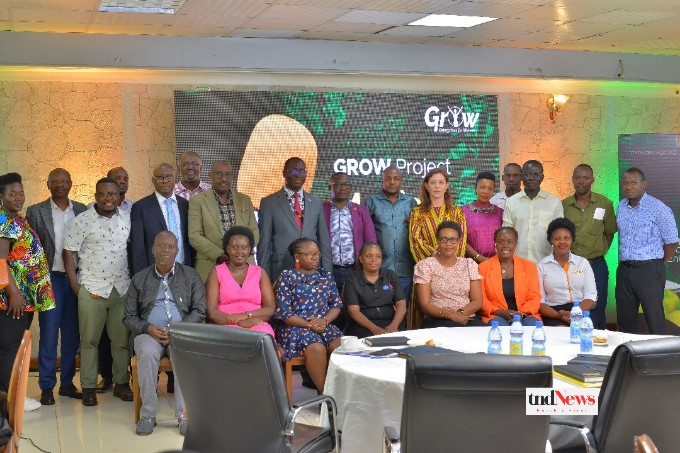
Kampala | The Minister of State for Gender, Labour and Social Development (Labour, Employment and Industrial Relations), Davinia Esther Anyakun has blamed the current setbacks in the GROW project on persistent misinformation regarding who the project is meant to serve.
Anyakun made this revelation while delivering a closing remark at the GROW Media briefing in Kampala on Friday. The meeting involved editors and reporters from different media houses across the country.
“The biggest challenge the project faces is persistent misinformation, especially around who it is meant to serve. Let me say this clearly; GROW is for women with existing businesses; these may be micro-enterprises, farms, trading stalls, or small workshops but they must be operational businesses that are ready to grow,” Anyakun stated.
The minister, however, appealed to the people to be mindful that the loan component alone cannot serve every eligible woman and following Cabinet’s directive, GROW loans are being equitably distributed across 19 sub-regions.
“This is a step towards regional fairness but it also means the number of loan recipients is limited,” she added.
According to the Minister, Uganda ranks among the top countries globally for women’s entrepreneurship; yet it faces a critical challenge of many of the enterprises remaining small, informal, and under-resourced.
The above, she said, is not because women lack vision, but because they often lack the support systems required to grow.
“The GROW project was designed to change that reality; it is not simply a loan scheme; it is a comprehensive Women’s Economic Empowerment program that provides businesswoman with access to finance, skills training, inclusive infrastructure, work placements, and market linkages,” she noted.
In addition, she urged the journalists and editors to play an essential role in shaping public opinion towards the project through stories, headlines, and broadcasts that have influenced opportunity and how government programs are judged.
“Today, we have begun a partnership that goes beyond reporting; it is about building a stronger, more inclusive economy and it is about ensuring that no woman with the drive to grow her business is left behind,” she urged journalists on Friday.
“I encourage you to take the knowledge and insights you have gained here and use your platforms to shine a light on the real impact of Women’s Economic Empowerment; tell the stories that matter, stories of resilience, of growth, and of transformation.”
Aggrey D. Kibenge, the Permanent Secretary, Ministry of Gender, Labour and Social Development revealed that the GROW project has rolled out another important innovation, Common User Facilities (CUFs) which are shared spaces designed to support women-led groups in improving production, packaging and quality assurance.
“I am pleased to share that we have already received over 2,000 applications from women’s groups interested in accessing these facilities, showing strong demand and interest in value addition and cooperative production,” Kibenge said.
According to Kibenge, the project has moved a step further by signing formal Memoranda of Understanding (MoU) with Makerere University, Rwentanga Farm School and NARO Kawanda who will be instrumental in providing technical support, research linkages, and space for production and innovation.
“This is a major stride in enabling women to scale up their businesses with the right support systems; and these services are available now and free of charge to eligible women entrepreneurs; yet they received far less attention than the loan component, simply because public discussion tends to focus narrowly on financing,” he noted.
He further appealed to the media to be partners in broadening the public understanding of GROW and highlight the vital services, skills training, work placements, production so that more women across the country can access the services and grow sustainably and beyond credit.
“When we share accurate information, when we explain the full value of this program, we empower women not just with tools but with knowledge and knowledge is transformative,” he emphasized.
Cabinet in their sitting on October 14, 2024, directed that loans should be lent out by Participating Financial Institutions (PFIs) at not more than 10%.
The same sitting directed that there should be equal allocations across the 19 sub-regions and all the PFIs have compiled with the directive to lend at not more than 10%.
Discover more from tndNews, Uganda
Subscribe to get the latest posts sent to your email.