Kampala I People with mental health conditions in Uganda face stigma, isolation, and social exclusion.
They suffer exploitation, violence in all its forms and abuse remain common, denial of autonomy, they are often subjected to forced treatment and, in the absence of community-based services, they have been forced to stay home without adequate access to care, said Mental Health Uganda (MHU) executives.
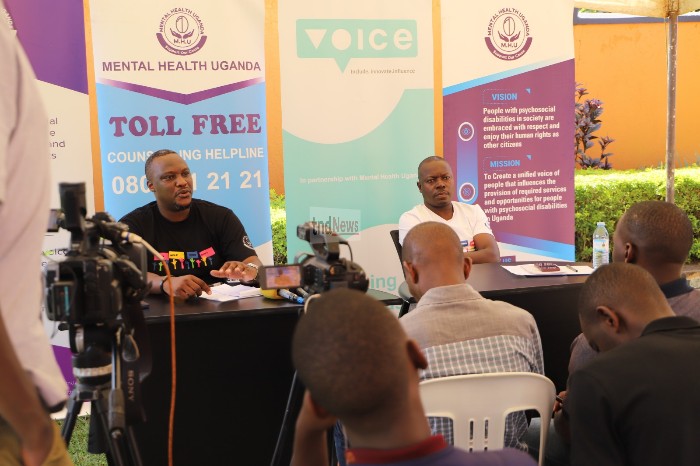
On June 14, MHU Executive Director Derrick Kizza and Programme Manager Daniel Lubanga spoke to the press in Kampala.
In a joint statement, the pair stated that practices such as beatings and cutting continue to be reported in non-traditional settings, while chaining or tying and seclusion are frequently used in communities.
“Besides all this, Ugandans are grappling with high levels of poverty; alcoholism and drug abuse; lost incomes coupled with high interest rates on loans; insecurity like the recent violent crimes in and around Kampala, and unemployment inter alia.
“Youth unemployment is at 41%, and 9.3 million of them have no access to education, employment or training, according to the UBOS National Labor Force Survey Report, 2021. All these expose communities to serious mental health problems including suicide.
“More recently the cases of suicide have increased with about 08 reported in various forms of media in recent weeks. The most affected age group is 20-45 years, with males being three times more likely to die by suicide than females, even if females ideate suicide more.”
Their statement revealed that a school-based study in Wakiso and Gulu by MHU and SOS Children’s Villages in 2023 revealed that 20% of students had ideated suicide. Among the striking triggers identified by the students were bullying, body shaming, examination pressure, relationships (including with parents and teachers), among others.
“Suicide is not a new phenomenon though. With advancement in technology, cases of suicide or attempted suicide effortlessly get to the public domain.”
Majority of suicide cases go unreported due to the associated stigma towards both the victim and their families, added the statement. “Suicide has often been rebuked and criminalized from history to this date, yet people continue to take their own lives, the consequences in those they live behind notwithstanding.”
According to a recent World Health Organisation study, countries that have decriminalised suicide, such as Ghana, India, and Pakistan, continue to report declining numbers, whereas countries where attempted suicide is illegal, including Uganda, have soaring suicide rates.
“As countries continue to invest heavily in institutional care, COVID-19 has taught us that mental health care and conversations on mental health should be at the heart of every community. Mental health problems do not know tribe, color, sex, location or age. All of us can potentially be victims. Although increasing access to treatment is important, having open conversations about mental health and problems should be commonplace across society. It is ok not to be ok!”
At Mental Health Uganda, they have a toll-free helpline, and countless suicide ideations have been averted. “Overall, up to 64% of the callers (from May 2021 to date) have been managed through talk-therapy.”
MHU also do make the following specific recommendations:
- Uganda must take positive steps towards the decriminalization of suicide (Section 210 of the Penal Code Act) to ease timely access to mental health care.
- Formal institutions like workplaces, institutions of learning, places of worship, etc. need to expeditiously integrate mental health care and services e.g. providing reasonable accommodation to employees that report not being well and establish safe spaces for everyone who is unwell.
- The Ministry of Health needs to quickly deliver on all tenets of Community Mental Health Care as stipulated in the Mental Health Act 2019, so as to increase utilisation and access to care, increase awareness and facilitate the key role of families in the provision of care.
Discover more from tndNews, Uganda
Subscribe to get the latest posts sent to your email.